



Sign in to share
Shikha Sharma
My husband met my parents too early.
I know this now. I did not know it then.
At the time, it felt efficient. We had been dating for a few months. Things were going well. He was in my part of town one Saturday. My parents were home. I had mentioned him enough times for my mother to begin asking questions that were pretending not to be questions.
“What does he do?”
“Where is his family?”
“Does he eat non-veg?”
“Is he serious type or funny type?”
The last one was my favourite because I did not know how to answer it. He was both, depending on the room. This should have been my first clue.
That Saturday, my mother called while I was with him and asked where I was. I told her. She said, “Come for tea if you’re nearby.”
Then, after one second, she added, “Bring him also.”
Him.
No name. Just him.
He looked at me when I repeated it. I said, “Only tea.”
This was a lie, though I did not know it yet.
Nothing in an Indian home is only tea.
The First Visit
He was calm in the cab.
I was not.
I was explaining my family to him in the frantic tone of someone preparing a candidate for an interview conducted in a language they only half understand.
“My mother will ask if you’ve eaten. Say yes, but not too strongly because then she’ll think you don’t want anything.”
“Okay.”
“My father may be quiet at first. That doesn’t mean anything. Or it may mean something. I’ll tell you later.”
“Okay.”
“If my mother asks about your parents, that is normal.”
“Okay.”
“If she asks whether you know how to cook, I don’t know why she asks this. Just answer.”
He was listening carefully, which annoyed me because I wanted him to understand the urgency but not look like he was taking notes.
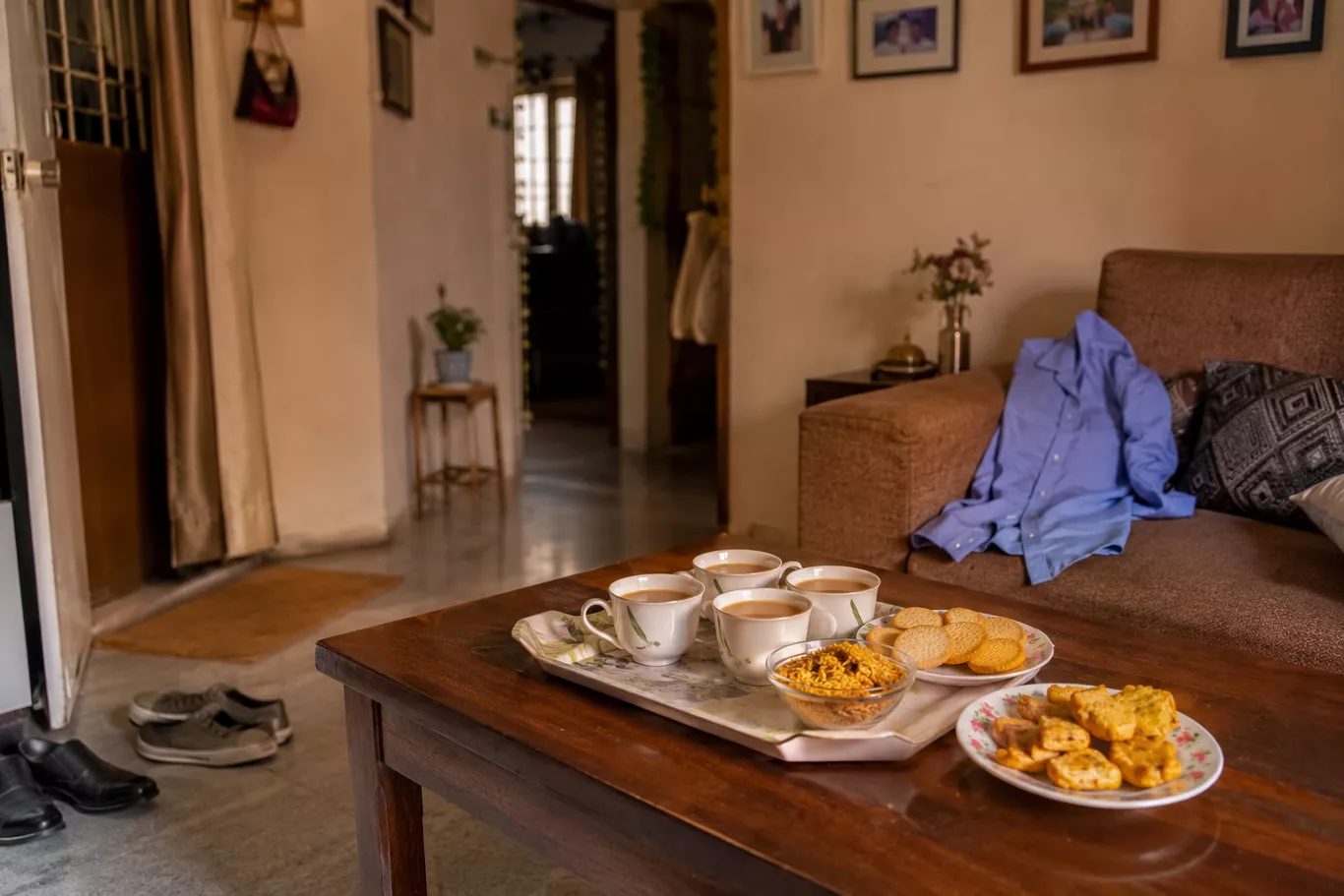
When we reached, my mother opened the door with the expression of someone who had prepared for a casual visit with unusual seriousness. The house smelled of tea and something fried. There were already plates on the table.
Only tea.
Of course.
My father came out of the bedroom wearing a shirt he does not wear at home unless someone is coming. I noticed this and felt both touched and alarmed.
My husband said namaste. Properly. Hands joined. Slight bend. Not too much. Not performative.
My mother’s face softened by about two percent.
This was his first success.
The Version He Met
He met a version of me that day, but not the full one.
He met the daughter version.
The version who automatically stood up when my mother carried the tray, even though at my own place I will let a Swiggy bag sit on the table for ten minutes before dealing with it.
The version who became slightly more polite than usual.
The version who answered some questions before they were asked because she knew they were coming.
The version who watched her mother’s face, her father’s silence, the placement of the cups, the level of snacks on the plate, and her boyfriend’s body language all at once while pretending to be relaxed.
He had seen me on dates by then. He had seen me at restaurants, in coffee shops, in cabs, on long phone calls, in the early-stage relationship glow where everyone is still presenting the version of themselves they hope is accurate.
He had not seen this.
Me in my parents’ house.
Me as someone’s child.
This is a separate person.
My friend Priya says the first time her now-husband came home, she became “school monitor polite.” Her words. She said he kept looking at her because she was saying things like “Mummy, should I bring plates?” in a voice he had never heard before.
He told her later, “You became very good.”
She said, “I am good.”
He said, “No, no. Different good.”
Different good is exactly it.
The Inspection
My mother did not interrogate him.
This is what she would say if asked.
She would say she was just talking.
But there is talking and there is mother-talking.
Mother-talking has layers.
She asked about work. Normal.
She asked about his parents. Also normal.
She asked where they lived, whether he had siblings, whether he liked Delhi, whether he had eaten lunch, whether he drank tea with sugar, whether traffic had been bad, whether his office was far, whether he travelled for work, whether he had any food restrictions, whether his mother was working, whether his father had retired.
All of this happened in one sitting.
He answered everything.
Not too briefly. Not too eagerly. With the calm of a man who had understood that he was not being attacked, he was being mapped.
This is also when I saw something I liked.
He did not perform charm.
He did not become extra funny. He did not try to impress my father with opinions. He did not agree with everything my mother said in that eager way that makes everyone uncomfortable.
He just answered.
At some point, my mother put out Sunfeast Marie Light with the tea and he took one without waiting to be coaxed. This was another small success. In my mother’s house, refusing food too many times is suspicious. Accepting a biscuit is socially intelligent.
I remember thinking, good.
Then immediately thinking, why am I evaluating him like this?
Because I was.
Of course I was.
The Parents as Witnesses
When your partner meets your parents early, the relationship changes slightly.
Not officially. Nothing has been promised. Nothing has been decided. But someone else has seen it now. The relationship has entered a room where people who love you are paying attention.
This makes it heavier.
Not worse. Just heavier.
Before that visit, he belonged to my life outside home. After that visit, he had sat on the sofa my father had chosen badly and my mother still defended. He had drunk tea from our cups. He had seen the family photos on the wall. He had watched my mother tell me to eat one more thing and watched me say no in a tone that meant yes if insisted upon.
He had crossed from idea into evidence.
My friend Meera says this is why she waited almost a year before introducing her husband to her parents when they were dating. She knew that once her mother saw him, the relationship would start existing in the family atmosphere. Not because anyone would pressure her. Her parents are not like that. But because mothers remember. They notice who makes you calmer, who makes you louder, who calls when, who you mention casually.
Once introduced, the person remains introduced.
Even if things end, the file stays.
This is exactly the sort of thing I should have thought about before saying yes to tea.
I did not.
The Drive Back
On the way back, I asked him what he thought.
This was a mistake because what I really wanted was a detailed emotional report and what he gave me was, “They’re nice.”
I waited.
He added, “Your mother made a lot of food.”
This was not news.
“What else?”
He thought about it.
“You’re different at home.”
I felt exposed immediately.
“How?”
“Not bad different.”
“That is not an answer.”
He smiled because by then he knew that saying “not bad” was not going to satisfy me.
“You become more alert.”
This was accurate.
I did not like that it was accurate.
He said it gently. Not as criticism. Just as something he had seen.
I remember looking out of the cab window and feeling two things at once. A little embarrassed that he had noticed. A little relieved that he had noticed and not seemed put off by it.
That is a strange intimacy.
Someone sees the family version of you and stays interested.
The Later Understanding
Years later, I think he met my parents before he really met me because my parents are part of the explanation.
You cannot fully know me without knowing that house a little.
The way my mother asks questions from the kitchen. The way my father is quiet until he suddenly says something extremely precise. The way food appears constantly. The way every plan is slightly earlier in my mother’s head than it is in everyone else’s. The way I become efficient, alert, affectionate, impatient, and twelve years old within the same hour.
He did not know me fully that day.
But he saw where some of me came from.
That is useful information in a relationship.
I have seen the same with him. The first time I met his parents, something clicked into place. Not the whole person. Never the whole person. But enough to understand a few things. His patience. His avoidance of certain conflicts. The way he makes tea. The way he says “it’s fine” and means three different things depending on context.
Families do not explain everything.
But they explain more than we admit.
The Second Visit
The second time he came home, he was more relaxed.
So was I.
My mother still made too much food. My father still wore the outside shirt. The tea still came with biscuits. But something had shifted. He knew where to sit. He knew my mother would offer twice. He knew my father would ask one question after ten minutes of silence and that the question would be worth answering properly.
I was still the daughter version of myself.
But I was less nervous about him seeing her.
That, I think, was the real beginning of him knowing me.
Not the dates. Not the long calls. Not the carefully chosen stories we tell early in relationships.
The sofa. The tea. The questions. The way I said “Maa” in three different tones in one hour.
He met my parents before he really met me.
Maybe that was not too early.
Maybe it was exactly how he began to understand the rest.


