



Sign in to share
Shikha Sharma
My husband and I had dinner in near silence last Thursday.
Not angry silence. Not tired-of-each-other silence. Not the kind of silence that arrives after a conversation has gone wrong and both people are waiting for the other person to repair it.
Just silence.
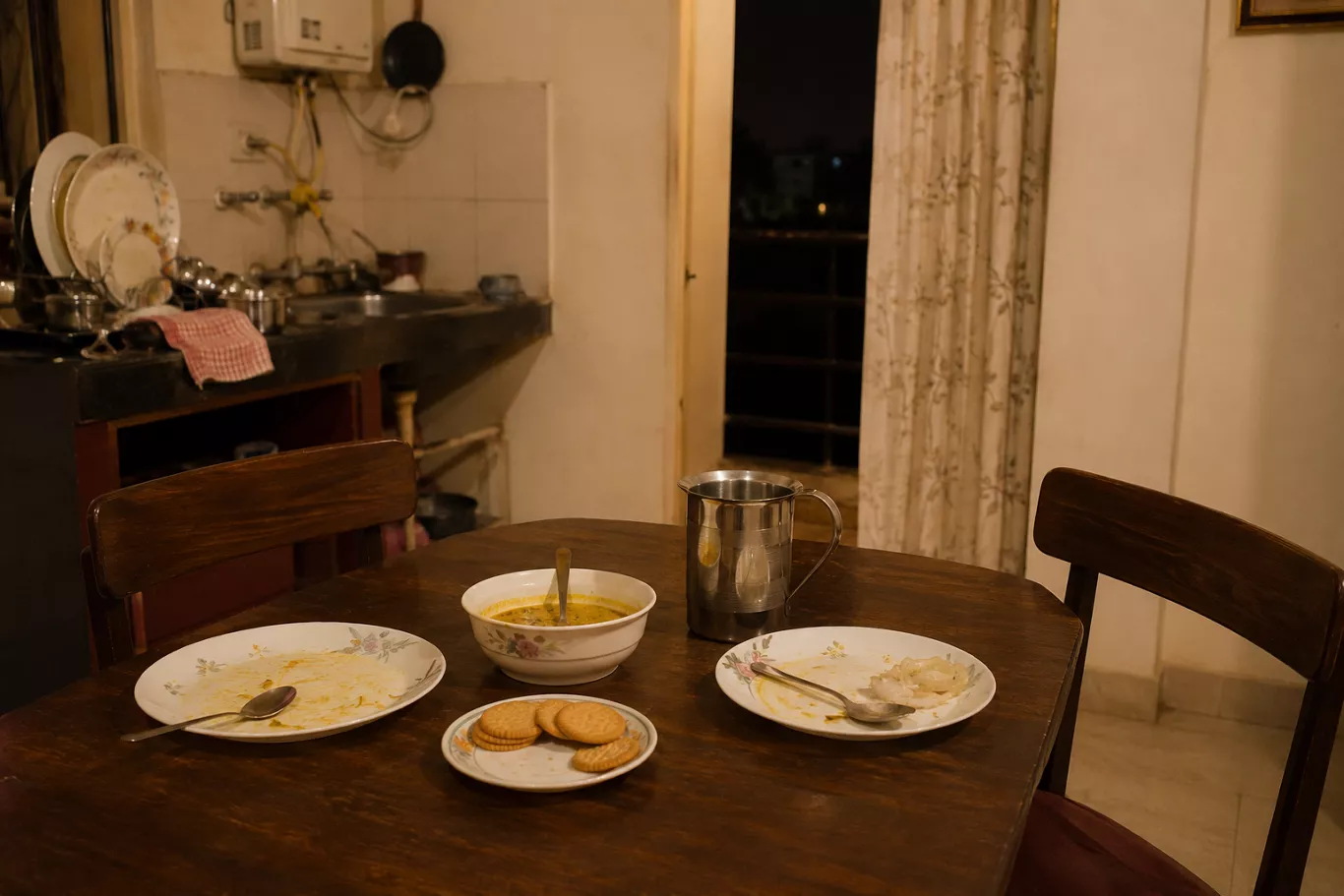
There was dal, rice, bhindi, and the last of some sabzi from the previous night that neither of us wanted enough to finish but both of us respected too much to throw away. The TV was off. Our phones were in the other room because I had left mine there by accident and he had gone to wash his hands without bringing his back. The fan was making a small sound that I keep meaning to notice properly. Outside, someone in another flat was dragging furniture or exercising or living in some way that involved repeated thuds.
We sat at the table and ate.
I think he asked once if there was more rice.
I think I said yes.
That may have been the only exchange for seven or eight minutes.
At one point I looked up and had the strange, slightly delayed realisation that if this had happened three years ago, I would have been worried.
I would have thought something was wrong.
Not seriously wrong. Just relationally wrong. Quiet in the way you begin to examine when you are still building a life with someone and have not yet learned which silences are structural and which ones are symptoms.
But last Thursday I was not worried.
I was just eating dinner with my husband.
And he was just eating dinner with me.
That was enough.
The Early Version
In the earlier part of our relationship, silence made me nervous.
Not because he was bad at conversation. He isn’t. Not because I felt distant from him. I didn’t. It was more basic than that. I had not yet learned that silence between two people can be neutral.
I thought silence had to mean something.
Disappointment. Boredom. Tension. Fatigue. Disconnection. Something that needed to be addressed or fixed or at least lightly probed with a “what happened?” said in the right tone.
So if we were quiet, I filled it.
I said things that did not need saying. I narrated some small part of my day that had no actual content. I asked questions whose only real purpose was to create sound. Sometimes he answered properly. Sometimes he answered briefly and returned to eating, which I interpreted as a sign of some deeper male mystery I was being expected to solve.
There was no mystery.
He was just having dinner.
My friend Priya told me she used to do the same thing in the first year of her marriage. She said she would ask her husband what he was thinking if he was quiet for too long.
He would say, “Nothing.”
She would not believe him.
Not because she thought he was lying. Because she thought no one could simply be sitting there with nothing urgent happening internally.
Apparently they can.
Apparently this is one of the ways people relax.
The Silence of Not Performing
I think some of the anxiety comes from how dating works in the beginning.
In the beginning, conversation carries a lot of the relationship. You are getting to know each other. You are presenting yourself. You are learning what the other person notices, what they laugh at, what they avoid, what they come alive around. You talk because the talking is one of the main places where closeness is happening.
Then, if things go well, the relationship changes form.
You start sharing not only time but ordinary time. Not only stories but space. Not only the curated interesting parts of your week but the unremarkable middle of it. The evening after the long day. The breakfast when neither of you is fully awake. The car ride where traffic has replaced personality. The dinner where both of you are hungry enough to focus more on the food than the conversation.
This is not less closeness.
It is a different kind.
It is the kind where nobody has to be particularly interesting for twenty minutes.
My husband and I had chai after dinner that night. He opened a packet of Sunfeast Marie Light, put some on the plate between us, and we took one each without discussing it. There was still not much conversation. He said something about a mail he had to send. I said something about remembering to soak rajma for the next day. Then silence again.
Still fine.
I remember thinking: this is a relationship too.
Not the dramatic talking-until-2 am version. Not the big-confession version. Not the version where everyone is sparkling with attention and chemistry and good timing.
Just two people in a room, eating biscuits, not needing to prove they are connected.
The Fear of Dullness
There is a fear, especially in the first few years, that quiet means the relationship has become dull.
People talk about this as if dullness is a cliff you suddenly fall off. One day you are having long conversations and the next day you are discussing groceries and looking at the weather app and the romance is over.
I do not think that is how it works.
I think there is a difference between dullness and ordinariness, and we are not always good at telling them apart.
Ordinariness is not the enemy.
Ordinariness is where most relationships live.
My friend Meera said she panicked the first time she and her husband spent an entire Sunday afternoon together saying almost nothing. He was reading. She was half-watching something on TV and half-folding laundry. At one point she thought, is this it now?
Years later, she said that afternoon is one of the clearest memories she has of feeling peaceful in marriage.
Nothing happened.
That was the good part.
Nothing needed to happen.
The thing about closeness is that we often imagine it as expressive. Talking, confessing, laughing, sharing, discussing. And yes, it is those things.
But it is also the absence of strain.
The ability to be quiet without checking the room every few seconds to see if the quiet has turned dangerous.
The Dinner Table
There is a particular kind of trust that appears at the dinner table.
You can tell a lot about a relationship from how people eat together. Not in the obvious body-language way. In the smaller rhythm way.
Can one person get up and bring water for both without making it a statement about who does more?
Can one person say “there’s less salt” without it becoming criticism?
Can you sit quietly for five minutes and let the food be the main event?
Can the conversation be small if it wants to be small?
My husband and I are not experts at all of this. We have had dinners that went sideways over tiredness, over assumptions, over one badly timed question. We have both, at different points, brought the wrong mood to the table and then expected the other person to correct for it.
But on the whole, our dinners have become easier.
Not more exciting.
Easier.
I value easier more now.
Last Thursday, after we ate, he got up and put the plates in the sink. I started wiping the table. No one assigned either task. This is the kind of thing I would have described to no one because it is too ordinary to narrate.
But I think relationships are mostly made of unnarratable things.
The person who gets the extra bowl.
The one who notices the water is finished.
The one who wipes the table while the other checks the gas.
The one who says nothing for ten minutes and still somehow remains company.
What We Used to Think
I used to think a good relationship would always feel lively.
I do not think that anymore.
I think a good relationship contains liveliness, yes. It also contains calm. It contains routine. It contains some dinners that are mostly about the dal. It contains evenings where both people are slightly low-energy and nobody mistakes that for emotional failure.
My friend Karan said something useful after getting married. He said that in the beginning he thought companionship would feel more eventful. What surprised him was how often companionship felt like administrative peace.
I understood exactly what he meant.
Administrative peace is not sexy language. But it gets close to the truth.
There is a deep comfort in being with someone and not needing to generate atmosphere all the time.
Some days the atmosphere is simply: we are here, we are fed, we are not fighting, the kitchen is manageable, tomorrow’s tiffin is half sorted, and the house is quiet.
That is not a poor substitute for intimacy.
That is one of its forms.
The Difference Between Alone and Together
The silence last Thursday did not feel like being alone.
This is the distinction that matters most.
I am quiet by myself often. So is he. That is not special.
The special part is being quiet together and still feeling accompanied.
That feeling is hard to explain if you have not had it. It is not dramatic enough for most language. It is not the kind of thing you announce to friends. You do not call someone and say, “We had nothing to say and it went really well.”
But it is a milestone, I think.
Or not a milestone. That makes it sound too sharp.
A development.
The point where the relationship no longer relies on constant exchange to reassure itself that it exists.
I used to need more evidence.
Now sometimes the evidence is just that he is there, eating rice, asking once for more dal, and reaching for the biscuit plate after dinner like we have done this before and will do it again.
That is enough evidence for one evening.
It might be enough evidence for a life.
The Conversation That Came Later
The funniest part is that later that night, while brushing our teeth, he suddenly told me a long story about someone in his office.
Fifteen minutes of detail. Names, context, side observations, an impression of a meeting, a complaint about the structure of the discussion.
Apparently he had not been quiet because he had nothing to say forever.
He had been quiet because he had nothing to say at dinner.
This should not have been revolutionary information, and yet it felt like it.
There are times for silence.
There are times for stories.
There are relationships where both are allowed.
That is what I think we are building.
Not the couple that performs connection all the time.
Not the couple that says everything at once.
The couple that can sit down to dinner, say almost nothing, and still leave the table feeling more together than apart.


