



Sign in to share
Dhruv Saxena
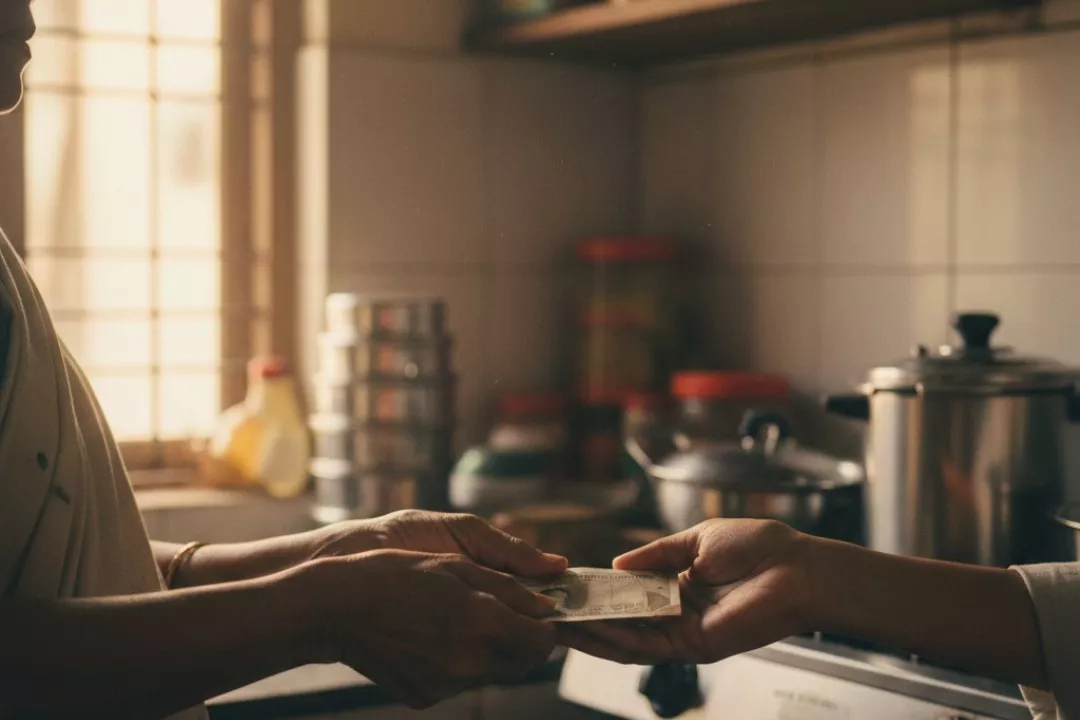
I was seventeen when my mother first slipped a five-hundred rupee note into my palm and closed my fingers around it.
“For your outing,” she said. “Don't tell Papa.”
I didn't ask why. I already knew. Papa would have said it was too much. And that we should be careful with money.
Hey, my father is not cruel. I love him. He loves me too. But you know how most Indians dads are.
But my mother? She’s a soft-hearted cutie. She had decided I needed the money. And so the note appeared, the way things always appeared with her. Quietly. Without ceremony. With the implicit understanding that this was between us.
I nodded. Put it in my pocket. And we never discussed it again.
That was my first real memory of the economy. But looking back, it had been running long before that.
The quiet understanding
Every Indian mother and child I know has some version of this system.
It’s not always money. Sometimes it's permissions granted that weren't officially on the table. “Go. I'll handle Papa.” Sometimes it’s the food. The specific thing saved for you, quietly, before anyone else could get to it.
And sometimes it's just an agreement. The unspoken kind. Where you both know something, and both know that you both know, and neither of you brings it up because bringing it up would ruin it. Haha
It’s a whole parallel economy. Whispered, invisible, and remarkably efficient.
And it runs entirely on trust.
The system
My friend grew up in a house where her father was strict about screen time. No TV on weeknights. Homework first, always.
But her mother had a system.
If her father was working late, her mother would let her watch one episode of whatever she was obsessed with. Then help her finish homework quickly, and the house would be perfectly arranged by the time he got home.
Honestly, I find this to be kindness. A mother reading a child’s needs and deciding that one episode of TV was not, in fact, going to ruin anyone’s life.
“She never told him," my friend said. “And he never asked. I think maybe he also knew and didn't want to know. But my mother made that call.”
Care-taker of the tummy
Another friend told me his mother used to hide snacks for him. The good ones. Sunfeast Mom’s Magic biscuits in the back of the cupboard, behind the dal packets, where others find them.
It wasn’t every time. Just occasionally. On a day when he’d had a hard week, or an exam had gone badly, or he just seemed like he needed something small and good.
He’d come home and she’d quietly tell him where to look. “Back of the shelf,” she’d say. Nothing else.
He’s twenty-nine now. He still tears up a little when he talks about it.
You see, it wasn’t about the biscuits. It was about being seen. About someone tracking your emotional weather carefully enough to know when you needed a small act of kindness. And then delivering it without making a production of it.
Why this economy?
I’ve thought a lot about why this economy exists. Why it runs the way it does. Why it’s always quiet, always between the two of you.
I think it comes down to the fact that mothers understand their children in ways that are genuinely difficult to explain to anyone else in the family. They understand what you need before you can articulate it. They understand which battles matter and which ones will only make things harder for everyone.
And sometimes, protecting you means working around the system.
The “don't tell Papa” is not about secrecy for its own sake. It’s not deception. It’s her making a call she knows is right, without wanting to spend forty-five minutes in a committee meeting justifying it.
She’s the executive. The note appears. The snack is saved. The outing happens.
Some extra room
There’s another layer, though. One I only understood recently.
I think the secret economy is also how mothers give children the thing they’re not always officially supposed to give. A little more room than the rules allow.
A little more money than was budgeted. A little more freedom than was officially sanctioned. A little more grace than the household code of conduct permits.
She’s not undermining anyone. She’s supplementing. Quietly expanding the edges of what's allowed.
Isn’t it beautiful that someone so close to you is doing all of this to basically put across a message. And it’s, “I’m on your side.”
Ah! I’d trade everything to have that phase of my life back again. Where I didn’t have to care about the world because my mother was on my side.
Anyway, I don’t want to make you tear up. Let’s move on.
The new parallel
My mother is older now. The economics have shifted.
She doesn’t slip me money anymore. I’d refuse if she tried, and she knows it. The power balance has changed too much for that particular transaction to still make sense.
But the system still runs.
Last month I visited home. I was stressed about something, hadn’t said much about it. I was doing that thing where you’re clearly not okay but you keep saying “I'm fine” because you don't want to worry anyone.
She didn’t push. Didn’t even ask directly. But on the morning I was leaving, I found a small packet of Sunfeast Mom's Magic biscuits in my bag. My favourite ones from childhood, the ones she hadn’t bought in years.
There was no note. No mention of it. I found them at the train station when I was looking for my earphones.
I sat with my bag in my lap and felt, suddenly, completely taken care of.
I guess, the economy never closes. It just changes currency.


