



Sign in to share
Dhruv Saxena
Every December, without scheduling it, without announcing it, without asking if I am available or emotionally prepared, my mother conducts my annual performance review.
It covers everything. Weight. Sleep schedule. Career trajectory. Relationship status. Posture. Dietary habits. Financial decisions she has heard about and formed opinions on. The frequency of my calls. The quality of my calls. Whether I sound tired on my calls and if so why and what am I doing about it.
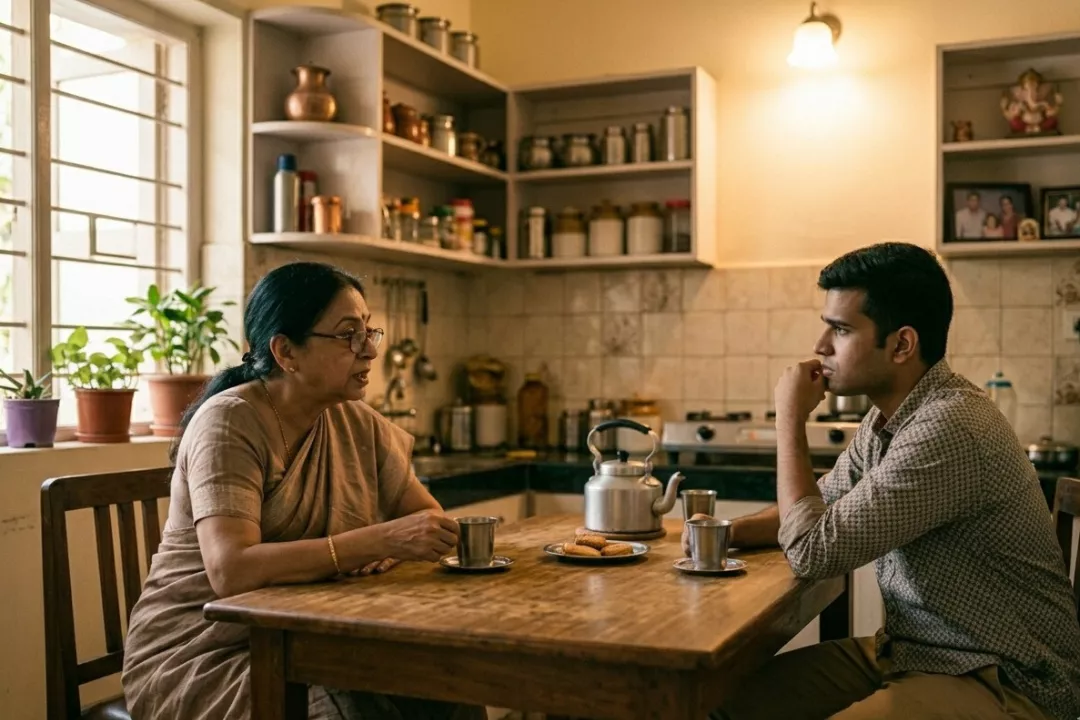
The review takes approximately twenty to forty minutes depending on how much material she has accumulated since the previous year. It is delivered conversationally, which is the most sophisticated part of the whole operation. It does not feel like a review while it is happening. It feels like a chat. You are sitting there having chai, thinking this is a normal visit, and then you realise forty minutes have passed and she has covered your entire life and suggested improvements to most of it.
I have never once asked for this review. It has never once not happened.
I was home in December. She had put out chai and Mom's Magic biscuits, which is the default state of my mother's kitchen table and also, I now realise, the standard setup for conducting a performance review without it looking like one. I sat down. She sat down. We talked.
By the time I left that afternoon she had covered my weight, which she felt was slightly down from last time and wanted explained. My sleep, which I had mentioned was inconsistent and which she had filed as a concern. My career, which she had questions about regarding stability and trajectory. My posture, which she had observed during lunch and found wanting. And my relationship status, which she did not address directly but circled twice in a way that made its presence in the room very clear.
She did all of this while also making excellent conversation about other things. Family updates. Something funny that had happened with the neighbour. A show she had been watching. The review was threaded through the visit so seamlessly that I only recognised it in its entirety on the drive back.
The Weight Section
The weight section of the annual review is always first.
My mother assesses my weight within approximately four minutes of my arrival. She does this visually, the way a doctor might do a quick preliminary examination, and reaches a conclusion before I have fully put down my bag. The conclusion is then stored until a natural opportunity arises to raise it, which is usually within the first hour.
The assessment has two possible outcomes. Either I have lost weight, which is concerning and requires investigation into whether I am eating properly and sleeping enough and managing my stress. Or I have gained weight, which is fine and in fact positive because I was too thin before, but she will also note it in case it continues, just to keep track.
There is no outcome in which my weight is exactly right and requires no comment. I have never experienced this outcome. I do not believe it is available.
My weight has been assessed at every visit for thirty-one years. I have never once arrived at the correct weight. I have come to understand that the correct weight does not exist. It is a moving standard, recalibrated at each visit to ensure that some observation is always available.
The Career Trajectory
The career section is more subtle than the weight section but covers more ground.
My mother does not ask directly about my career because she does not fully understand my career despite my best efforts to explain it. What she does instead is ask questions that allow her to assess the career without requiring her to engage with its specific details.
Is the company stable. Is the boss good. Am I being recognised for my work. Do I have job security. Is there a path forward. These questions are not about content strategy or digital platforms or any of the actual things my job involves. They are about whether I am okay in the broader sense. Whether the thing I am doing is taking care of me the way she would take care of me if I were still at home and she had direct oversight.
I answer these questions. She listens. She files the answers. At the end of the career section she says something like "just make sure you are not overworking" and moves on, which is her way of saying she has heard me and has concerns she is choosing not to fully articulate because she trusts me to manage it but wants me to know she is tracking.
The Relationship Status Circle
My mother does not ask about my relationship status directly. She has not done this since I was twenty-nine and I explained to her that I would update her when there was something to update and she should not ask in the meantime.
She agreed to this arrangement.
She has maintained the agreement technically. She does not ask. What she does instead is circle the topic. She mentions a cousin who has recently gotten engaged. She references a friend's child who has sorted out their personal life. She says something about how it is nice when people have someone to look out for them. She makes observations about the general value of companionship.
None of this is a question. All of it is the question.
I hear the question. I do not answer it. She does not push. We both know what just happened and we move on with complete mutual understanding and zero direct communication about the actual subject.
It is the most efficient non-conversation I have ever participated in.
The Posture Note
The posture note arrives at lunch.
My mother watches me sit down at the table and within approximately two minutes she says something about my posture. Not aggressively. Just as an observation. "Beta, sit straight." Or, if she is being more indirect, "your back will give you problems later."
I sit straight. I maintain the correct posture for approximately seven minutes. It drifts. She notices. She says nothing the second time. But she has noticed, and it has been added to the general file of things she is monitoring.
My friend Nikhil has the same experience. His mother does not say anything about his posture when he first sits down. She waits. She watches. And then, when it drifts, she places one hand briefly on his back without saying a word. Just the hand. A gentle, silent correction. He straightens. She removes the hand. The whole transaction takes four seconds.
He told me about this with the expression of someone describing a magic trick. The wordless posture correction. No confrontation. Complete effectiveness.
The Frequency and Quality of Calls
This section of the review is delivered almost at the end, which is tactically sound because by that point you are relaxed and your defences are lower.
My mother does not say I do not call enough. She says she understands I am busy. She says she knows I have a lot going on. She says she is not complaining.
Then she says that sometimes she worries she does not know how I am actually doing because the calls are brief and she cannot always tell from a brief call whether things are really fine or whether I am saying fine because fine is easier than the actual answer.
This is not a guilt trip. This is accurate reporting. My calls are sometimes brief. Fine is sometimes easier. She is correct on both counts and her noting this is correct.
I told her I would call more. I have called more. The review works.
The Closing Statement
Every annual review ends the same way.
She has covered everything. She has noted the concerns. She has made the suggestions. And then she says something along the lines of "I just want you to be well" or "I worry, that's all" and the formal portion of the review concludes.
This closing statement is not a technique. It is just true. The whole review, the weight and the career and the posture and the relationship circles, it is all the same thing underneath. She wants me to be well. She is checking whether I am. She has developed, over thirty-one years, a comprehensive framework for conducting this check without it feeling like a check.
It feels like a chat.
It is the most thorough welfare assessment I receive from anyone in my life.
I do not always enjoy it in the moment. I am always, afterwards, glad it happened.
Same time next December. Neither of us will schedule it. It will happen anyway.


