



Sign in to share
Dhruv Saxena
My friend Priya's mother has a story about a pressure cooker.
It happened in 1987. Priya was not yet born. Her mother was newly married, cooking for the first time in her new home, and the pressure cooker did something unexpected. Nobody was hurt. Nothing was permanently damaged. The kitchen required some cleaning.
That's the whole story. It takes about three minutes to tell at its natural pace and approximately eight minutes when her mother tells it, because her mother tells it with full sound effects and dramatic pauses and a physical reenactment of her own expression at the moment of impact.
Priya has heard this story at least forty times. Possibly more. She has heard it at Diwali lunches, birthday dinners, weddings, casual Sunday visits, and once, memorably, at a parent-teacher meeting when her mother ran into an old friend in the corridor and the story somehow came up.
Every single time, her mother laughs. Really laughs, the way you laugh at something that happened yesterday, not something that happened before your children existed.
Priya doesn't find the story funny anymore. She finds it something else. Something she took her a long time to name.
I asked her once what she thought her mother was actually doing when she told it. She was quiet for a moment. Then she said, "I think she's keeping something alive."
The Stories They Keep
Every mother has one. Sometimes it's an embarrassing childhood moment, yours or theirs. Sometimes it's a family legend, something that happened before anyone who is currently in the room was born but which has been retold so many times it feels like shared memory. Sometimes it's a small domestic mishap that became permanent mythology through the simple act of being repeated.
My friend Nikhil's mother has a story about him as a toddler and a ceiling fan. He has no memory of the incident. He has heard it so many times that he almost does. At this point the story feels like his own memory, even though he was eighteen months old when it happened and can definitively not remember anything from that period of his life.
His mother tells it at every family gathering. Every single one. She tells it with the same energy and the same punchline and the same laugh at the end. Nikhil used to find this slightly embarrassing. He is thirty-three now and no longer embarrassed. He is something else.
He told me he realised, at some gathering last year, that he had stopped being the subject of the story. He was the audience. The story wasn't really about him anymore. It was about her, about the version of her that existed in 1992 with a toddler and a ceiling fan and a house that was still new and everything still ahead of her.
She's keeping that woman alive. Every time she tells the story.
What Gets Preserved
My friend Karan's mother has a story about a road trip that happened in 1994. The whole family, a borrowed car, a destination they never reached because of a flat tyre in the middle of nowhere, and the afternoon they spent by the side of the road eating packed food and playing antakshari until someone came to help.
By any objective measure, it was an inconvenient afternoon. By his mother's retelling, it was one of the best days of her life.
Karan said he used to hear the story and think about the flat tyre. Now he hears it and thinks about what she's actually saying. She's saying: we were all together. The children were small. The day went wrong and we made something good out of it anyway. That was us. That is still us.
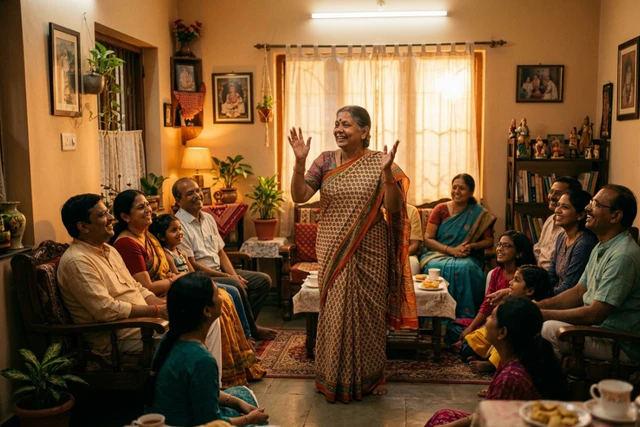
I was visiting Karan's family last year for a gathering. His mother told the 1994 road trip story. I had heard it twice before. I watched her tell it. She was in the middle of a room full of people, most of whom had heard it as many times as I had, and she was fully alive in it, back on that roadside, thirty years ago, with the flat tyre and the antakshari and everyone young and present and together.
Karan's mother had put out Mom's Magic biscuits with the chai, the way she does at every gathering, and I sat there eating them and watching her tell the story and I understood, maybe for the first time, what these stories actually are.
They're not just jokes. They're not just family lore. They're the moments she has decided to carry forward. The ones she has elected, from among everything that happened, to keep alive. She's telling you what mattered. She's telling you what she wants to remember. She's telling you who she was when she was in the middle of her life with everything still happening.
Why We Roll Our Eyes
We roll our eyes because we've heard it before. Because we know the punchline. Because we're in the middle of a conversation and the story takes eight minutes and involves sound effects.
We are not wrong to find it familiar. But we are wrong to find it only familiar.
My friend Ananya told me she spent years being mildly impatient with her mother's stories. Then her mother had a health scare last year. Nothing serious ultimately, resolved without drama, everyone fine. But Ananya said the three days before they knew it was fine were the longest three days she'd had in a long time.
When it was over and her mother was clearly okay and back to her usual self, she told the pressure cooker story. A different one from Priya's, but the same genre. Domestic mishap, dramatic retelling, sound effects, laughter.
Ananya said she sat there and listened to every single word. The whole eight minutes. She didn't check her phone. She didn't exchange a glance with her sister. She just listened.
She said it was the best version of the story she had ever heard.
The Last Time
You don't know when the last time will be. That's the thing about recurring stories. You've heard them so many times that each telling feels like just another in an endless series. It doesn't occur to you that there's a number. That one of these times will be the last time.
Let her tell it. All of it. The sound effects and the dramatic pauses and the punchline you already know.
It's not really about the pressure cooker. It never was.


