



Sign in to share
Dhruv Saxena
My mother has two modes.
Guest mode and everyone-else mode. The gap between them is so large that they feel like they belong to different people. Different households, even. Different centuries.
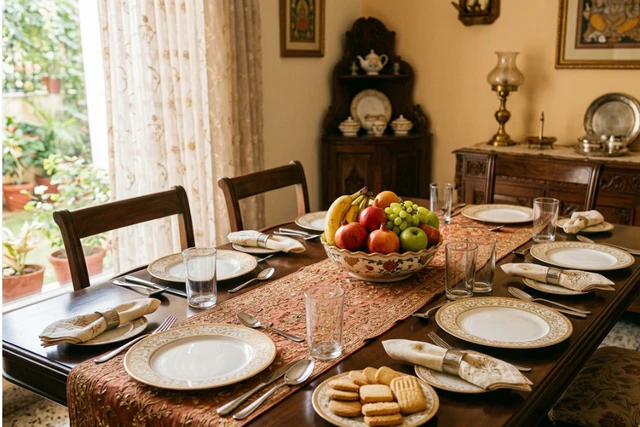
I discovered this at age fourteen when my father's colleague came for dinner. I had been eating dal and rice for four consecutive days. That evening, my mother produced a full spread. Paneer. Raita. Two kinds of sabzi. A dessert that I had not known existed in our kitchen. The good plates came out. The ones that live in the top shelf and require a stool to access. The tablecloth appeared. The tablecloth. We have a tablecloth.
I sat at the table and stared at the food and then at my mother and then at the food again.
"Where did all of this come from," I asked.
She looked at me like I had asked something very stupid. "We have guests," she said. And went back to the kitchen.
I had been living in this house for fourteen years. I was apparently not enough reason to find the tablecloth.
This was my introduction to the great Indian maternal hospitality paradox, and I have been studying it closely ever since.
The guest transformation, when it happens, is genuinely remarkable. The house that was fine five minutes ago is suddenly not fine. Cushions get repositioned. Surfaces get wiped. The good crockery comes down from wherever the good crockery lives. My mother moves through the house with the energy of someone preparing for an inspection they have known about for weeks, even if the guests called forty minutes ago.
The food that appears is also different. Not just more food. Different food. Better food. Food that requires effort she does not apply to Tuesday dinners. She will make something she has not made in months specifically because a guest is coming. She will buy fresh fruit. She will arrange it on a plate. She will put out Mom's Magic biscuits on a separate plate alongside because the biscuits are for snacking and the fruit is for presentation and both must be present and the distinction matters to her even if it matters to nobody else in the room.
I have eaten Mom's Magic biscuits from my mother's kitchen my entire life. I have never once had them arranged on a plate. That is exclusively a guest service.
The Standard Treatment
When it is just us, the household operates on a different system.
The crockery is the daily crockery. The food is whatever is practical. If something runs out, it runs out. If I want more of something, I can check the kitchen myself. She is not running a restaurant for family. Family knows where things are.
My cousin Arjun described it as the difference between being a hotel guest and being a hotel employee. The guest gets the suite. The employee gets the staff room. Both are technically in the same building.
He said this to his mother once. She told him that employees get a salary and asked what he was contributing. He did not have a good answer.
My friend Priya grew up with the same system and has developed what she calls the guest inventory. She knows, from years of observation, exactly which items in her mother's kitchen are designated guest-only. The good chai cups. A specific brand of biscuit that never appears on regular days. A particular type of namkeen kept in a tin that Priya once opened on a non-guest occasion and her mother looked at her with such genuine alarm that she quietly put it back and has not touched it since.
"That tin," Priya told me, "has been refilled maybe twice in ten years. It exists to be offered to guests. It is not for eating."
I asked what would happen if a guest actually finished it.
She said her mother would be quietly devastated but would not show it, and would refill it before the next guest came, and the cycle would continue until the end of time.
The Speed of It
What I find most impressive about the guest transformation is the speed.
My mother can receive a phone call saying someone is coming in an hour and produce, within that hour, an environment that suggests she has been expecting guests for days. The house looks different. The food smells different. She herself looks different. She has changed into a specific outfit that exists for receiving people. It is not her best outfit. That is reserved for weddings and certain festivals. But it is distinctly above the regular home clothes, which apparently are not suitable for being seen in by outsiders.
My friend Karan's mother has a guest saree. A specific saree she wears exclusively when people come over. It is not her nicest saree. That also comes out only for special occasions. But it is the guest saree and it signals, to the family, that company is arriving and everyone should adjust accordingly.
He once asked her why she didn't just wear it normally sometimes. She looked at him for a moment and then said, "then what would I wear for guests?" The logic was complete. He did not pursue it.
The Hierarchy of Guests
Not all guests receive equal treatment. This is important to understand.
There is a guest hierarchy, and my mother applies it with precision she does not apply to many other things in life.
At the top are the guests who are coming for the first time. Maximum effort. Every good thing comes out. The house is at its best. The food is ambitious. Nothing is left to chance.
Below them are the guests who come occasionally. Good effort. The good crockery, solid food, fruit on the table. Not the maximum but clearly above the everyday.
Below them are the guests who come regularly enough that they have stopped being guests in the formal sense. For these people, my mother will cook properly but she will not produce the tablecloth. They have been demoted to something between guest and family. They know where the glasses are. They are allowed to help themselves.
And then there is family. Family gets whatever is there.
My friend Nikhil made the mistake of bringing a girlfriend home before his mother knew she was coming. His mother answered the door in her home clothes, which she immediately registered as a problem. She excused herself, disappeared for four minutes, and reappeared in something noticeably better. She had also, in those four minutes, somehow set out a plate of snacks in the living room.
Nikhil still does not know how she did this. He has asked. She says she just moved quickly. He suspects there is a guest snack reserve kept in a state of permanent readiness for exactly this kind of emergency.
He is probably right.
The Explanation
I asked my mother once why guests get better treatment than family.
She said guests are not always comfortable in someone else's house and it is the host's job to make them feel welcome. Family is already at home. Family does not need to be made comfortable. Family is comfortable.
I pointed out that I was not always comfortable. That sometimes I would also like the good plates.
She said I knew where the good plates were and could get them myself if I wanted them.
This was technically true and also completely missed the point, which I think she knew and chose not to acknowledge.
There is a version of this that is actually quite loving if you think about it long enough. The family gets the relaxed version of her, the one that doesn't perform, the one that assumes you're fine and knows you'll say if you're not. The guests get the effort because they need it. You don't need it. You're already home.
I still think I should get the tablecloth sometimes.
I have not pushed this further. I know where the tablecloth is. I could get it myself.


