



Sign in to share
Dhruv Saxena
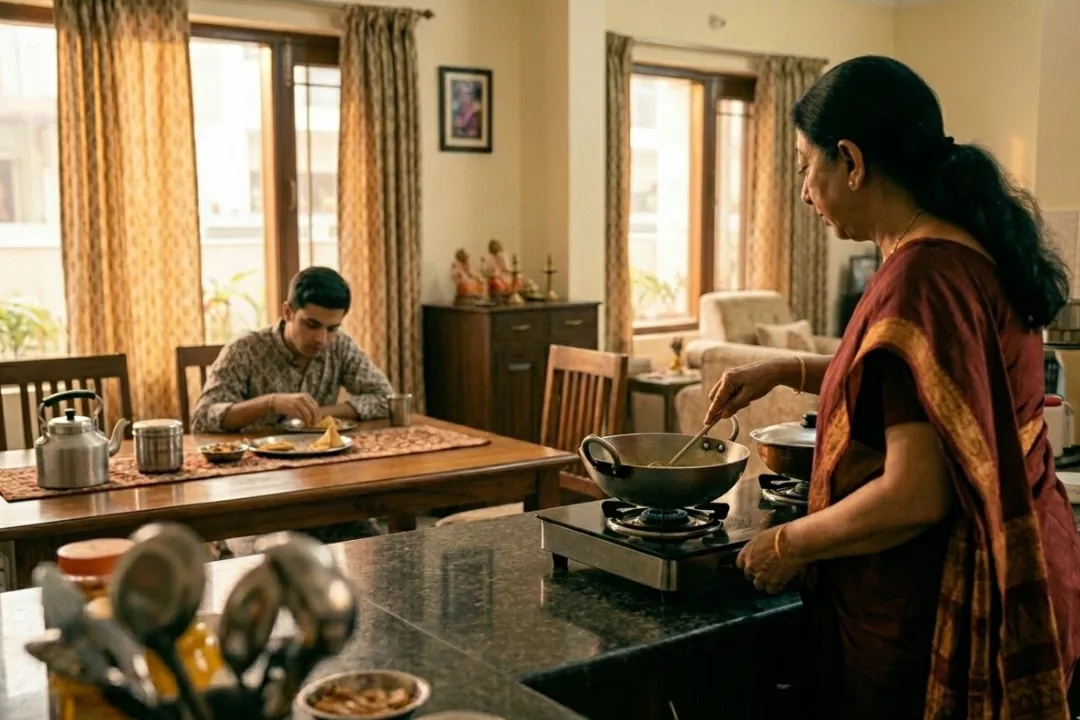
I have never, in thirty-one years, successfully convinced my mother that I have eaten enough.
Not once. Not at the end of a full meal I have visibly eaten in front of her. Not after second helpings. Not after pointing at my plate and stating clearly that I am full and cannot eat more. The information does not land. Or it lands but does not stick. Or it sticks but is immediately weighed against a competing dataset she is maintaining internally and found to be insufficient.
She is already making something else.
The phenomenon operates at every scale. A visit home of two days. A phone call where I mention what I had for lunch. A Sunday where she has made a meal and I have eaten it and she has watched me eat it and I have told her I am full. In all cases, within a short period, the question arrives. Have you had enough. The answer yes is received and then supplemented by something additional just to make sure.
I was home last month for four days. Every meal was a full meal. I ate everything that was put in front of me because it was good and I was hungry. At no point during those four days did my mother indicate that she felt the eating situation was satisfactory. She kept making things. Small additional things, after the main meal, described as light but constituting their own entire category of food. Something sweet. Something she had leftover that needed to be used. Something she had made extra of because she thought I might want it.
On day three I told her I was genuinely full and did not need anything else. She nodded. She went to the kitchen. She came back with chai and Mom's Magic biscuits and said this is just something small. The biscuits are not nothing. The biscuits are also chai. My mother does not consider chai and biscuits to be food in the category she is trying to address. They are a separate category. The eating situation was still open.
The Standard She Is Measuring Against
The problem, as far as I can tell, is that my mother has an internal standard of what sufficient eating looks like and I have never met it.
This standard was formed during my childhood, when I was a growing person and sufficient eating was measured differently. The quantities that registered as adequate when I was twelve are stored somewhere in her framework as the baseline. Thirty-one-year-old adult eating has not fully updated this baseline.
I am not twelve. My caloric requirements are different. My appetite is different. My life does not involve the physical activity of a twelve-year-old. None of this has been incorporated into the assessment.
When I eat an adult portion of a meal and declare myself full, she hears this through a filter calibrated to the eating of a child she was responsible for keeping fed. The adult portion does not clear the bar.
My friend Nikhil had a revelation about this at thirty. He was home for a week and watched his mother watch him eat. He said he could see her running calculations. He would finish a serving and she would look at the serving and then look at him and he could see her determining that more was required. He said it was like being monitored by a very caring system that had not been updated in twenty years.
He ate a lot that week. He said he felt better than he had in months. The system, he concluded, was calibrated incorrectly but not wrong.
The Phone Evidence
The conviction that I am undereating is not limited to visits. It operates continuously at a distance.
My mother forms opinions about my eating from phone calls in which I have not described my eating at all. She asks what I had for lunch. I tell her. She says that's it? I say yes, that is the full description of lunch. She says something about how that does not sound like very much.
I have described meals that I considered substantial. She has consistently found them light. I have described meals with multiple components. She has noted which components are missing. I once described a meal that I felt was comprehensively balanced and she said what did you have for protein, and I named the protein, and she was quiet for a moment and then moved on, which is her version of mild acceptance rather than approval.
The threshold for her approval of a meal I have described remotely is very high. I have not achieved it. I have come close once or twice. I have not achieved it.
The Offering Mechanism
When she offers food and I say no thank you, a sequence begins.
The first offer is received and declined. She accepts the decline. She returns to the kitchen. A short period passes. She comes back with the thing anyway, described slightly differently. Not as the thing I declined but as something adjacent. It is not the full portion. It is just a small amount. Just to try.
The small amount is placed in front of me. The placement has a quality of inevitability to it. The small amount is there now. The social calculus has shifted. It is easier to eat the small amount than to re-decline it. I eat the small amount. She registers this. A short period passes. She comes back with slightly more.
My friend Priya mapped this sequence once. She called it the ratchet. Each small offering advances the position. Declining resets you to the previous position but does not take you below it. Over the course of an evening you end up having eaten significantly more than you intended through a series of increments each of which seemed minor at the time.
The ratchet is not manipulation. It is logistics. She has a goal and a method and the method works.
The Defence
I want to say something in defence of the conviction.
When I was actually undereating, because there have been periods of stress where I ate less than I should, she knew. She could hear it in my voice. She could tell from the descriptions of my meals. She asked different questions during those periods and she was right to ask them.
The calibration is off. The quantities she considers necessary exceed what I actually need. But the underlying attentiveness, the continuous monitoring of whether the person she loves is being adequately nourished, is not nothing. It is her version of care expressed through the most direct channel available.
She cannot see me every day. She cannot make my meals. What she can do is ask, and receive the answer, and form an opinion, and offer more when she has the chance.
The offering is the point. Not the food exactly. The offering.
I am full. She knows I am full. She is making something small anyway.
That is not a failure to understand. That is love with a second helping.


