



Sign in to share
Dhruv Saxena
I showed my mother an Instagram reel last month.
It was one of those accounts. You know the ones. Aesthetic mother in a white linen kurta, soft morning light, golden hour glow, journaling peacefully at a wooden table while her children play quietly in the background. The caption was something about "holding space" and "intentional mothering" and "choosing presence over productivity."
My mother watched it twice. Then she handed my phone back and said, "what is she doing?"
I said she was journaling. About her feelings. About motherhood.
My mother looked at me for a moment. Then she said, "I didn't have time for that."
And went back to cutting vegetables.
We were sitting at the kitchen table, me with my chai and the Mom's Magic biscuits she always puts out when I visit, her with the cutting board and absolutely no interest in pausing for content. I showed her the reel because I thought she'd find it funny. She found it mildly puzzling. The gap between her reaction and what I expected told me everything.
That's the gap this piece is about.
The Aesthetic My Mother Never Had
Let me describe my mother's mornings when I was growing up.
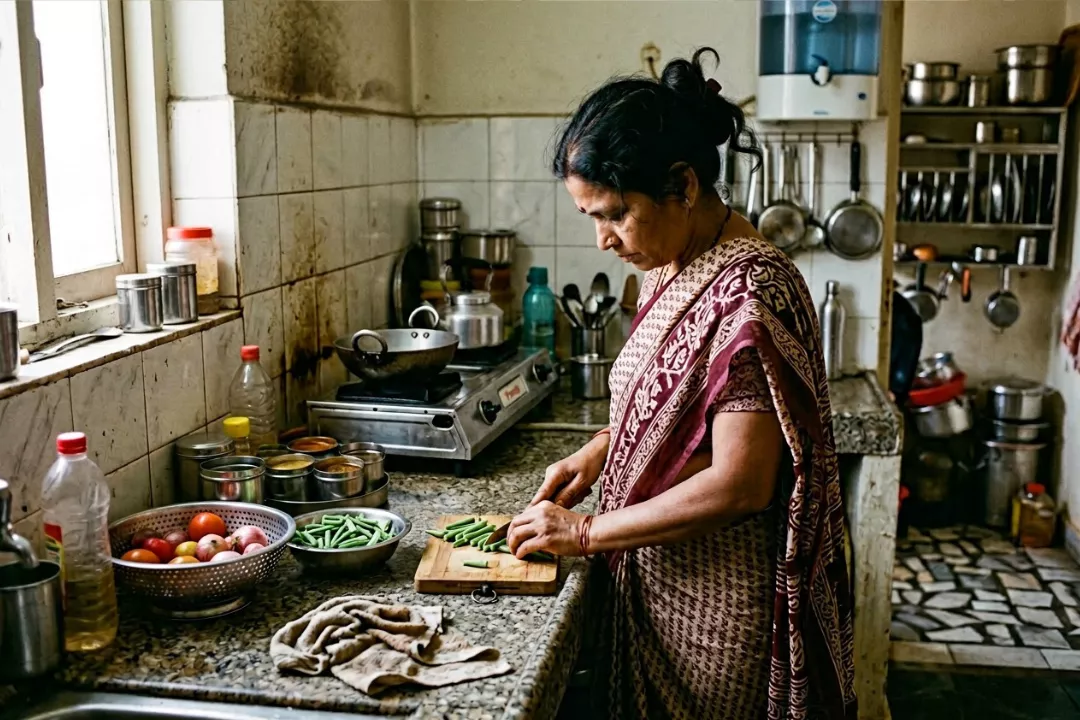
She was up at 5:30am. Not because she'd set an intention. Because that's what time things needed to happen. By the time I woke up, she had already made breakfast, packed my tiffin, ironed at least two items of clothing, and had some version of a plan for dinner. She had also, at some point, had her own chai, usually standing at the kitchen counter because sitting down felt like a luxury the morning hadn't earned yet.
There was no linen. There was a cotton salwar she'd been wearing for six years because it was comfortable and practical and she had no opinion about its aesthetics. There was no golden hour lighting. There was a tubelight in the kitchen that flickered slightly and that my father was supposed to fix and never did.
There was no journaling. There was a mental list, running constantly, of everything that needed to happen today and tomorrow and this week and whether we were running low on anything and whose birthday was coming up and had someone called the plumber yet.
My mother did not journal. My mother was the journal. She kept everything in her head and somehow nothing was ever missed.
I tried to explain this to my friend Karan once. He'd shown his mother a similar reel and she'd had roughly the same reaction as mine. Polite confusion followed by a return to whatever was actually happening.
"My mother held space," he said, "by just being there. All the time. Without a caption."
That's it exactly.
The Language She Never Used
Influencer motherhood has a very specific vocabulary. Boundaries. Presence. Intentionality. Gentle parenting. Holding space. Processing emotions together. Creating safety.
My mother used none of these words. She also did all of these things, just without the vocabulary and without anyone filming it.
She had boundaries. She just called them "no" and delivered them without a follow-up discussion about how the no made everyone feel.
She was present at every school function, every exam, every illness, every 2am when something was wrong. She just didn't announce her presence because presence, for her generation, was not a choice you made. It was just what you did.
She processed emotions with me in the way Indian mothers process emotions, which is to make food and sit nearby and not say very much and let the food do the talking. It worked. I have no complaints about the methodology.
Later that same evening another reel came up on my phone. A mother in a beautiful kitchen, speaking softly to camera about the importance of regulating your nervous system before responding to your children.
I looked up at my mother, who was telling me at that exact moment that I needed to sit up straight because my posture was going to cause me problems.
I did not show her the reel.
What the Algorithm Doesn't Capture
The influencer version of motherhood is not wrong exactly. Some of it is genuinely useful. The emphasis on emotional availability, on talking to children like people, on not just managing behaviour but understanding it, these are good things.
But the aesthetic of it, the linen and the golden hour and the journaling, has nothing to do with what makes a mother good. And it creates, without meaning to, a version of motherhood that looks nothing like the one most of us actually had.
My mother's motherhood looked like this. Waking up before everyone else to make sure the day worked. Eating the last roti so nobody else had to. Knowing, without being told, when something was wrong and addressing it not with a conversation about feelings but with a specific food that meant I see you and I want you to feel better.
Thirty years of showing up, quietly, without content strategy, without a ring light, without anyone watching except the people she was doing it for.
The Part That Gets Me
My mother will never be on Instagram. She has a WhatsApp. She uses it to send Good Morning images and to ask if I've eaten. That's the full extent of her digital footprint.
She will never be tagged in a reel about intentional mothering. She will never have an aesthetic. She will never journal about holding space.
She just held it. Every morning at 5:30am, in a practical cotton salwar, under a flickering tubelight, with a mental list running and a plan already forming and a tiffin already packed.
No caption required.


