



Sign in to share
Shikha Sharma
My husband has a guest personality.
I discovered this after marriage, although I should have seen the signs earlier. There were hints. The way his voice changed when talking to my parents. The way he suddenly became extremely interested in whether everyone had water. The way he could sit with older relatives and nod with a seriousness I had never seen him apply to anything I said about the laundry basket.
But I saw the full version properly last month.
My parents were coming over for tea. Not dinner. Not a formal visit. Just tea, because they were nearby and my mother had called to say they would come for “half an hour,” which in family time means anywhere between forty-five minutes and three hours.
I told my husband this around 4 pm.
He looked up from his laptop and said, “Today?”
I said yes.
He closed the laptop.
This was my first clue that a transformation had begun.
“What time?”
“Six.”
He looked at the clock as if six was not two hours away but a tactical deadline.
Then he stood up and became a person I do not live with.
The Preparation
I want to be clear. My husband is not messy in the dramatic way some men are messy. He is not one of those people who thinks a towel left on a chair has entered its natural habitat. He is reasonably functional. He knows where the broom is. He knows that cups do not migrate to the sink on their own.
But there is normal clean and then there is guest clean.
Guest clean is different.
Guest clean has urgency.
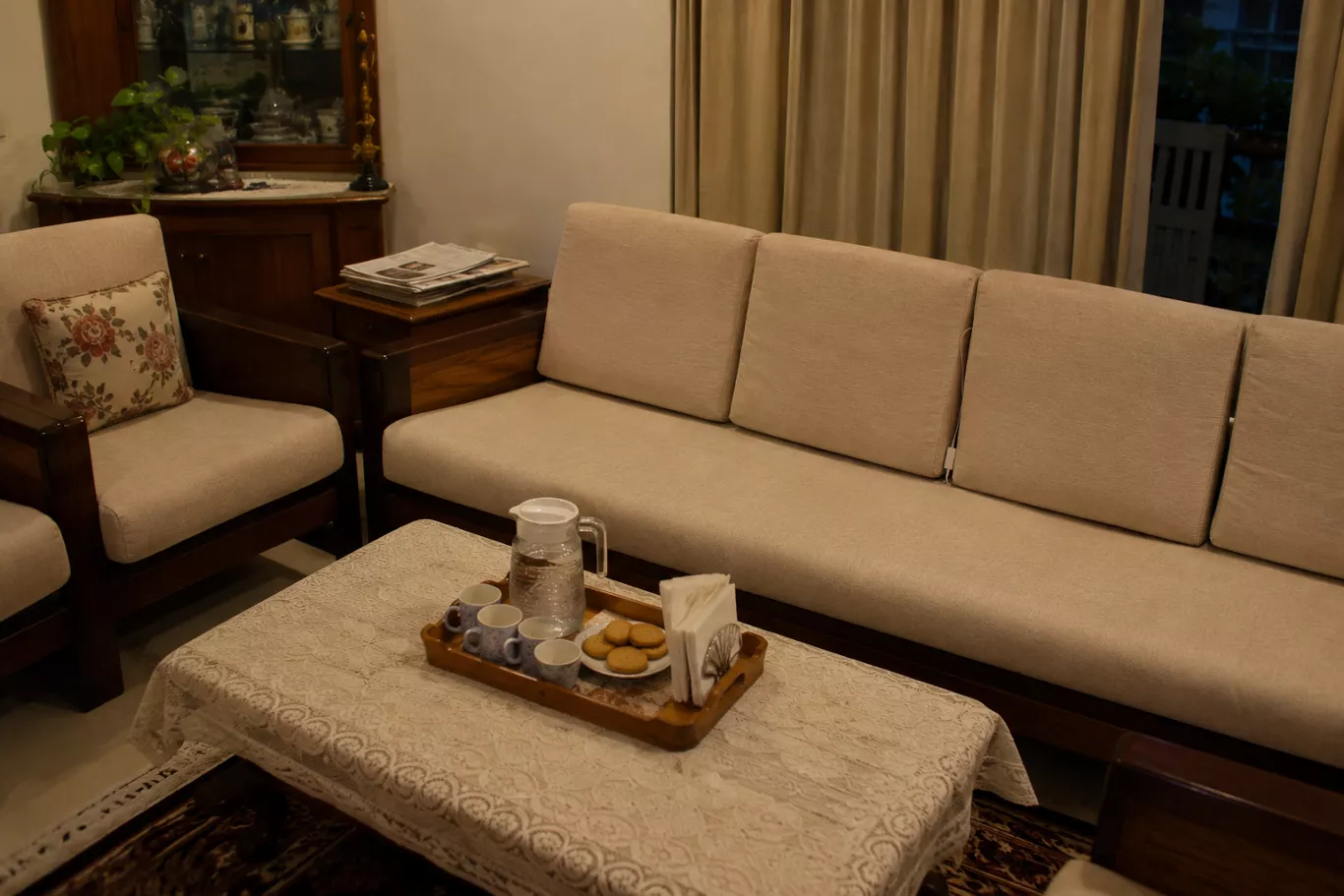
He started with the living room. Cushions were straightened. Newspapers disappeared. The remote was placed in a location where it has never naturally lived. A charger that had been lying near the sofa for three days was suddenly considered unacceptable to civilisation.
Then he entered the kitchen and asked if we had enough cups.
We have cups.
We have always had cups.
We have enough cups for a small training workshop.
Still, he opened the cupboard and counted.
I stood there watching him behave like the hospitality department of a boutique hotel.
He asked, “Should we put out Marie Light?”
I said, “For tea, yes.”
He took out a plate. Not the everyday plate. A better plate. I did not know he knew which one that was.
Then he wiped the table.
Twice.
The Voice
The voice arrived at 6:07.
My parents rang the bell. I opened the door. My husband came from the kitchen and said, “Namaste, Uncle. Namaste, Aunty. Come, come.”
Come, come.
My husband does not say come, come to me. He says “haan, one second” from another room and then appears after three minutes. But here he was, saying come, come like a man raised by etiquette manuals.
He took my mother’s bag before she had fully entered.
He asked my father about traffic.
He offered water.
Not just “water?” in the way normal people offer water. A full sentence.
“Will you have water first?”
My father said yes.
My husband brought water.
On a tray.
I looked at him.
He did not look at me because he was busy being this other person.
The thing about the guest personality is that it is not fake exactly. That would be too simple. It is real. It is just a specialised real. A version that appears when the doorbell rings and leaves when the last guest does.
My friend Priya says her husband has this too. When her relatives visit, he becomes calm, attentive, and strangely well-spoken. He says things like “please sit comfortably” and “let me get that” and “no, no, I’ll do it.” The same man, she says, once ate dinner standing in front of the fridge because he did not want to take out a plate.
The range is impressive.
The Host
My husband is a better host than I am in my own house.
This is annoying to admit.
I am good at the emotional part of hosting. I know who likes what. I know what conversation to avoid. I know when my mother is about to say something about my curtains and how to redirect her before she gets there.
But he is better at the physical part.
He notices empty cups. He refills plates. He makes sure the fan is not too high. He asks if the tea is strong enough. He brings out the biscuits before anyone has to ask. He does not sit down fully until everyone else has settled.
At one point, my mother said, “No, no, I don’t want anything else.”
He said, “Just one more Marie Light?”
She took it.
This is power.
My mother does not take things when I offer them. If I say “one more?” she says no as if I am trying to trick her into indulgence. If he says it, she takes one, breaks it neatly, and says, “Bas, half.”
Then eats the other half later.
He has access I do not understand.
The Stranger
For about three hours, I watched him as if from a short distance.
He was still my husband. Obviously. I knew this. He was wearing the T-shirt I had told him not to wear because it had a small stain near the sleeve, although he had cleverly positioned himself so the stain was not visible. He was making the tea slightly too strong because he always does. He was still the person who asks where his wallet is while holding it.
But he was also someone else.
Not better. Just different.
A little more formal. A little more attentive. A little more careful with his words. The version of him that appears when other people are in the room and he wants the room to go well.
I realised then that marriage gives you access to someone’s private version, but it also means you occasionally watch their public versions from very close range.
The office voice. The parent voice. The guest voice. The talking-to-the-electrician voice. The explaining-something-to-a-child voice. The voice they use with old friends. The voice they use with your relatives. All of these are them. None of these are the full them.
My husband’s guest personality is part of him. It just does not live with me all day.
This is probably healthy.
I do not need to be told to sit comfortably in my own house.
The After
The moment my parents left, the personality began to dissolve.
Not immediately. There was a transition phase.
He stood at the door, waved, came back in, picked up two cups, put them in the sink, and then exhaled like a person who had completed a shift.
I said, “You become very different when guests come.”
He said, “No, I don’t.”
This was said while he was loosening the invisible tie of his invisible host uniform.
“You do.”
“How?”
“You said come, come.”
He laughed.
Then he said, “Your parents were here.”
“So?”
“So one should behave properly.”
There it was.
One should behave properly.
I had married someone who believed in the category of proper behaviour and deployed it selectively when relatives entered the house.
I found this both funny and, annoyingly, sweet.
The Work of Being Welcomed
I think what moved me later, after I stopped laughing about the come, come, was that he had made an effort.
Not a grand effort. Not the kind anyone would name. Just the small labour of making people feel received.
The water. The plate. The extra biscuit. The wiped table. The asking about traffic. The sitting forward when my father told a story he had definitely heard before. The way he made my mother feel like she was being hosted properly in her daughter’s house.
This matters.
Especially in marriage.
Because when someone hosts your family well, they are not only hosting guests. They are acknowledging the people you came from. They are saying, in practical terms, these people matter here.
My friend Meera says she fell a little more in love with her husband the day he remembered how her father takes tea. No speech could have done what that cup did. It told her that he had been paying attention not just to her, but to the world around her.
I understood that after my parents left.
My husband had not become a stranger for three hours.
He had become a version of himself built for making my people comfortable.
That is not nothing.
The Return
After the house was quiet again, we sat on the sofa. The cushions, which had been standing in neat guest formation, slowly returned to their actual lives. One fell sideways. The charger came back. The remote disappeared within ten minutes.
He ate the last Marie Light directly from the plate.
No tray.
No serving.
No “will you have.”
Just picked it up and ate it while scrolling through his phone.
The guest personality had officially left.
I was relieved.
I liked the host. I respected the host. I was grateful to the host.
But I married this person.
The one who can make my parents feel cared for and then sit beside me with his feet on the centre table until I tell him to take them off.
Both versions are useful.
One is just more familiar.


