



Sign in to share
Shikha Sharma
My husband has two voices.
There is the voice I know, which is the one he uses at home, with me, with his friends, with his family. It is a normal voice. It has a specific quality of ease, of not-trying, of being the voice of a person who is comfortable. It says things like have you seen my keys and what do you want for dinner and did you hear that thing about the neighbour. It is the voice of a person I have been listening to for six years.
And then there is the work voice.
The work voice is different in a way that I find difficult to fully articulate. It is slightly more formal. The sentences are more constructed. The pauses are in different places. The laugh, when it comes, is a notch more considered. It is not a performance exactly. It is a register. A specific register that he steps into when he is on a work call and steps out of when the call ends.
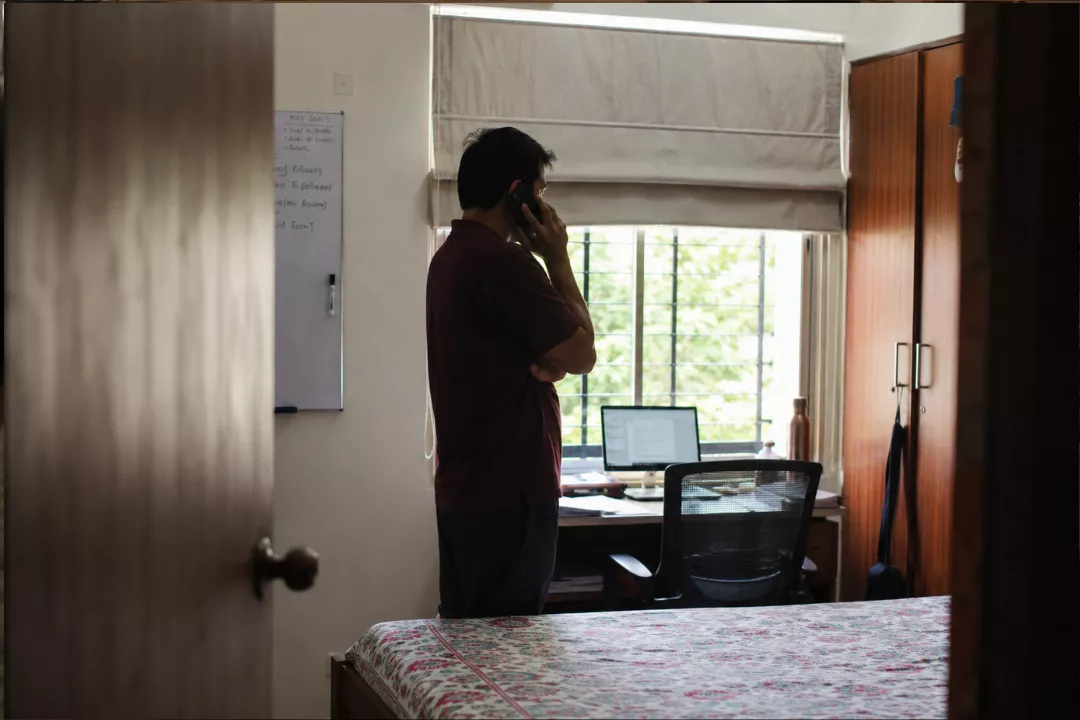
I have heard the work voice accidentally many times. He takes calls from home sometimes and I am in the other room and the door is not fully closed and the work voice comes through and I think, for a moment, who is that.
It is my husband. But it is the version of my husband that exists for other people. The professional, constructed, operating-in-the-world version. The version that existed before I knew him and that continues to exist in contexts I am not part of.
I find it deeply unsettling and also very interesting.
Last Tuesday he was on a work call in the study. I was passing the door. The door was slightly open. I heard the work voice. I stood outside the door for about thirty seconds listening to it. He said something in the work voice that he would have said differently in the regular voice and the difference was genuinely instructive. The professional framing of the same idea. The careful word choice. The construction.
He came out of the study after the call. He had Sunfeast Marie Light in his hand because he takes snacks into work calls the way I take snacks everywhere. He was back in the regular voice immediately. He said the call had run long. I said I had heard part of it. He asked if I had been standing outside the door. I said I had been passing.
He looked at me. I looked at him. We both understood what had happened.
The Register
Every person has registers. I know this. I have my own.
I have a phone voice that is slightly different from my regular voice. I have a register for professional interactions that is not the same as my register for friends. I become a slightly different version of myself in different contexts and this is normal and not suspicious.
But my husband's work register is more distinct than I expected. The difference between the two versions is larger than I had estimated. I thought I had a complete picture of him. The work voice suggested the picture was not complete. There is a version of him that is not available to me in the normal geography of our relationship and the work call is where I occasionally hear it.
My friend Priya has the same experience. Her husband works in a different field and she overheard him on a call once. She said he used a word she had never heard him use. Not a technical word. Just a word that was more formal than his regular vocabulary. A word that belonged to the professional register and not the domestic one. She said she thought about the word for two days. It revealed a version of his mind she had not seen.
She asked him about it later. He said he did not know what word she was referring to. She described it. He said he used it all the time. She said not at home. He said no, not at home. She said why. He said because at home he did not need it.
The Laugh
The work laugh is the most specific part.
My husband laughs in a particular way. It is quiet and arrives in a rush and has a slightly helpless quality, the laugh of someone who has been caught genuinely off guard by something funny. This is his real laugh and I know it very well.
The work laugh is different. It is a beat later. It is controlled. It acknowledges that something funny has been said without fully arriving in the funny. It is the laugh of a professional acknowledging humour while remaining in the professional register.
I have heard both. The real laugh is better. The real laugh is him. The work laugh is the professional performing the social function of laughing. Both are genuine in their own contexts. They are not the same.
My friend Meera noticed her husband's work laugh when he was on a call she happened to be nearby for. She said she stopped what she was doing because the laugh was wrong. Not bad wrong. Just not right. She said she walked into the room and he was on the call and she watched him do the work laugh two more times and then the call ended and he laughed about something she said in the real laugh and the difference was immediate and very clear.
She said she had not known the work laugh existed. She said it made her think about all the things she did not know about how he moved through the world when she was not there.
The Interesting Part
I find the work voice interesting because it is evidence of something I sometimes forget.
He lived a whole life before I was in it. He built a professional identity that has its own vocabulary and its own register and its own laugh. He moves through a world every day that I am not part of, with people I have never met, in a voice I only hear by accident through slightly open doors.
This is true of both of us. I have my own professional register. He has heard my work voice too, accidentally, and has mentioned that it is different from my regular voice. I said is it. He said yes, more formal. I said interesting. He said yes.
We are both, in various parts of our lives, performing versions of ourselves that the other person does not have full access to. The full-access version is the one we are at home, at the table, in the car, in the ordinary.
The work voice is not the real voice. The real voice is the one that says have you seen my keys.
I have seen his keys. They are on the hook by the door.


