



Sign in to share
Shikha Sharma
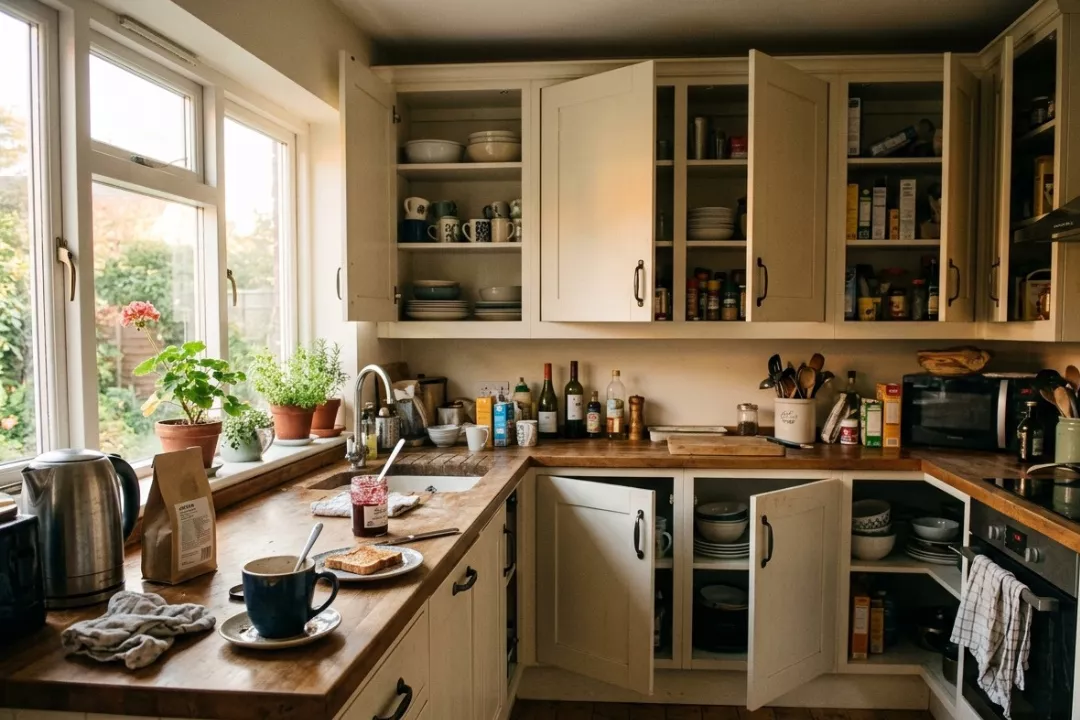
My husband leaves every cupboard door open.
Every. Single. One.
He will open the cupboard, take what he needs, and walk away. The cupboard door remains open behind him, apparently unconcerned, waiting for someone else to close it. That someone is always me. I have been closing cupboard doors in this house for six years. If I stopped closing them, I believe we would eventually live in a home where every single storage surface was permanently open, like some kind of avant-garde installation about the futility of organisation.
I used to find this mildly infuriating. I would close a door, turn around, and another one would be open. I started to wonder if he was doing it on purpose. I decided he wasn't because nobody is that committed to a bit. I accepted it as one of the unresolvable mysteries of sharing a life with another human being.
And then, about a year ago, he went on a work trip for two weeks.
The first three days, I was fine. Enjoying the quiet. Sleeping in the middle of the bed. Eating dinner at whatever time I wanted without coordinating with anyone. Very liberated. Very independent.
Day four, I walked into the kitchen and every cupboard door was closed.
I stood there and felt, inexplicably, sad.
I had closed them all myself the night before. Obviously. I knew that. But the closed cupboards looked wrong. They looked like a kitchen that nobody was living in. They looked like the kitchen of a person who lives alone and closes all her cupboard doors because there is no one else here to leave them open.
I opened one. Just one. Left it open. Made my tea and sat down with a couple of Sunfeast Marie Light biscuits and thought about what was happening to me. The answer, I concluded, is that I had spent six years being annoyed by the open cupboards and had apparently, at some point without noticing, started to find them comforting. The open cupboard is proof that someone else lives here. Someone messy and absentminded and completely unbothered by door angles. Someone I married.
I closed it before he got home. I have some dignity.
The Inventory of Irritations
I started asking around after this, because I suspected I was not alone, and I was not.
My friend Divya's husband hums. Not songs. Just sounds. A low, continuous, tuneless hum that happens when he's reading or working or just existing in a room. She spent the first two years of their marriage asking him to stop. He would stop, briefly, and then start again, because he didn't even know he was doing it. She gave up asking. She learned to not hear it.
Then he was in hospital for a week last year for a minor procedure. She came home the first evening to a completely silent flat. She said it was the most unsettling silence she had ever experienced. She put on music to fill it and cried a little bit, which she described to me as embarrassing and also completely understandable.
The hum, she told me, is now her favourite sound in the world. She would never tell him this. He would become insufferable.
My other friend Kabir's wife narrates things. Out loud. To herself. She will be chopping vegetables and say, quietly but audibly, "okay so the onions go in first." She will be getting dressed and murmur something about whether the blue top works. She will be reading and occasionally comment on the text. For the first few years, Kabir found this slightly unhinged. He would look up from whatever he was doing to check if she was talking to him. She was not talking to him. She was just narrating her own life, apparently.
He's stopped noticing. Except when she's not there. Then the silence is too loud and he genuinely doesn't know what to do with it.
The Specific Quality of a Familiar Annoyance
There is a particular category of irritation that only long-term relationships produce. It's not the sharp irritation of something genuinely upsetting. It's softer than that. More textured. It's the irritation of knowing someone so well that you know exactly which specific small thing they do that will mildly bother you on a Tuesday morning.
It is, I have come to understand, a form of intimacy.
To be annoyed by someone's specific habits means you know their specific habits. It means you've been paying attention. It means their patterns have become so familiar to you that any deviation from them registers as absence rather than relief.
My colleague Nisha's husband eats in a particular way that she spent three years finding inexplicably aggravating. She couldn't even fully explain it. He just ate too... cheerfully. With too much enthusiasm. Like every meal was the best thing he'd ever had. She found it grating in the specific way that only completely harmless things can be grating.
She would never have described this as one of her favourite things about him. And yet, last month, she was eating alone because he was travelling, and she said the silence of a meal eaten by herself was so bleak that she ate standing up over the sink just to make it feel less formal.
The cheerful eating, she told me, is actually one of her favourite things about him. She's working through the implications of this.
The Recalibration
I think what happens, over years of sharing a life with someone, is that their habits become part of the furniture of your existence. You stop registering them as habits and start registering them as ambient conditions. The cupboard doors aren't annoying anymore. They're just the way the kitchen looks when he's been in it.
And when those conditions are suddenly absent, the room doesn't feel quiet. It feels wrong.
My husband came back from his work trip and opened three cupboard doors in the first ten minutes of being home. I closed them. He didn't notice. We ate dinner and I did not mention the cupboard incident or the sad biscuit moment or any of what had happened in the two weeks he was gone.
I am not telling him this story. He will become impossible to live with. He will leave the cupboards open on purpose and claim he's doing me a favour.
Some things are better kept to yourself. This is one of them.
The open cupboard doors, though. I've genuinely stopped minding.


