



Sign in to share
Shikha Sharma
My husband believes a drawer is clean if it closes.
This is not a metaphor.
It is his exact operating system.
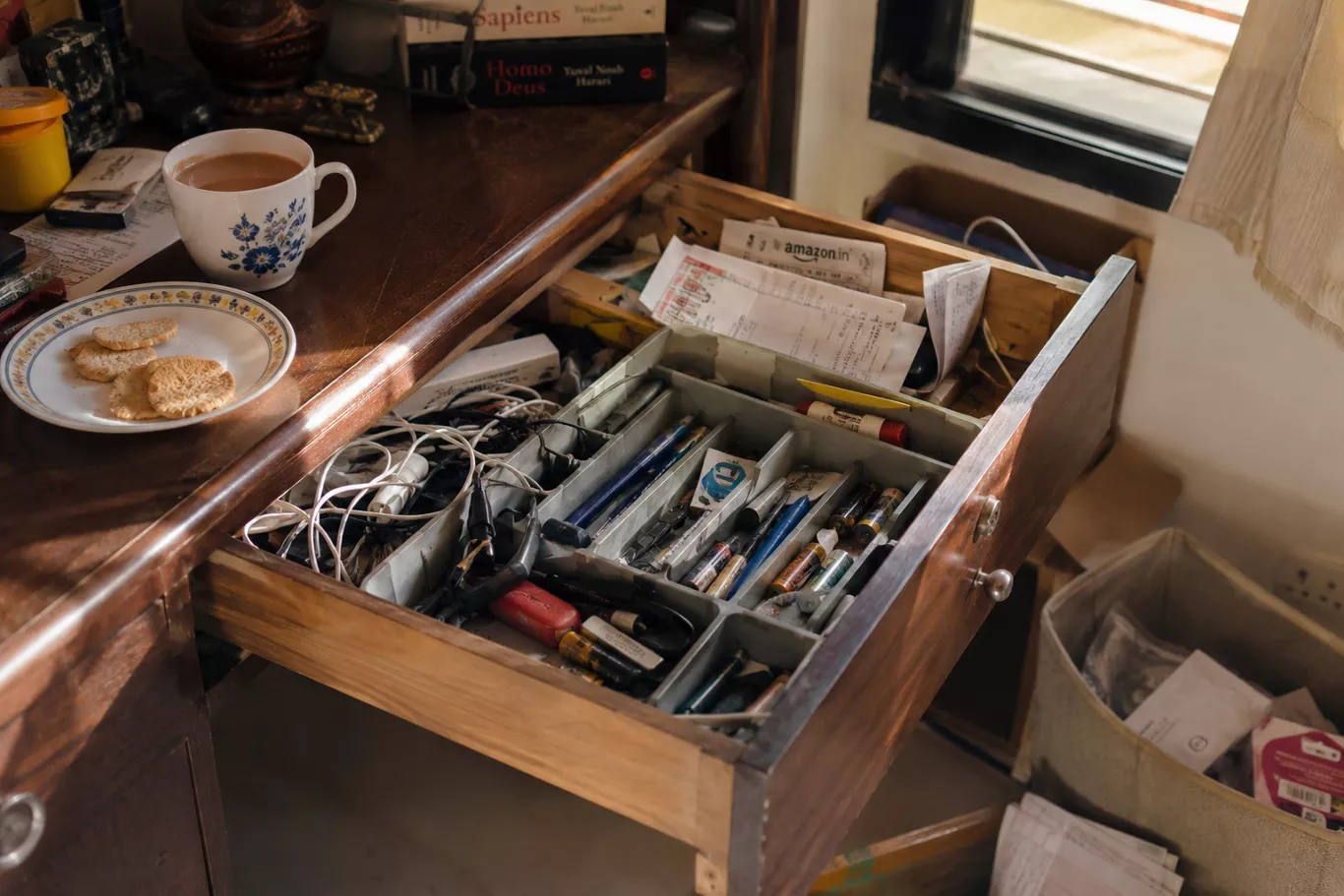
If the drawer slides in, the matter is resolved. What happens inside the drawer is apparently private. Cables, receipts, old batteries, visiting cards, expired coupons, one loose button, three pens that do not write, and a charger for a device we no longer own may live in crowded tension. As long as the drawer shuts, he feels order has been achieved.
I discovered this again last Sunday when I was looking for a stapler.
The stapler was supposed to be in the study drawer.
Instead, I opened the drawer and saw what looked like the aftermath of a small stationery landslide.
My husband was at the dining table with tea and Sunfeast Marie Light biscuits, reading something on his phone. I called him in the tone that means come here and explain your civilisation.
He arrived, looked at the drawer, and said, "What?"
That was when I knew the problem was deeper than clutter.
**We Have Different Definitions of Clean**
My definition of clean includes visibility.
I should be able to open a drawer and see the things inside it without performing archaeology.
His definition is exterior-based. If the surface is clear, the drawer shut, and no object is on fire, the area is clean.
This difference explains many small battles in our house.
When he cleans the table, things migrate into the nearest drawer. When I clean the table, things go where they belong, or at least where future me can accuse past me accurately. His method is faster. Mine is less likely to create a paperclip trap.
Priya says her husband has a drawer called "miscellaneous." She says every time she opens it, the word miscellaneous expands to include the moral decline of the household. He says the drawer is useful because everything random is in one place. She says that is also a description of a garbage truck.
I found this unfair but persuasive.
**The Drawer Has Layers**
The top layer is harmless.
Pens, sticky notes, one measuring tape, some rubber bands, two envelopes, and a pair of scissors I had accused him of losing.
Below that is the historical layer.
Old bills. A warranty card for a mixer we replaced. A gym membership card from a hopeful year. A wedding invitation from people whose child's birthday party we attended last month. Instruction manuals for appliances that have already gone to their ancestors.
Below that is the mystery layer.
Keys that do not open anything we recognise. A tiny screw. An adapter. A badge from a conference he says was "some office thing." One dried-up glue stick. A photo print of us from a trip, bent at one corner, which made me less angry for four seconds.
Then I found the stapler.
It was under a pile of takeout menus from restaurants that have shut.
Karan says men keep unknown screws because throwing them away feels dangerous. "It must be from something," they say. He admits he has a box of them. His wife calls it the museum of possible collapse.
My husband has that museum in drawer form.
**His Logic Is Not Entirely Wrong**
This is the irritating part.
Sometimes the drawer saves us.
When we need a safety pin, it is there. When a remote battery dies, there may be a battery with enough life left for one evening. When a courier form needs a pen, one of the pens may work after being scratched angrily on old newspaper. When a screw falls from something, there is a small chance its cousin already lives in the drawer.
The drawer is chaotic, but it is not useless.
That makes it harder to condemn.
Meera says her father had a drawer like this and everyone mocked it until the day he produced the exact cable needed for a printer in 2011. After that, the drawer acquired mythic status. No one could question it for years. She says one successful retrieval can protect clutter for a decade.
My husband has been living off one such retrieval from 2022, when he found a spare fuse during a power issue.
He still mentions it.
I wish the fuse had stayed hidden.
The drawer also has emotional blackmail built into it. You go in angry about dead pens and come out holding a movie ticket from your first year together. Suddenly, throwing things becomes complicated. He says, "See, memories," as if the restaurant bill from a Tuesday lunch also deserves citizenship. I say memories should not be sticky. He says that is a harsh view. Then we both stand there holding paper that neither of us wants but neither of us can throw while the drawer waits, smug and half open.
**Cleaning It Became a Joint Task**
We decided to clean the drawer together.
This sounds wholesome.
It was not.
It was a negotiation with dust.
I wanted to throw. He wanted to review. I wanted categories. He wanted piles. I wanted to ask why we had twelve old envelopes. He said envelopes are useful. I asked when he last posted a letter. He said that was not the point.
Many things are apparently not the point.
We made three piles: keep, throw, unsure.
The unsure pile became the largest, which tells you everything about two people who own too many small things and not enough courage.
He held up a cable.
"This might be useful."
"For what?"
"Something."
"What something?"
"We'll know when we need it."
This is not logic. It is prophecy.
Nikhil says he and his wife solved this by having a one-year box. Anything unsure goes into a box with a date. If no one uses it in a year, it goes. I liked this until I realised we would need a box for the box.
After twenty minutes, we found three rubber bands that had hardened into rings of sadness, a loyalty card from a bakery that shut before we finished collecting points, and one tiny plastic part that my husband said belonged to something. I asked what. He said he would remember when he saw the thing. I said that was a very large condition. He put it in unsure. I moved it to throw. He moved it back when he thought I was not looking.
**The Drawer Now Has Dividers**
I bought drawer dividers.
My husband said they were unnecessary.
Then he used them and admitted, in the smallest possible voice, that they were "not bad."
This is high praise in the dialect of reluctant husbands.
Now pens have a section. Batteries have a section. Cables have a section, though I have forced them into tied loops because loose cables behave badly. Receipts have been reduced to actual receipts we may need, not paper memories of sandwiches. Unknown screws live in a tiny pouch because apparently throwing them away would disturb the universe.
The drawer closes.
But now it also opens without making me question our choices.
Last night, after dinner, I needed tape. I opened the drawer and found it in three seconds. My husband looked pleased, though he tried to hide it.
We took tea to the dining table. The Sunfeast Marie Light packet was there. He opened it, took one biscuit, and said, "Drawer is clean."
I said, "Because of dividers."
He said, "Because it closes."
I stared at him.
He smiled.
The drawer has improved.
The man remains under observation.


