



Sign in to share
Dhruv Saxena
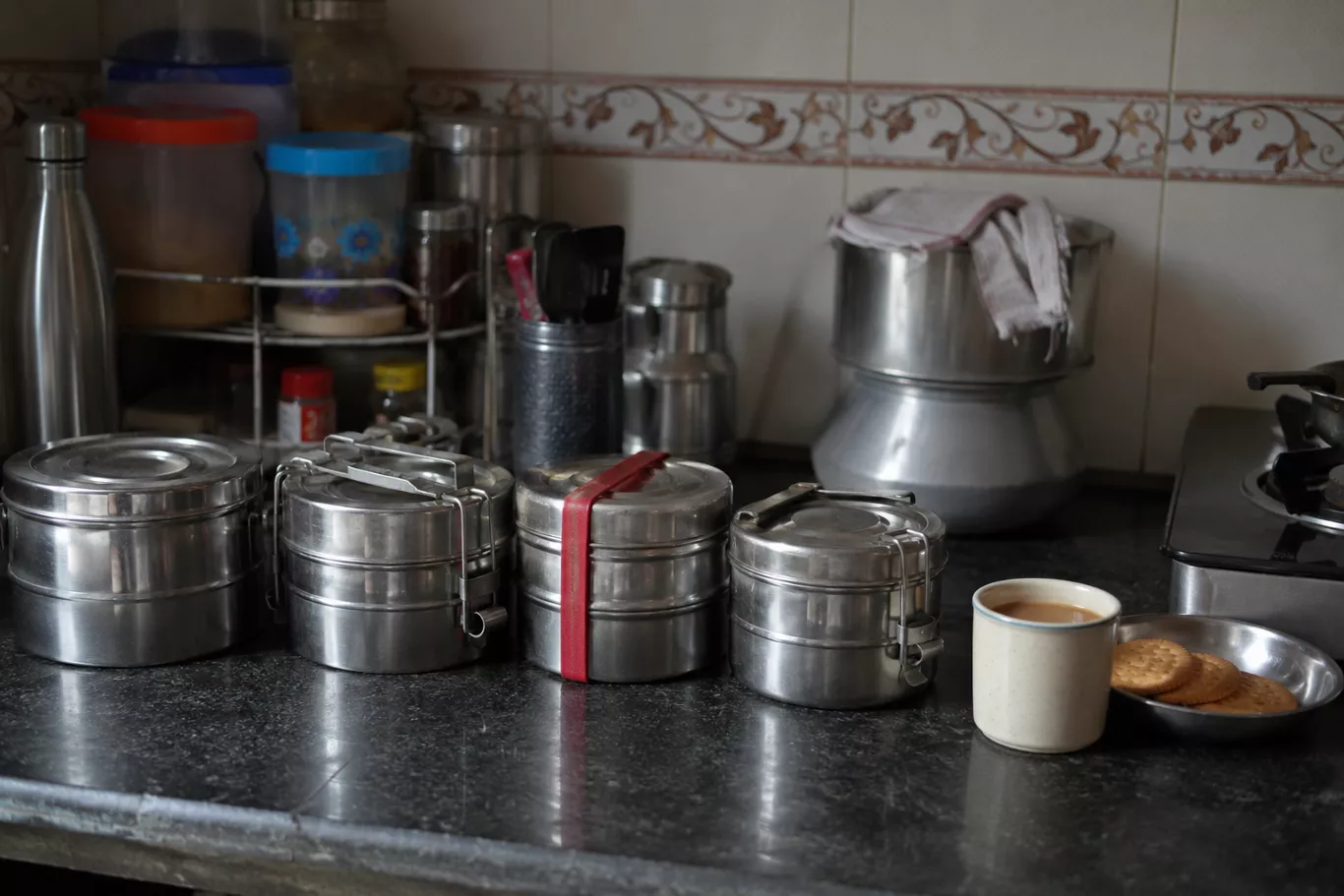
There were five steel tiffin boxes on our kitchen counter when I walked in.
This is not unusual in my parents' house. At any given time, the kitchen contains at least three containers that do not belong to us and two that do belong to us but have been living in someone else's house long enough to qualify for local residency.
I picked one up and asked whose it was.
My mother looked at it for half a second.
"Mrs. Batra's," she said.
I opened it. Empty.
"How do you know?"
She pointed with the knife she was using to cut cucumber. "That small dent near the side. Also she uses the red rubber band. And she never sends the second lid."
I looked at the tiffin again. There was, in fact, a small dent near the side. There was a red rubber band. There was no second lid. I had not noticed any of these things because I am a normal person with ordinary powers of observation.
My mother had already moved on.
We were at the kitchen counter, chai cooling on the table and Mom's Magic biscuits open because I had opened them and then forgotten to close the packet. She picked up another tiffin, gave it one quick turn, and said, "This is Mehta aunty's. Return it tomorrow. Not today. Today she has her music class."
The tiffin had a schedule.
**The Tiffin Circuit**
Every Indian neighbourhood has a hidden transport system.
Food goes from one house to another in steel boxes. Sabzi goes up. Kheer comes down. Chole moves across the landing. Idli arrives from the third floor. Someone made too much dhokla. Someone's daughter came from Pune. Someone had a puja. Someone's maid did not come and lunch became a shared responsibility of the building.
The food is eaten. The box is washed. The box is returned.
In theory.
In practice, the tiffin box enters a complicated diplomatic channel that involves memory, timing, emotional debt, and whether the correct lid can be located.
My mother understands this system. I do not.
To me, a tiffin box is a tiffin box. It is steel. It has compartments. It either contains food or has completed its purpose.
To my mother, each box has a biography.
This one belongs to the woman who always sends too much oil in the aloo. This one belongs to the family downstairs who are very nice but never dry the lid properly. This one is ours, but it has been with the Guptas since Holi and must be retrieved without making it seem like a retrieval. This one is not ours, not theirs, and has entered the house through a chain of events nobody fully remembers.
**There Is a Correct Way to Return a Box**
I learned this the hard way.
Three years ago, I returned an empty box.
I thought this was correct. The box had come with food. We ate the food. I washed the box. I returned the box.
My mother looked at me like I had walked into a wedding wearing cycling shorts.
"Empty?" she said.
I said yes.
She said, "You returned it empty?"
I said it was not our box.
She said that was not the point.
There is apparently a rule. A box that comes with food should not go back empty unless the relationship is very close, very casual, or already beyond formal accounting. A return box should ideally contain something. Not a full dish necessarily. A few pieces of something. Fruit. Mathri. Something made that day. Something that says: received, appreciated, returned with respect.
Nobody told me this.
My mother said everyone knows this.
Everyone did not know this. I was living proof.
My friend Nikhil made the same mistake with his neighbour in Pune. His neighbour sent poha when his parents were visiting. He returned the empty box the next morning, clean and dry, feeling very proud of himself. His mother found out on a video call and went silent for three full seconds.
Then she said, "Call them and say I told you not to return it like that."
Nikhil said this would make things worse.
His mother said things were already worse.
**The Box Remembers the Relationship**
The more I watched my mother, the more I realised that the tiffin system is not about food.
The food is one part of it. The larger part is attention. Who sends what. Who sends when. Who remembers who likes less chilli. Who sends extra because they know your son is visiting. Who sends the good sweet during festival season and the average sweet when there is no occasion.
The box carries all that.
My mother can read the weight of a container and know if the sender has packed generously or symbolically. She can read the food and know if it was made specially or sent from what was already made. She can read the timing and know if the gesture is casual or pointed.
This sounds excessive until you remember that families have survived on this kind of intelligence for generations.
My friend Meera's mother once sent rasam to a neighbour whose husband had come back from the hospital. No announcement. No long message. Just rasam in a small steel box, not too spicy, with rice in another container and strict instructions that the containers did not need to be returned soon.
Meera asked how her mother knew they needed food.
Her mother said the neighbour's balcony clothes had not been taken in for two days.
Again, the level of noticing is slightly frightening.
**The Lid Is Always the Problem**
Every tiffin box has an enemy. The enemy is the lid.
The box returns. The lid does not. The lid returns. The box does not. A lid that looks correct is placed on a box it does not belong to and then everyone pretends not to see the mismatch because confronting the mismatch would require opening a case file.
My mother has a whole shelf of unattached lids. She claims she knows what they belong to.
I do not believe her, but I also would not bet against her.
Last month, she held up a lid and said, "This is ours."
I said all steel lids look the same.
She said no, this one has a scratch from when I used it to open something in 2017.
I had no memory of this.
She did.
Karan told me his mother labels boxes with nail polish dots. One red dot for their house, two blue dots for the aunt upstairs, one green dot for boxes that are not to be lent further because they are part of a good set. Karan said it looked excessive until he got married and lost four containers in one month. He now respects the dots.
Respect comes late in life. Usually after you have lost property.
**I Am Not Trusted With Returns Yet**
My mother has begun training me, but slowly.
Yesterday she gave me one box to return upstairs. It had come with lauki kofta. I was instructed to wash it, dry it fully, put two pieces of mango inside, and say, "Mummy said thank you, it was very nice."
I asked if I could say it in my own words.
She said no.
I carried the box upstairs like a junior diplomat with poor instincts.
Mrs. Batra opened the door. I handed it over and delivered the line exactly. She smiled and said to tell my mother she would send the recipe.
I came back and reported this.
My mother nodded. "Good."
Then she asked where the red rubber band was.
I had left it upstairs.
Her face changed.
Not dramatically. Worse. Slightly.
I went back upstairs for the rubber band.
When I returned, she was at the kitchen table, drinking her chai. The Mom's Magic packet was closed properly this time. She had done that while I was gone.
She took the rubber band, looped it twice around Mrs. Batra's box, and put the box near the door.
"Tomorrow," she said. "After music class."


