



Sign in to share
Dhruv Saxena
My mother cannot watch television in silence.
This is not a complaint. It is an observation, made over thirty-one years of watching television in the same house as her, and it is simply true. She sits down, the show begins, and within approximately ninety seconds she is talking to it.
Not to me. To the television. To the characters. To the general situation unfolding on screen. She has opinions about what is happening and she shares them in real time, continuously, without pausing to consider whether anyone has asked.
I used to find this mildly distracting. I now understand that watching television with my mother is a fundamentally different activity from watching television alone. It is collaborative. It is social. It is, once you stop resisting it, considerably more entertaining than watching something by yourself in silence.
The commentary began, as far as I can tell, when I was very young and has not stopped since. It does not vary by genre. It does not vary by the seriousness of the content. She has provided running commentary on everything from daily soaps to news programmes to, once memorably, a documentary about deep sea creatures that she found both fascinating and personally upsetting.
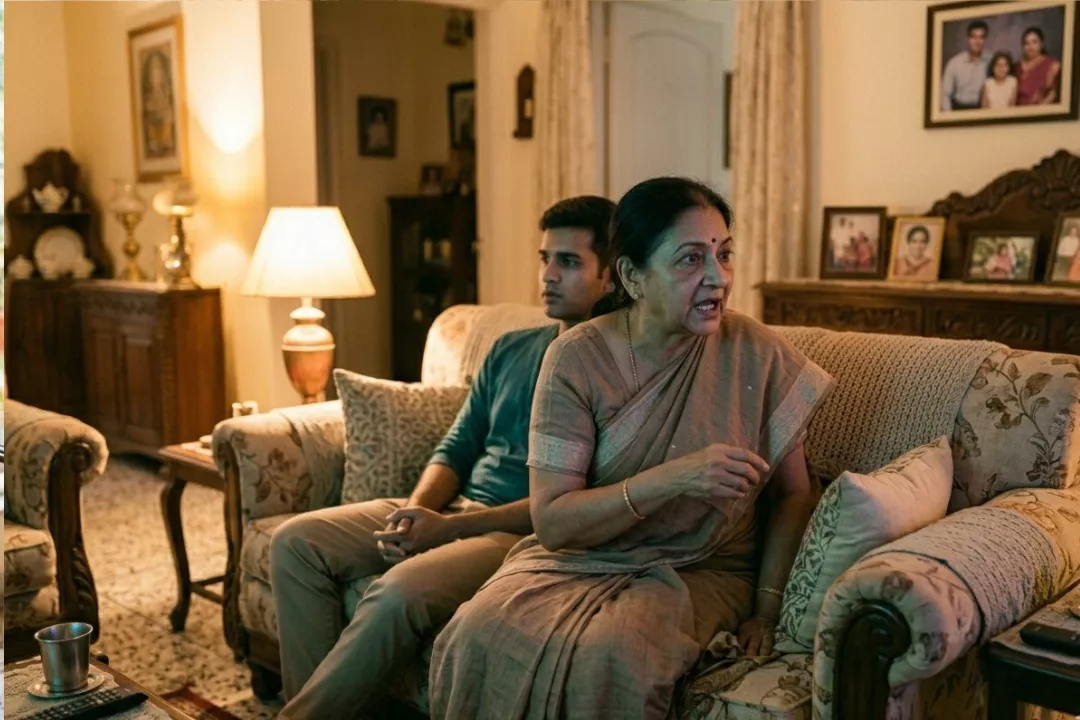
I was home last month. She had put out chai and Mom's Magic biscuits, we had settled in to watch something, and within the first five minutes she had formed and shared opinions about three characters, predicted a plot development that did turn out to be correct, and expressed a personal grievance about the interior design of the fictional house on screen.
The interior design grievance was specific. She felt the curtains were wrong for the space. The show was not about interior design. The curtains were visible for approximately four seconds.
She noticed. She commented. We moved on.
The Character Assessment
The first thing my mother does when a new show begins is assess the characters.
This assessment is rapid and comprehensive. Within the first episode she has determined who is trustworthy, who is going to cause problems, who is not what they appear to be, and who she has already decided she does not like and will not be changing her mind about regardless of subsequent character development.
Her assessments are also frequently correct, which is the most frustrating thing about them. She will look at a character who has appeared for thirty seconds and say "this one is trouble" and then, six episodes later, that character will turn out to be exactly the kind of trouble she predicted.
I asked her once how she knew.
She said she could tell from the eyes.
I have been watching for the eye thing ever since. I cannot identify it. She clearly can.
The characters she dislikes receive a running commentary that is equal parts critical and personal. She does not dislike them abstractly. She dislikes them specifically, the way you dislike someone you actually know. When they do something wrong she says "see, I told you" with the satisfaction of someone who has been vindicated. When they get their comeuppance she says good, quietly, and takes a biscuit.
The Prediction System
My mother predicts plot developments approximately fifteen minutes before they happen and announces these predictions out loud.
The predictions are delivered not as speculation but as statements of fact. She does not say "I think maybe." She says "now watch, this is what's going to happen." And then it happens. And she says "yes, see." And I say yes, I see, you told me this would happen fifteen minutes ago while I was still hoping to be surprised.
She has ruined the endings of several shows for me by correctly predicting them before they occurred. She does not consider this ruining. She considers it sharing relevant information.
My friend Karan has the same experience with his mother. He told me he has started watching things alone first, forming his own opinions, and then rewatching with his mother to see what she catches that he missed. He says she always catches something. A look between characters that he missed, a detail in the background, something in the dialogue that he registered but did not flag as significant.
He says watching with his mother is like watching with subtitles that explain what is actually happening underneath what appears to be happening.
I think this is the most accurate description of the experience I have ever heard.
The Personal Grievance
Beyond the characters and the plot, my mother has opinions about the world the show inhabits.
The house is too big. No family in this city actually lives like this. That kitchen does not make sense, where is the storage. Why is everyone wearing such nice clothes at home, nobody does that. This neighbourhood does not look like that neighbourhood actually looks.
She watches fiction with the eye of someone fact-checking it against her own experience of the world. When things do not match, she notes the discrepancy. She is not wrong to do this. The discrepancies are real. She is just the only one in the room who feels the need to document them in real time.
Her most consistent grievance is food. When characters in shows eat, she has opinions about what they are eating, how it has been prepared, and whether the quantity is realistic for the number of people at the table. She once watched a dinner scene in a drama and said there was not enough dal for six people. She was right. I had not considered the dal situation at all. She had assessed it immediately.
The News Problem
When my mother watches the news, the commentary intensifies.
News is not fiction. News is the real world, and the real world is full of things she has opinions about. Politicians, policies, events, people being interviewed, the way things are being handled, the way things should be handled. She watches the news the way a very engaged citizen watches the news, which is to say with complete attention and continuous commentary and occasional direct address to the people on screen.
She once told a politician on television, clearly and calmly, that he was wrong about something and explained why. The politician continued making his point regardless. She seemed unsurprised but not satisfied.
My father has adapted to this over decades. He watches the news with her and adds his own commentary, which means they are often having a parallel conversation about the news while the news is also happening. It is a three-way discussion between two people and a television and it works, somehow, as its own form of engagement.
I tried to participate in this once. I was home for a week and I watched the news with them and offered my own opinion on something. Both of them looked at me, registered my contribution, and continued their own conversation. I had been a guest commentator, briefly, and had been returned to audience status.
The Best Way to Watch Anything
I want to say something about what the commentary actually does to the experience of watching television.
It makes you pay attention differently. When you know someone next to you is tracking every look, every detail, every consistency error in the dal quantity, you start watching more carefully yourself. You start noticing things you would have let pass. The show becomes more textured.
It also makes you less alone in it. Something dramatic happens and she reacts and you react and there is a shared experience of the thing rather than two people sitting near each other having separate private experiences of the same screen.
I watch a lot of television alone in Bangalore. I notice the silence.
When I am home and she is next to me, predicting the plot and assessing the curtains and noting that there is not enough dal for six people, I am not watching a show.
I am watching a show with my mother, which is a different and considerably better thing.
She is usually right about the curtains, too.


