



Sign in to share
Dhruv Saxena
I bought tomatoes from the wrong man.
That was how the incident began.
I had gone downstairs because my mother needed tomatoes, coriander, and green chillies. This sounded simple. I am thirty-two years old. I have lived alone in Bangalore. I have bought vegetables many times. I believed I was qualified.
The vendor was right outside the gate. He had tomatoes. I bought them.
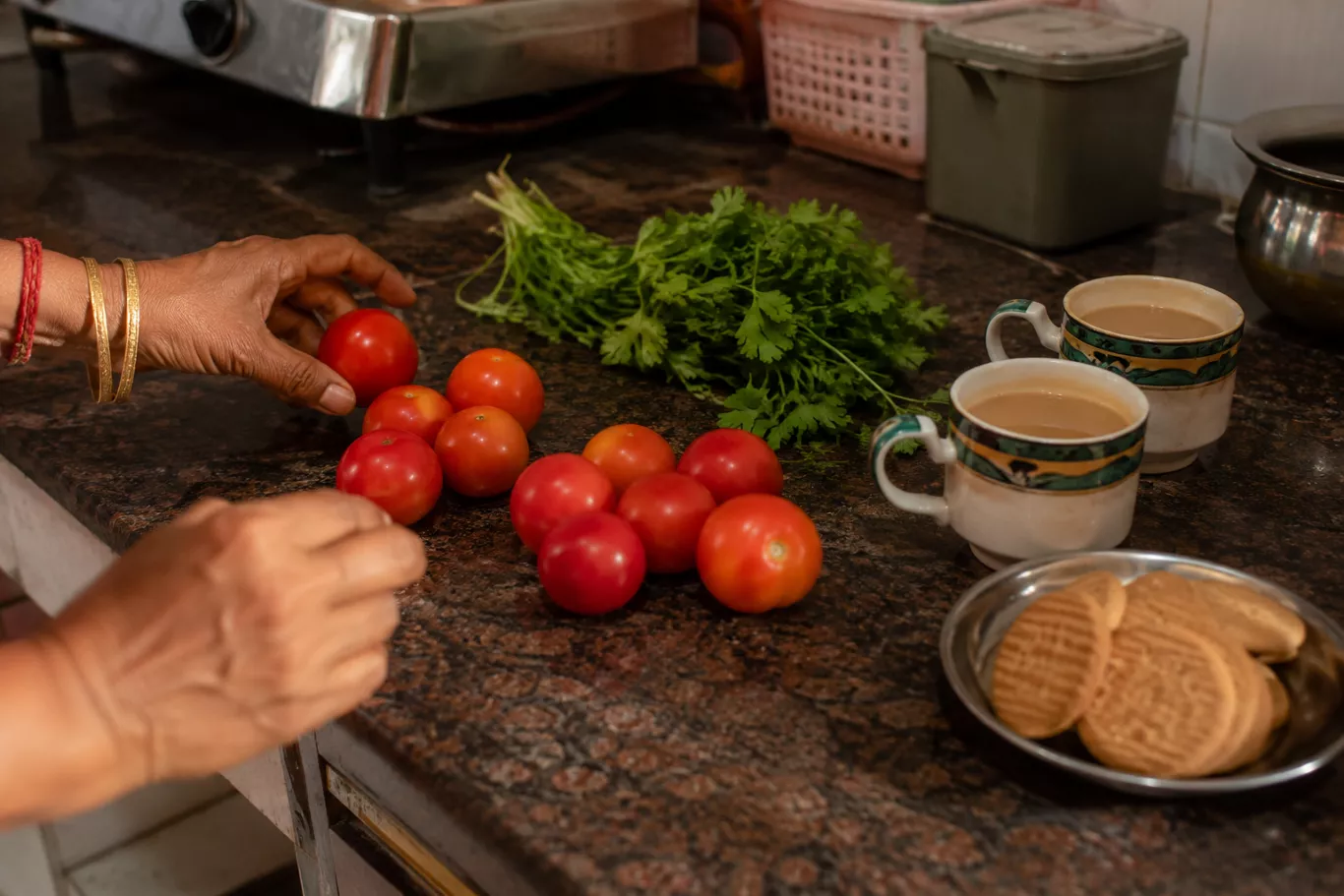
When I came back, my mother was at the kitchen table with chai and Mom's Magic biscuits, sorting methi leaves into two piles with a seriousness I have only seen in surgeons and exam invigilators.
I placed the tomatoes on the table.
She looked at them.
Then she looked at me.
"From where?"
I pointed vaguely downstairs.
"Which one?"
I said the man near the gate.
She closed her eyes for one second.
Not anger. Worse. Disappointment in the vegetable supply chain.
**There Is a Correct Vendor**
His name is Mahendra.
I know this now.
Mahendra does not stand near the gate. He stands near the corner under the neem tree, but not on Tuesdays because on Tuesdays he comes late after going to the wholesale market. He has better tomatoes, but only if you ask from the crate at the back. He gives proper coriander if he knows it is for my mother. He sometimes adds two green chillies without being asked, which my mother pretends not to notice but absolutely notices.
The man near the gate is not Mahendra.
The man near the gate is, according to my mother, "fine for emergencies."
I did not know tomatoes had emergency categories.
My mother picked one up, pressed it once, and said, "Too soft."
It was a tomato. It felt like a tomato.
I said it looked fine.
She said, "For you everything is fine."
This is one of those sentences mothers use that begins with vegetables and ends somewhere near your character.
**The Relationship Is the Point**
I thought she preferred Mahendra because his vegetables were better.
They are, apparently, better. But that is only part of it.
She prefers him because he knows her standards. He knows she will not take brinjal with too many seeds. He knows she does not want coriander that has been sprayed with water until it looks briefly alive. He knows she will ask the price and then ask why the price has behaved like this.
He is ready for her.
She is ready for him.
This is not shopping. This is a long-running negotiation with respect on both sides.
My friend Kabir's mother has a fish seller in Kolkata. Kabir once bought fish from someone else because that person was closer. His mother did not shout. She only said, "Then ask him to cook it also."
Kabir said he understood immediately that a line had been crossed.
Priya's mother has a fruit man who saves guavas for her. The guavas have to be hard, because she does not like soft ones, but not so hard that they taste like furniture. Priya tried to buy guavas from a supermarket once and her mother said, "These have no history."
I have not stopped thinking about that.
Some vegetables have history. Some apparently do not.
**The Wrong Tomato Changes the Meal**
My mother used the tomatoes.
This is important. She did not waste them. She is not that kind of person.
But she adjusted the meal around them with the tired competence of someone managing a situation created by others. The tomatoes were too soft for salad, she said. Too watery for the sabzi she had planned. They would have to go into dal.
I said dal sounded nice.
She said dal was not the plan.
Again, the tomato had become a planning issue.
I watched her work. She cut the tomatoes, removed two parts she found unacceptable, changed the tadka, added less water, and somehow made the dal taste like the tomatoes had not let us down as badly as they had.
This is one of my mother's main skills. She can rescue a bad purchase without forgiving the buyer.
Karan told me his mother once made excellent bhindi from bhindi she had described as "not serious." He said the bhindi tasted good. She said that was because she had intervened early.
Vegetables, in our homes, have career trajectories.
**Mahendra Knows Things**
The next morning, my mother took me to Mahendra.
Not for vegetables. For education.
He was under the neem tree with crates arranged around him. He greeted my mother by name. He looked at me and said, "Bangalore?"
I asked how he knew.
My mother said she had told him.
Of course she had.
Mahendra asked how long I was staying. My mother answered before I did. He asked if I wanted good mangoes for taking back. My mother said I was flying and would not carry properly. He agreed with her. I stood there, a grown man, being assessed for mango transport by committee.
Then the tomatoes came out.
My mother did not pick from the front. She pointed to the crate behind him. He took it out without argument. The tomatoes were firmer, redder, less dramatic. She picked six, rejected two, added one back after he said it would be good by evening.
This was not a transaction. This was choreography.
I asked him if people really bought from the gate vendor.
He smiled and said, "New people."
My mother did not look at me.
She did not have to.
**I Have Been Assigned a Vendor**
Before I returned to Bangalore, my mother gave me instructions.
Find one vegetable vendor. Not the app. Not the supermarket. A person. Go often enough that he recognises you. Learn which day the good stock comes. Do not buy tomatoes from the front if the back crate is better. Do not be shy about asking for coriander. And if someone gives you old beans, do not go back quietly the next week as if nothing happened.
I said Bangalore is different.
She said vegetables are not different.
This is both untrue and impossible to argue with.
I have started trying.
There is a vendor near my apartment now. His name is Salim. I know this because I asked, which my mother would consider the first step toward civilisation. He gives me decent onions. I am still learning tomatoes. Last week he added two chillies without charging. I felt disproportionately proud.
I told my mother.
She said, "Good. Now check if he cheats in coriander."
The training continues.
I have also learned that coriander is never only coriander. It is a signal. If the vendor gives it with enthusiasm, he respects the relationship. If he gives two tired stems and looks away, he is testing you. If he says coriander is finished while a bunch is visible behind him, the relationship has entered a difficult phase.
I repeated this to my mother and she said, "Now you are understanding."
When I left home this time, she packed the tomatoes she had bought from Mahendra into a small cloth bag for me to take to the airport, then decided against it because they would get crushed, then kept them back and said she would make something in the evening.
We were at the kitchen table again. Chai between us. Mom's Magic biscuits on the plate. The wrong tomatoes had become dal. The right tomatoes were waiting.
She picked one up, pressed it lightly, and said, "See this?"
I said yes.
I did not see it.
But I am learning where to look.


