



Sign in to share
Dhruv Saxena
The courier rang the bell at 4:17 in the afternoon, and my mother said, from the kitchen, "That will be Suresh."
Not the courier. Suresh.
I was sitting at the kitchen table with chai and Mom's Magic biscuits on the plate, doing the extremely difficult work of being home for two days and behaving like I had returned from a posting at the border. My mother was cutting coriander. She did not look up when the bell rang. She did not ask who it was. She said Suresh had come early today.
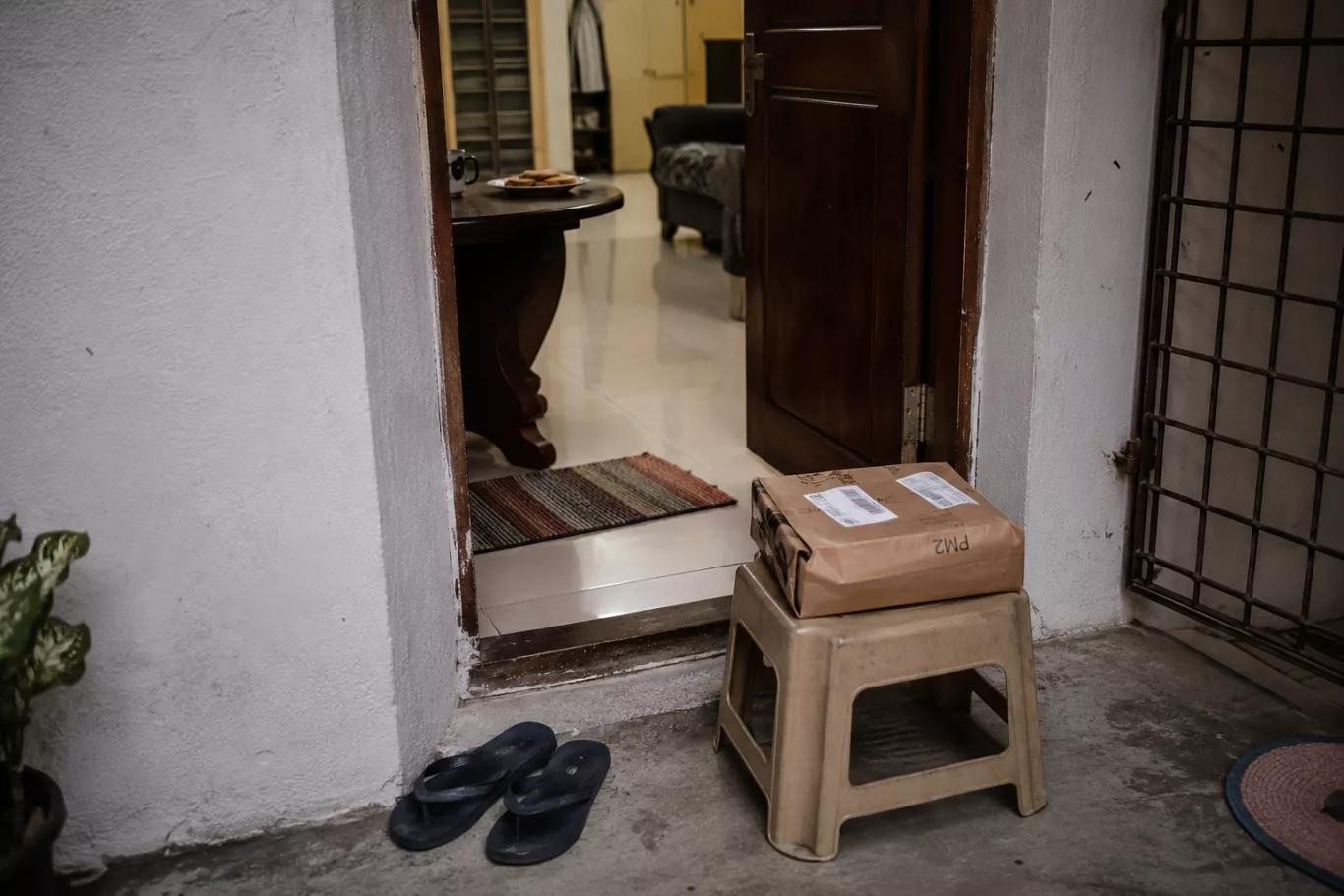
I opened the door.
It was Suresh.
He was holding a parcel for my father, one packet for the woman upstairs, and a small white envelope that he said had been left with him by the dry cleaner because he was coming this side anyway. He said all of this with the calm of a man who had been absorbed into the operating system of our building.
My mother came to the door and asked him if his daughter's school admission had gone through.
I stood there holding the parcel and briefly lost my place in my own house.
**The Neighbourhood Has Staff I Do Not Know About**
This is what I have learned. My mother has relationships with people I have spent years treating as functions.
The milkman is not the milkman. He is Ramesh, whose younger son wants to do hotel management and whose elder son has a scooter that my mother does not approve of because he rides too fast near the park.
The newspaper man is not the newspaper man. He is Imran, who used to come at 6:20, now comes at 6:35, and has apparently been warned twice that this is not a society where people are loose about newspapers.
The vegetable vendor is not the vegetable vendor. He is Mahendra, and there is a whole issue with his brother that I am not across because I live in Bangalore and nobody briefs me on policy changes.
I asked her when she had learned all this.
She looked confused. "They come every day," she said.
As if that explained it. As if every person who came every day naturally became a person whose family structure, medical worries, children's marks, and delivery timing one would know.
I do not know the name of the person who delivers groceries to my flat in Bangalore. I have seen him at least twenty times. I know his helmet colour. That is the extent of the relationship.
My mother would consider this a personal failure.
**The Five-Minute Conversation**
The thing about these interactions is that they do not look like anything from the outside.
Suresh comes to the door. My mother takes the parcel. She asks one question. He answers. She says one more thing. He laughs. The door closes.
Five minutes, sometimes less.
But repeated over months, those five minutes become a ledger of human information. Who had fever. Whose daughter got admission. Whose wife went to her mother's house. Who is planning to leave the delivery job after Diwali. Who has stopped coming because he moved to another route. Who has become thin in a way that requires comment.
My friend Karan told me his mother has this with the man who comes to repair the water filter. The man comes twice a year. Twice. And still his mother knows that his younger brother failed his driving test once and then passed the second time because the inspector was better.
Karan asked how she knew this.
His mother said, "He told me."
Karan said, "Why would he tell you?"
His mother said, "Because I asked."
This is the part we miss. They ask.
Not in a dramatic way. Not like an interview. They ask because a person is standing there and the person has a life and asking one question about that life seems to them like the minimum requirement for being properly alive in a place.
**My Mother's Intelligence Is Local**
I used to think my mother did not know much about the outside world.
This is one of those things you think in your twenties because your idea of the outside world is very narrow and usually involves news, apps, industries, and whatever your friends are arguing about that week.
My mother knows the outside world. She just knows the version that arrives at the door.
She knows when the building is having water trouble because the cleaning woman mentioned the third floor had complained before the notice went up.
She knows which family is travelling because the driver came to collect the big suitcase.
She knows which shop has started charging extra because the boy from the pharmacy said business was slow and then immediately overcharged her for cotton.
She knows which watchman is honest, which watchman is sleepy, which watchman needs a sweater in December and will not ask for one.
This is not gossip. Gossip is what happens when information is used for entertainment. My mother's information is functional. It helps her understand the place she lives in. It helps her notice when something has shifted. It helps her know who needs help and who is trying to take advantage and who is having a difficult week and pretending not to.
Priya's mother once sent food down to the ironing man because she noticed he had not had lunch.
Priya asked how she knew.
Her mother said his hand was shaking when he took the hangers.
Priya said she had been standing right there and had noticed nothing.
Her mother said, "You were on your phone."
Priya had no defence. None was available.
**The Door Is a Social Place**
I have always treated the front door as a checkpoint.
Parcel comes. Door opens. Parcel enters. Door closes.
For my mother, the door is a small public square. People arrive there carrying more than the thing they came to deliver. A packet, a bill, a bag of vegetables, a stack of ironed shirts. Also a mood. Also a story. Also some piece of news that may or may not be relevant but is still part of the day.
She reads all of it.
The other day, the paper man came late. I was there. I heard the cycle stop downstairs and the soft thud of the newspaper at the door. My mother opened the door before I had even registered the sound properly.
He looked tired.
That is what she said later. Not late. Tired.
She asked if everything was all right. His mother had been unwell. He had gone to the hospital in the morning and then done his route. My mother listened, told him which doctor in the area was decent, and gave him the number of the clinic where my father had once gone for a blood test and been treated with unusual politeness.
Then she came back to the table and picked up her chai.
I asked if she knew everyone in the neighbourhood.
She said no, in a tone that suggested the question was excessive.
Then she listed seven people she did not know properly yet.
Properly yet.
**I Am Learning the Names**
I am trying now.
Not with the full range of my mother's competence. That would require years of training and a much better memory for other people's children's academic decisions.
But I am trying in small ways.
I know the name of the person who delivers groceries to my flat now. It is Faizan. He is from Bihar. He has been in Bangalore for four years. He likes the morning shift because traffic is less irritating then. I know this because one day I asked him if the rain was making deliveries difficult and then, to my own surprise, did not immediately close the door after he answered.
It took ninety seconds.
My mother would still say I have a long way to go.
She would be right.
Yesterday, Suresh came again. Another parcel. This one was mine. I opened the door and said hello using his name. He looked slightly surprised, then pleased. My mother was behind me, pretending not to listen, which is one of her least convincing performances.
After he left, she sat down at the kitchen table, moved the plate of Mom's Magic closer to me, and said, "Good. Now ask about the admission next time."
I said I would.
She nodded like a manager approving a trainee after a first adequate day.
Then she took the last biscuit from the plate before I could reach it.


