



Sign in to share
Dhruv Saxena
My mother told me not to take that job.
I took the job.
She had reservations she expressed clearly, in order, with supporting evidence. The company was too new. The role was unclear. The salary bump wasn't worth the instability. She'd heard mixed things about the founder from someone who knew someone. She thought I was making the decision with my ego rather than my head.
I told her she didn't understand the industry. I told her this was a good opportunity. I told her, with the specific confidence of a twenty-seven year old who has recently decided he knows more than his parents, that she was being unnecessarily cautious and I had thought about this carefully.
I had not thought about it carefully. I had thought about it for about a week, which is not the same thing.
Fourteen months later I left that job. The company was, in fact, too new. The role was, in fact, unclear. Several of her other concerns had also manifested with impressive accuracy. I did not call her and say you were right. I did not say anything about it at all.
She did not bring it up. Not once. She asked how I was doing in the new job, expressed genuine interest in how things were going, and never once said anything that could be interpreted as I told you so.
This is, I have come to understand, its own form of restraint that deserves significant respect.
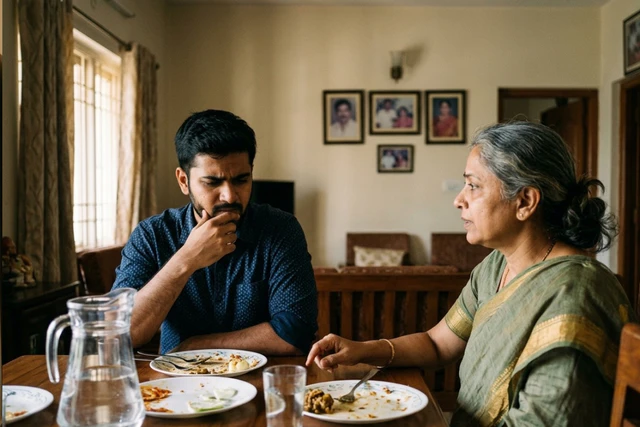
I was home shortly after starting the next job. She'd put out Mom's Magic biscuits with the afternoon chai, the way she does, and she asked how things were going. I said better. She nodded. The previous job was not discussed. The original advice was not referenced. She had been completely right and she let it go without ceremony.
I have thought about that a lot.
The Advice We Don't Take
My friend Nikhil's mother told him not to sign the lease on his first flat in Mumbai.
She had looked at the photos he'd sent. She'd asked questions about the building, the landlord, the neighbourhood. She said the rent seemed high for what it was. She said the building looked like it had water issues. She said he should look at a few more before deciding.
He signed the lease. He was excited. It was his first flat and he wanted it to be that flat.
The building had water issues. The landlord was difficult. After eight months he moved out.
His mother, when he told her he was moving, said "okay, let me know if you need help finding something." That was the full extent of her response. No reference to the original conversation. No I said so. Just, okay, what do you need.
He told me this with the expression of someone who has realised, possibly too late, that he has been consistently underestimating a very perceptive person.
The Pattern
My mother has been right about an uncomfortable number of things.
She was right about the job. She was right about a person I dated briefly in my late twenties, about whom she said very little but what she said was accurate. She was right about a financial decision I made that I was certain she couldn't fully understand. She was right about a friendship that I defended to her and which subsequently dissolved in exactly the way she'd implied it might.
She did not tell me she was right about any of these things. I had to figure that out myself, retrospectively, going through the evidence.
My friend Priya has a similar inventory. Her mother was right about the apartment, the job switch, the relationship she stayed in two years too long. All of it advised against, none of it listened to, all of it subsequently confirmed.
Priya asked her mother once how she knew. Her mother said she didn't always know. She just had a feeling and she said it and then left it with Priya to decide.
That last part is important. She said it and left it. She didn't repeat it. She didn't campaign. She gave her perspective once, clearly, and then respected Priya's right to be wrong.
The Intelligence We Dismiss
I've been thinking about why we don't listen.
Part of it is age. When you're twenty-seven and feeling capable and independent, advice from your mother feels like an implication that you're not capable and independent. You're not hearing the advice. You're hearing a challenge to your competence.
Part of it is that her intelligence doesn't look like the intelligence we've learned to respect. She doesn't cite sources. She doesn't have a framework. She says things like "I just feel like" and "something about it doesn't seem right" and "I've seen this kind of thing before." None of that sounds rigorous. It is, in fact, often more rigorous than the analysis we do ourselves.
My friend Karan figured this out after his mother was right about something significant. He went back and thought about what she'd actually said and how she'd said it. She'd been watching people and patterns for sixty years. She'd seen enough situations to recognise shapes. When she said something felt off, it was because something felt off to a person who had accumulated sixty years of data on how things tend to go.
He was twenty-nine with three years of adult data. She was sixty with sixty years of it.
The math was never in his favour.
What I Do Differently Now
I still don't take every piece of advice my mother gives me. That would be both impractical and slightly strange.
But I listen differently now. When she says something feels off, I ask her what specifically. I give the concern a proper hearing instead of filing it under unnecessary caution. I have found, consistently, that there's usually something real behind it even when her framing is imprecise.
She told me last year that she thought a particular decision I was considering needed more time. I took more time. The thing she was worried about surfaced during that time and I was able to address it before it became a problem.
I did not call her and say you were right. Old habits.
But I thought it. And I'll probably think it again the next time she says something I'm tempted to dismiss.
She's been right too many times now for dismissal to be a reasonable default.


