



Sign in to share
Dhruv Saxena
My mother has never said I love you to me.
Not once. Not at a wedding, not at a graduation, not at the airport, not in a moment of sentiment, not in any of the contexts where the phrase arrives naturally in other families. The phrase simply does not exist in her vocabulary directed at me. I am thirty-one years old and I have never heard those three words from her in that order.
This used to seem like a fact about absence. I have come to understand it as a fact about translation.
She says it in other languages. Every day, multiple times, in the specific vocabulary she has developed over thirty-one years for expressing something that the three words would make smaller if she tried to fit it into them.
She says it when she calls at 7am to check if I have eaten breakfast. I have eaten breakfast. She knows I have eaten breakfast. The call is not about the breakfast.
She says it when she packs an extra container of dal that she knows I will eat alone on a Tuesday in Bangalore when I have not planned dinner and the fridge has nothing useful. The dal is not about the dal.
She says it when she asks about my friend Nikhil, whom she has never met, in enough detail that it is clear she has been paying attention to every mention of him across the years and has been tracking his situation with the same care she tracks mine.
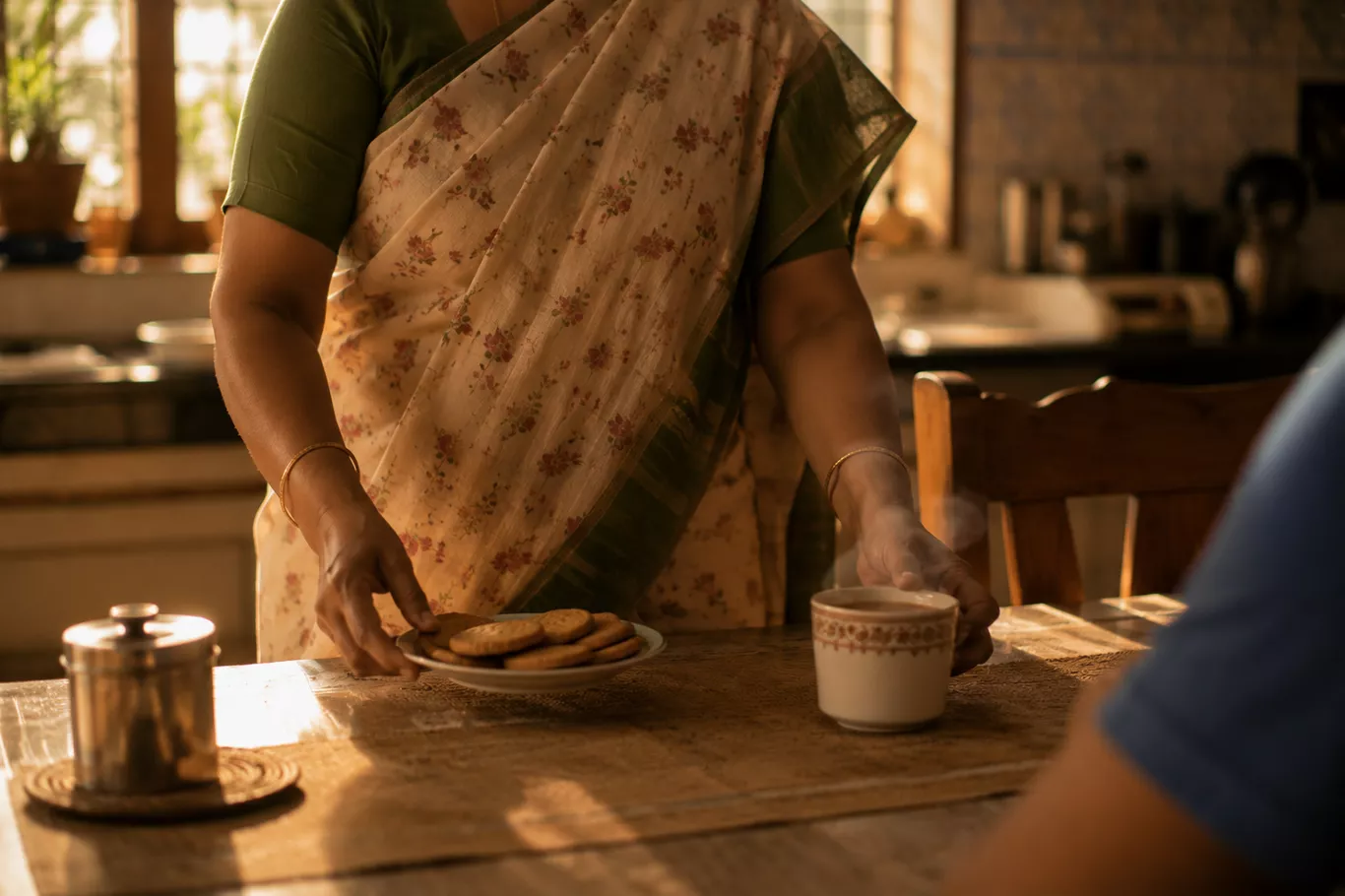
She says it when she puts the good biscuits out. The Mom's Magic biscuits that are always there at the kitchen table when I come home. Not because we are having guests. Because I am home. That is the occasion.
I was home last month. I sat at the kitchen table and she put the chai down and the biscuits out and sat across from me and asked about my week. Just asked, in the way she asks, with the full quality of her attention on the answer. I talked for twenty minutes. She listened. She asked the one question that went to the centre of the thing.
She has never said I love you. That conversation was I love you from start to finish.
The Vocabulary
I have been cataloguing the vocabulary for years. Not formally. Just noticing, the way you notice something that is everywhere once you start looking.
The early morning call when she knows I have an important day. She does not say I am thinking about you. She calls and asks a logistical question and the logistical question is the thinking about you.
The specific food made when I visit. Not the regular food. The one I mentioned once, in passing, eighteen months ago, that I had been craving. She remembered. She made it. The making is the remembering is the love.
The way she notices when something is slightly wrong in my voice on a call and asks one more question before we hang up. She does not say I can hear that something is off. She asks the question. The question is her saying I am paying attention.
My friend Nikhil's mother is the same. She has never said I love you to him in the direct English form. She has said it in Punjabi in the specific indirect way that is used in his family, which is also not quite the three words but something adjacent. Mostly she says it in food and calls and in the way she talks about him to other people, which is with a pride that is not performance.
He said he realised this late, in his late twenties, and it reframed everything. All the things he had received his whole life that he had filed under mother being mother suddenly had a label. He had been loved in this vocabulary his whole life. He had only just learned to read it.
Why the Words Don't Come
I have thought about why the words don't come and I think it is this.
The words exist in a register that her generation learned to distrust. Not the feeling. The performance of the feeling. The explicit verbal statement of love had, in the world she grew up in, a slightly theatrical quality. Love was not something you announced. It was something you demonstrated. Demonstrating was the real thing. Announcing was the lesser version.
She loves me in the mode that her mother loved her, which was the mode that was available and that was real and that worked. The mode does not include the three words. It includes everything else.
My friend Karan had a conversation with his mother once that I think about often. He asked her directly, as an adult, whether she loved him. She looked at him for a long moment and then said what kind of question is that. He said he just wanted to hear her say it. She said she had been saying it his whole life. He said not in those words. She said those words were not necessary. He said they were, to him, sometimes necessary. She was quiet for a while. Then she said of course she loved him and it came out stilted and slightly uncomfortable and they both laughed.
He said the laugh was the most honest moment of the conversation.
What I Have Decided
I have decided that the three words are not the definition of the thing.
The three words are a delivery mechanism. One delivery mechanism. There are others. My mother has been using the others for thirty-one years with a consistency and a specificity that the three words could not match.
The 7am call. The extra container of dal. The biscuits on the table. The question that goes to the centre. The remembered craving made into a meal.
I know what these things are. I have known for a long time, without always having the words for knowing.
She has never said I love you.
She said it this morning when she called to check if I had eaten.
I had eaten. She knew I had eaten.
That is not what the call was about.


