



Sign in to share
Dhruv Saxena
My mother has never rung the doorbell of her own house.
I noticed this properly last month, although she has been doing it my entire life. She had gone downstairs to give something to the watchman and came back five minutes later. I was inside, sitting at the kitchen table with chai and Mom's Magic biscuits, pretending to answer work messages and actually reading a long argument in a cricket group chat.
The doorbell did not ring.
Instead, from outside the door, I heard, "Dhruv."
Not loud. Not dramatic. Just my name, delivered through the wooden door with the full confidence of someone who did not need a mechanical device to announce herself in a house she had run for thirty years.
I opened the door.
She was standing there with the empty steel bowl she had taken downstairs and an expression that suggested I had taken slightly longer than a son should take to open a door for his own mother.
I asked why she did not ring the bell.
She said, "For what?"
I had no answer that survived the tone.
**The Bell Is for Other People**
This is the rule, apparently.
The bell is for couriers, neighbours, guests, the electrician, people who have come to sell water purifiers, and relatives who are close enough to arrive without warning but not close enough to shout from the staircase.
My mother is not in any of these categories.
She belongs to the house. The house belongs to her. The door is a formality.
She has a whole range of non-bell arrivals. If she is coming from downstairs, she calls my name from the corridor. If she is coming from the balcony side after talking to the neighbour, she taps once on the metal grill. If she has her hands full, she knocks with her elbow and says, "Open." If my father is inside, she says his name in a tone that contains both instruction and mild disappointment in advance.
The bell remains untouched.
My friend Karan said his mother does the same thing in Lucknow. She comes back from the terrace and does not knock. She says, "Arre," through the door, and the family knows this means someone should open immediately.
I asked what happens if nobody hears.
He said she says it again, but with history in it.
That made sense to me.
**The House Knows Her Sound**
There is a sound to each person's arrival.
My father uses the key in a very particular way. Too many jingles, one unnecessary throat clear, then the door opening with the caution of someone who knows he may be asked why he is late even if nobody asked him to come early.
My sister rings the bell once and then immediately calls because patience has never been her strongest subject.
I ring the bell like a visitor, which my mother dislikes. She says I should use my key. I say I do not know where the key is. She says that is also a problem.
My mother arrives as a voice.
The voice is enough.
When I was younger, this used to happen in the afternoon. She would come back from the market, stand outside, and say my name. I would run to open the door because she usually had bags and because the second call had consequences.
I did not think of it as a ritual then. It was just the sound of her coming home.
Priya told me her mother announces herself from the ground floor before climbing the stairs. Their building has three floors. Her mother will call out from below, "Priya, open," and then begin climbing, fully trusting that by the time she reaches the door, someone will be there.
Priya said this system works about seventy percent of the time.
The other thirty percent becomes a lecture on how phones have made people deaf.
**It Is Not About Convenience**
I thought it was convenience at first. Maybe she did not want to press the bell with wet hands. Maybe she was carrying something. Maybe the bell was too loud.
No.
It is about belonging.
Guests ring. Strangers ring. People who need permission ring.
My mother does not ask permission from her own front door.
There is something very funny and very moving about this, although I would not say that to her because she would ask why I was making a speech about the doorbell.
The house has accepted her voice as a valid key.
My friend Meera's mother has a similar relationship with the back door of their house in Jaipur. She comes in through it after watering plants, after talking to the neighbour, after checking if the milk packet has come. Nobody else uses that door. It is not locked when she is outside. It is her route.
Meera said once a cousin tried to use that door and everyone in the house found it strange.
Some entrances belong to people.
**The Day I Tried It**
I tried not ringing the bell once.
This was a mistake.
I came home from the chemist, stood outside the door, and said, "Maa."
Nothing.
I said it again.
Nothing.
I knocked.
Still nothing.
Then I rang the bell.
My mother opened the door and said, "Why are you standing outside?"
I said I had called.
She said, "You should have rung."
I said she never rings.
She said, "This is my house."
Again, no answer survived.
That is the thing with rules in Indian homes. They are not meant to be universal. They are meant to reflect status, history, labour, and who has spent the last three decades knowing where the spare batteries are.
My mother has earned the right to not ring.
I have not.
Nikhil said he tried the same thing once and his mother told him not to act like a hero at the door. I like that line. It applies widely.
**I Open Faster Now**
These days, when I am home and I hear my name from outside, I open faster.
Not because she cannot open the door. She has keys. She usually has keys in three places, none of which she will reveal because she thinks we are careless with security. She can open the door. That is not the point.
The point is that she has come back and called me.
There is a small pleasure in being the person who opens.
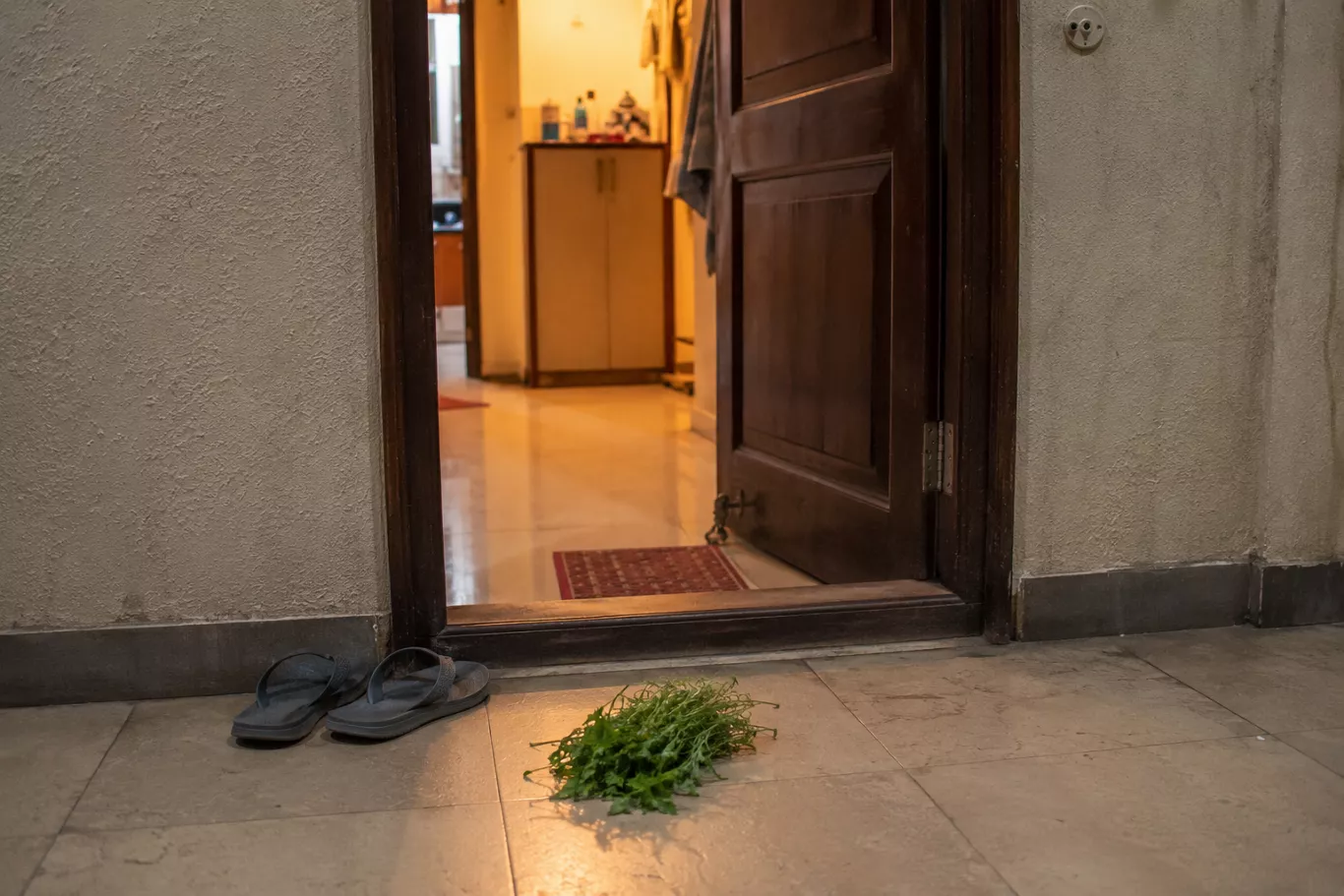
Last week she came back from downstairs with two coriander bunches she had not planned to buy and one packet of safety pins she said were "good quality," a phrase I have learned not to challenge. She called my name. I opened the door immediately.
She looked surprised.
"You were near the door?"
I said no.
She came in, placed the coriander on the counter, and picked up her chai from the table. It had gone cold. She drank it anyway. I pushed the Mom's Magic plate toward her.
She took one, stood near the doorway for a second, and said the watchman's son had got a job.
Then she shut the door.
Not fully at first. She opened it again, checked the latch, and shut it properly.
Some rituals are flexible.
Some are not.


