



Sign in to share
Dhruv Saxena
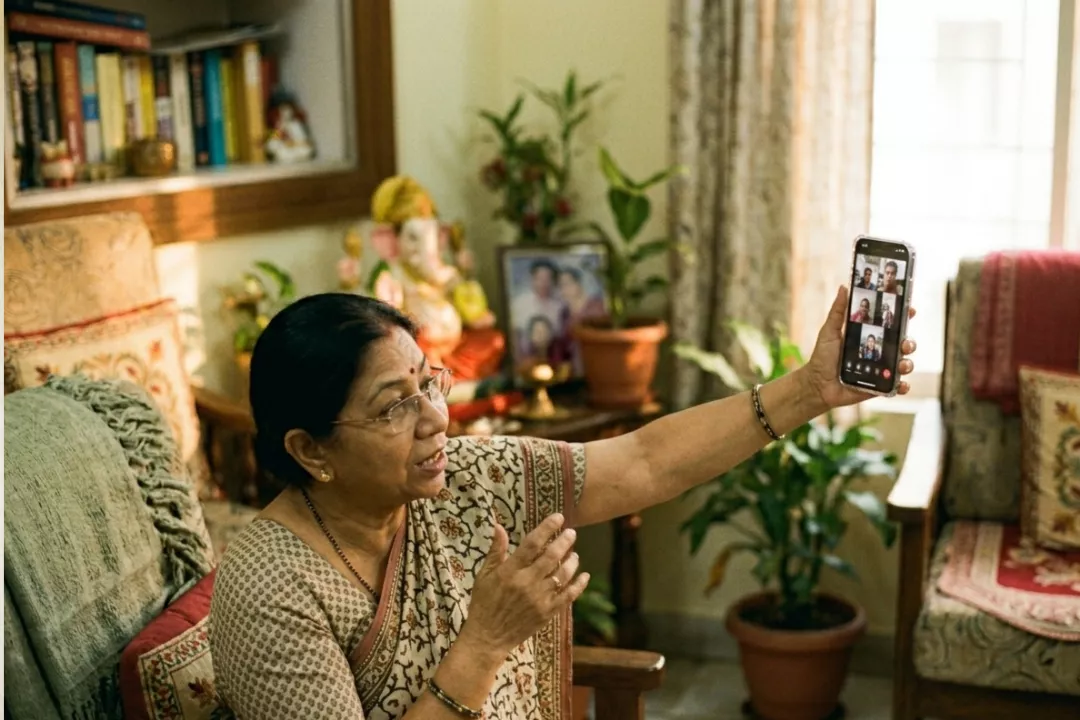
My mother learned to video call in 2020.
The timing was not a coincidence. A situation arose in which she could not come to Bangalore and I could not go to Delhi and someone, I believe my sister, showed her how to video call. Within approximately seventy-two hours the video call had replaced the regular call as the primary mode of communication between us.
This was, on balance, a development.
The first video call lasted forty-seven minutes. I know this because I checked after we hung up. In forty-seven minutes she had shown me the living room, the kitchen, the view from the balcony, a new plant my father had bought that she was uncertain about, and the contents of a shelf she had reorganised. I had not asked to see any of these things. She had offered them as natural components of the call.
I said it was nice to see the house.
She said she thought I would want to know what was happening.
I said the shelf looked good.
She said she was not sure about the reorganisation.
We discussed the shelf for six minutes.
This is what the video call introduced into our relationship. The visual dimension. Previously she would tell me things. Now she shows me things. The distinction sounds small. It is not small. The showing means I now have a continuous real-time update on the state of the house, the garden, the kitchen, any room she happens to be standing in when she calls, and anything she encounters during the call that she considers worth pointing the camera at.
I was sitting at my desk in Bangalore last month working on something when she video called. I picked up. She was in the kitchen. We talked for twenty minutes. At some point she walked from the kitchen to the living room and I travelled with her, in a small rectangle on her phone, seeing the transition from kitchen to living room in real time. I had not asked for this. I received it. We were at the kitchen table for the last part of the call, chai out and Mom's Magic biscuits on the plate, and she propped the phone against something so we could both have our hands free and it was, despite being a video call from Bangalore to Delhi, almost like being in the same room.
Almost. The difference between almost and actually is the thing I think about sometimes.
The Camera Situation
My mother's relationship with the camera on a video call is its own study.
The camera is rarely pointed at her face. This is not because she is camera-shy. It is because she is doing things while she talks and the camera goes where she goes and she goes to different parts of the house while talking.
The camera has shown me the ceiling of the bedroom, the floor of the kitchen, the side of a cupboard, my father's feet, the inside of the fridge when she opened it mid-call to check something, a neighbour's car that was parked in a way she found relevant to mention, and once, for an extended period, the inside of her handbag while she was looking for something with the camera still on.
I have spent significant time looking at the ceiling of my childhood home via video call. The ceiling has not changed. I now know this with certainty.
My friend Nikhil's mother sends him video messages when she cannot reach him on a call. The video messages are shot the way her calls look, which is to say the camera is pointed approximately at her and also at various other things as she moves through the explanation. He received one recently that began with her face, transitioned to a detailed shot of something in the kitchen, then went to the window, then came back to her face for the conclusion.
He said the video message had the quality of a documentary shot by someone who was also the subject. He said he watched it three times. He found it very soothing.
The Tour
The tour has become a feature of approximately one in every three video calls.
The tour is not announced. It begins organically. She is on a call and she is in a room and she remembers that something has changed in another room and she walks toward the other room while talking and the tour has begun.
The tour covers whatever has been recently modified, acquired, or noticed. A new thing my father brought home. Something a relative gifted that she is not sure where to put. The plant that is doing well or not doing well. The specific place she has decided to keep a thing that she had previously been keeping somewhere else and the reason for the change.
I know the current configuration of my childhood home better than I know the configuration of my own flat. I have a clearer picture of where things are in Delhi than I do of where things are in Bangalore because the Delhi house comes to me via video call in regular updates and my Bangalore flat simply exists around me without commentary.
My friend Karan's mother gives him a tour of the garden every two weeks. He lives in Hyderabad. The garden is in Jaipur. He has watched every plant in that garden grow across two years of fortnightly tours. He can identify each one. He knows which ones his mother is proud of and which ones are causing her concern. He said it is the only garden he knows as well as he knows his own face.
The Unmuted Background
The video call has introduced something the regular call did not have, which is the unmuted background.
When she calls, the house is present. The sounds of the house, the other conversations happening, my father's television in the other room, something being cooked, a door. These were present on the regular call too but the video call makes them more present. The background is visible as well as audible.
I have watched things happen in the background of video calls that were more interesting than the foreground. A complete domestic incident involving a courier and my father, conducted entirely behind my mother while she was talking to me about something unrelated. She did not know it was happening. I watched the whole thing. I did not mention it until it was resolved.
The video call is a window into the house. The house is always doing several things at once. The window shows all of them.
The Thing It Does
My mother learned to video call because she missed seeing me. The regular call had the voice but not the face and not the house and not the ceiling and not the inside of the fridge.
The video call gave her all of those things and also gave me all of those things and the exchange has been, on balance, worth the forty-seven-minute first call and the ceiling and the six minutes about the shelf.
I see her face now when we talk. She sees mine. We see each other's rooms and plants and reorganised shelves and the neighbours' cars and the inside of the fridge and it is all, in its way, part of the same thing.
She cannot be in Bangalore. She can be on a screen in Bangalore. The screen is not nothing.
The ceiling has not changed. I am glad I know.


