



Sign in to share
Dhruv Saxena
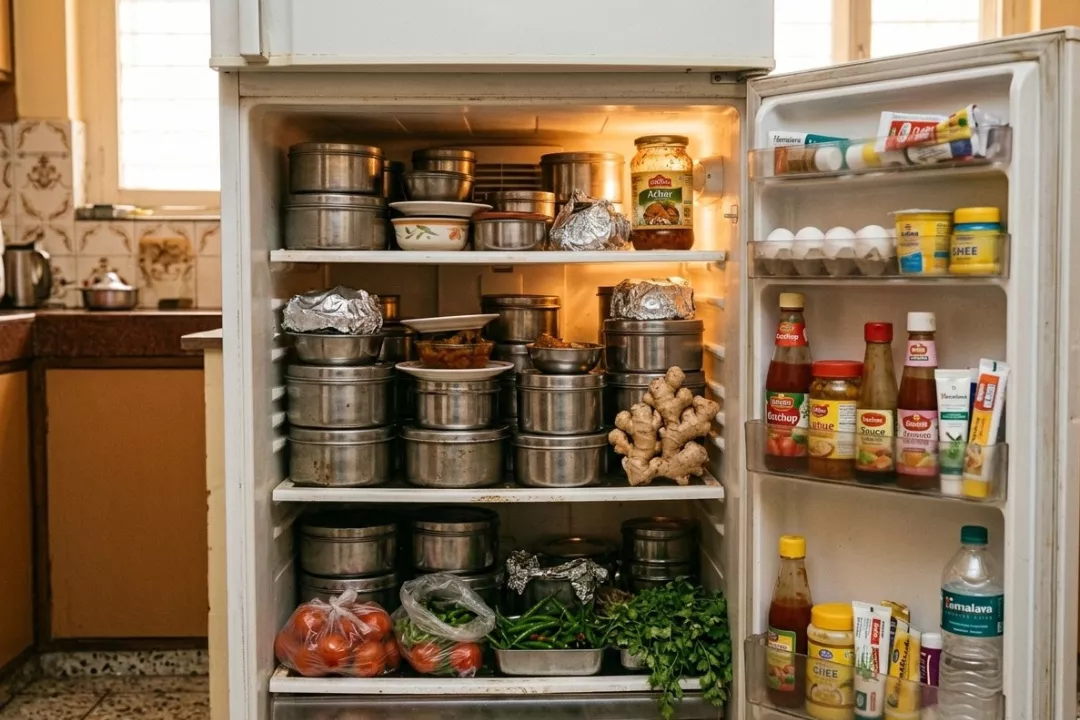
My mother's fridge has a system.
I do not fully understand the system. I have lived with it for twenty-six years and I still cannot predict where something will be. But I know, with complete certainty, that there is a system, that it makes perfect sense to her, and that any attempt on my part to put something in the wrong place will be identified and corrected within the hour.
The fridge is organised by a logic that exists entirely in her head. It is not written down. It does not need to be. She knows where everything is the way she knows where everything is in the medicine drawer, which is to say completely and without effort and in a way that cannot be transferred to anyone else through explanation.
The top shelf is for certain things. The middle shelf is for other things. The door has a specific allocation that I have tried to memorise and failed. The vegetable drawer contains vegetables but also several things that are not vegetables, whose presence there makes sense to her and to nobody else.
I came home last month and opened the fridge to put away some curd I had bought. I put it on the middle shelf. My mother was in the other room. She came into the kitchen seven minutes later, opened the fridge, looked at the curd, and moved it to the top shelf without saying anything.
I asked why.
She said that's where curd goes.
I said it had been perfectly fine on the middle shelf.
She said it goes on the top shelf and put out chai and Mom's Magic biscuits, which is her way of indicating that a conversation has been concluded whether or not the other party agrees. I ate the biscuits. The curd stayed on the top shelf. I have no idea why curd goes on the top shelf. I have accepted that I will never know.
The Container Situation
My mother's fridge contains more containers than food.
This is not an exaggeration. At any given time, approximately sixty percent of the fridge's contents are steel containers of various sizes, each holding something that was made at some point and has not been finished yet and will not be thrown away because it can still become something else.
The containers are stacked with an engineering precision that suggests significant thought has gone into their arrangement. A large container on the bottom, medium containers arranged around it, smaller containers balanced on top. It is a structural achievement. It is also completely opaque, because the containers are steel and you cannot see inside them, which means you have to open each one to find out what's in it, which my mother considers unnecessary because she knows what's in each one.
I do not know what's in each one. I have opened containers expecting dal and found chutney. I have opened containers expecting leftover sabzi and found something I could not identify. I once opened a container that contained half a lemon covered in foil, which had been placed inside a larger container for reasons that were never explained to me.
My friend Karan has the same relationship with his mother's fridge. He told me he has developed a strategy. When he wants to know what's available to eat, he does not open containers. He asks his mother. She gives him a complete inventory of the fridge's contents from memory, including the approximate age of each item and its potential future applications. It is faster and more accurate than investigating independently.
He said it once took him four minutes to find the butter by opening things himself. It would have taken his mother four seconds.
The Leftover Philosophy
Indian mothers do not throw away food. This is a foundational principle, and the fridge is where this principle lives in practice.
My mother's fridge at any given time contains leftovers from at least three different meals, each at a different stage of their lifecycle. Fresh leftovers from last night, which will be served for today's lunch. Medium leftovers from two nights ago, which will be incorporated into something new. And the old leftovers, which have been in the fridge long enough that they have transcended their original identity and become raw material for a future dish that has not yet been decided.
Nothing is waste. Everything is potential.
My mother can look at three containers of unrelated leftovers and see a meal. I look at the same containers and see a logistical problem. She has a gift I do not have and will never have, which is the ability to combine yesterday's dal, some rice from the night before, and a small amount of vegetable from three days ago into something that is not only edible but actually good.
My friend Priya's mother takes this further. She has a specific container designated the combination container. When individual leftovers become too small to be useful on their own, they go into the combination container together. The combination container is never the same twice. It is also, somehow, always fine.
Priya once asked her mother what was in the combination container. Her mother looked at it for a moment and said, "whatever needed to be used." This was both a complete and entirely insufficient answer.
The Things That Live in the Fridge Forever
Every Indian mother's fridge contains certain permanent residents. Items that have been there so long they have stopped being provisional and become structural.
In my mother's fridge, these include: a small steel bowl of something green that I believe is a chutney but have never confirmed, a ginger piece that gets smaller very slowly over many weeks, a container of ghee that technically does not need refrigeration but lives there anyway, and something in a bottle at the back of the bottom shelf that has been there for as long as I can remember and that nobody has ever discussed.
I once asked about the bottle. My mother said it was for cooking. I asked what kind of cooking. She said the kind that requires it. I did not pursue this.
My friend Nikhil's mother has a permanent fridge resident that his entire family refers to as the old achaar. It is a jar of pickle that has been in the fridge for a period of time that nobody can accurately specify. It predates certain family events. It has been there through two house renovations. Nobody eats it. Nobody throws it away. It simply exists, at the back of the fridge, acknowledged but undisturbed.
He asked his mother once why they still had it.
She said it was perfectly fine.
He said nobody ate it.
She said that didn't mean they should throw it away.
The Defence
I used to find my mother's fridge bewildering. I now find it impressive.
She has never thrown away something that could have been used. She has never let food go to waste when there was a way to save it. The system that looks chaotic from the outside is, from her perspective, complete. She knows where everything is. She knows what it can become. She knows exactly how long it has been there and what its status is.
The curd goes on the top shelf because that is where she can see it and remember to use it before it turns. The containers are stacked in that specific order because that is the order in which they need to be used. The combination container exists because throwing away fifty grams of dal is not something she is willing to do when fifty grams of dal can become part of tomorrow's lunch.
It is not chaos. It is conservation. It is decades of practice at making things last and making things work and making sure nothing is wasted when someone in this house could still eat it.
I still cannot find the butter without asking.
But I have stopped trying to understand the system and started trusting that she has it handled.
The curd is on the top shelf. It will be used. Everything in that fridge will be used.
She has never once been wrong about that.


