



Sign in to share
Dhruv Saxena
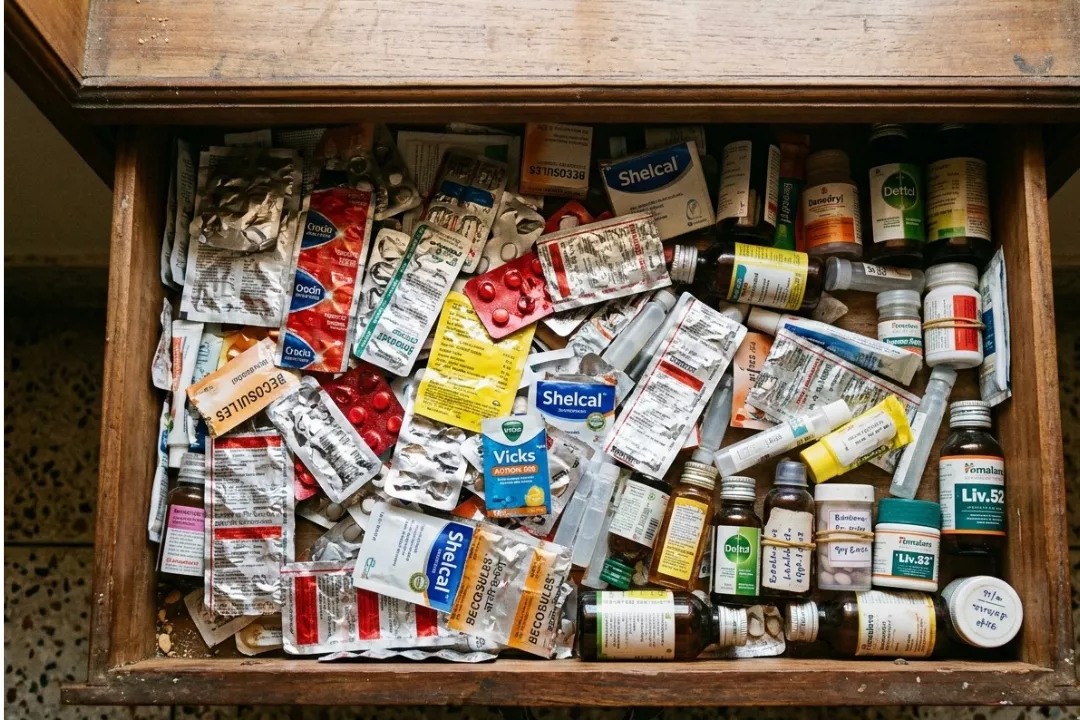
My mother has a drawer.
You know the drawer. Every Indian home has one. It is not labelled. It does not need to be. Everyone in the family knows exactly what it contains and exactly why it must never be reorganised.
I made the mistake of reorganising it once. I was home for a week, I was bored, I thought I was being helpful. I threw away three strips of tablets that had expired in 2021, a bottle of cough syrup that was three-quarters empty and had developed a skin on top, and something in a small glass bottle with no label that I could not identify and assumed was old.
My mother found out within forty-five minutes. She was not angry. She was something worse. She was calm.
"That bottle," she said, "was for gas."
"Maa, it had no label."
"I knew what it was."
"It had no label and it was from the previous decade."
She looked at me with the expression she reserves for when I have said something that doesn't deserve a full response. Then she went to the kitchen and put out chai and Mom's Magic biscuits, which is what she does when she needs a moment to collect herself after something upsetting has happened. I ate the biscuits. The unlabelled gas bottle was not replaced. But it was also not forgotten. She mentioned it again four months later, completely unprompted, in the middle of an unrelated conversation.
That bottle had clearly meant something to her. I still don't know what.
The Inventory
My mother's medicine drawer contains, at any given time, the following categories of items.
First, the current medicines. The ones actually prescribed by an actual doctor for an actual condition. These are a small minority of the drawer's total contents and receive no special status.
Second, the almost-finished medicines. Strips with two or three tablets left. She will not throw these away because what if she needs exactly two tablets someday and doesn't have them. The logic is flawless if you don't examine it.
Third, the expired medicines. These are the majority. Medicines from illnesses long recovered from, surgeries from years ago, prescriptions for conditions that resolved themselves. They stay because they might still work. Expiry dates, in my mother's philosophical framework, are more of a suggestion than a rule. "It's not like it becomes poison," she has said. I have chosen not to engage with this.
Fourth, the homeopathic section. Small white globules in tiny glass bottles arranged with a care that the actual prescription medicines do not receive. My mother does not fully trust homeopathy. She also does not fully distrust it. She keeps it as a backup system. An alternative framework, just in case.
Fifth, the ayurvedic section. Chyawanprash is technically in the fridge but there are several related items in the drawer. Triphala. Something a yoga instructor recommended three years ago. A powder whose origin nobody can trace.
Sixth, the neighbour recommendations. These deserve their own category. Mrs. Kapoor's son had the same knee thing and this worked for him. Her sister-in-law swears by this for digestion. The gentleman from the building next door had a doctor who said this was better than what my mother's doctor prescribed, and she has been keeping it in the drawer ever since as a point of comparison.
The Philosophy
My mother's relationship with medicines is not chaotic. I want to be clear about this. It only looks chaotic from the outside. From the inside, it is a highly organised system governed by principles she has developed over decades.
Principle one: more is better than less. A drawer with many medicines covers more eventualities than a drawer with few. You cannot predict what will be needed. You can only be prepared.
Principle two: finishing a medicine before the prescription ends is a form of optimism she is not willing to engage in. The illness might come back. Keep the tablets.
Principle three: doctors are useful but not infallible. The neighbour's cousin who is a pharmacist has been practising for thirty years and sometimes knows things the doctor doesn't. This is simply a fact.
Principle four: expired does not mean useless. It means less effective, possibly. Not useless. These are different things.
My friend Nikhil's mother has a similar system but with an added dimension. She keeps a handwritten register. A small notebook where she has recorded, in her own shorthand, what each medicine is for, who prescribed it, and how many are left. Nikhil found it once and described it as the most organised document in their household. More organised than the property papers. More organised than his school certificates.
His mother, when he pointed this out, said the school certificates weren't going to save anyone if someone got a fever at midnight.
She has a point.
The Doctor Problem
The drawer exists, in part, because my mother has a complicated relationship with doctors.
She respects them. She goes to them. She follows their advice, mostly, with certain modifications she considers minor and they would not.
She reduces the dosage slightly because the full dosage feels like too much. She stops the course three days early because she feels better and why take more medicine than necessary. She combines the prescription with something from the drawer that she feels addresses the root cause more effectively.
She does not tell the doctor any of this. The doctor is operating on the assumption that she is following the prescription exactly. She is following it in spirit.
My friend Karan's mother went one further. She was prescribed a blood pressure medication and decided, after reading about it online, that a different medication she'd seen advertised was better. She did not tell her doctor. She switched herself. When her blood pressure remained controlled, she took this as confirmation that she had been right.
Her doctor, when this eventually came up, was not delighted. Her mother, when Karan told me this, described the doctor's reaction as an overresponse.
The Inheritance
I used to find the drawer baffling. Now I find it oddly comforting.
It is, when you think about it, an archive. Every medicine in it corresponds to something that happened. An illness, a surgery, a phase of someone's life that required pharmaceutical intervention. She kept the tablets not because she is disorganised but because throwing them away felt like erasing something.
Also she genuinely believes the 2021 tablets still work. I have accepted this.
Last month I had a headache. Nothing serious. I mentioned it in passing during a phone call.
She called back the next morning. She had cross-referenced my headache with my screen time, my sleep pattern, and something she'd read about dehydration. She had a recommendation from the drawer. She also had the number of a specialist, just in case.
The drawer, it turns out, is not just storage. It is a response system. A standing army. A mother's way of saying I am prepared for whatever happens to you, at any hour, with multiple backup options.
I still think the unlabelled gas bottle should have been thrown away.
I have not said this to her again.


