



Sign in to share
Shikha Sharma
Nobody warned me about the in-between.
I knew about the honeymoon phase. Everyone knows about the honeymoon phase. The butterflies, the texting back immediately, the finding everything about each other fascinating, the general sense that you have discovered a person specifically designed for you by a benevolent universe.
I also knew it would end. I'd been told. I'd watched it end for other people. I was prepared.
What I was not prepared for was what came after the ending and before the settling. The stage that has no name and no timeline and no reassuring article telling you it's normal and you'll be fine.
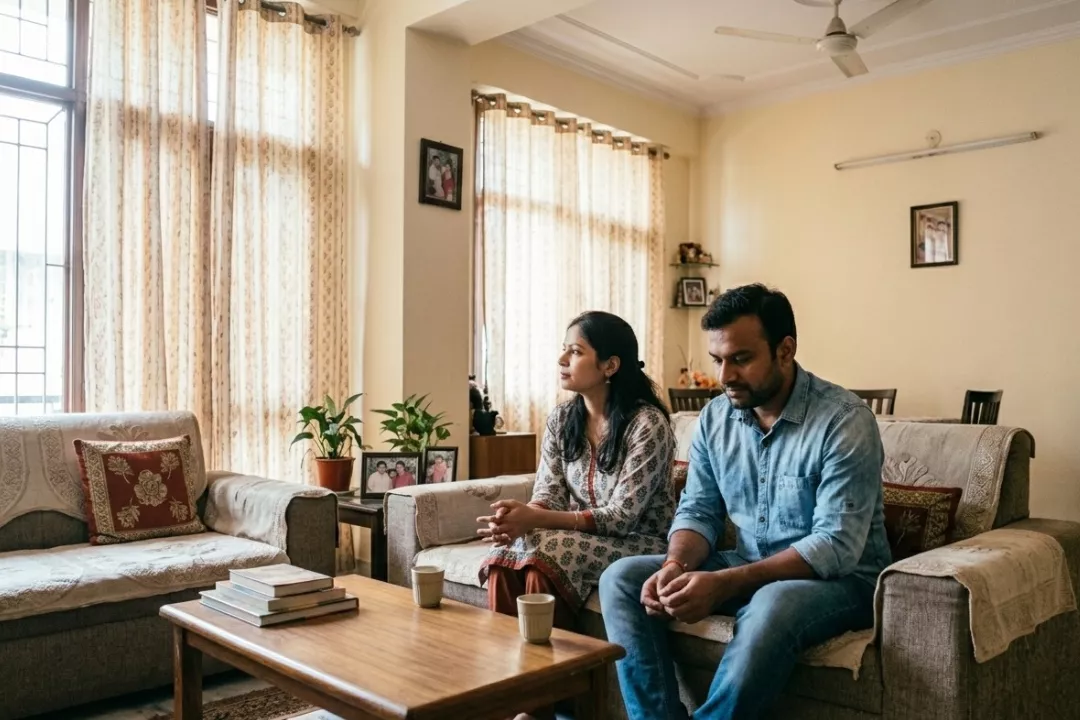
My husband and I hit it about eighteen months in. Things were good. Nothing was wrong. But the early intensity had faded and the comfortable routine hadn't quite arrived yet and we were both, without saying it out loud, slightly unsure of what we were supposed to be to each other now.
It felt like the relationship was asking a question we didn't know how to answer.
What the Stage Actually Feels Like
The closest I can describe it is this. In the beginning, you're both performing your best selves. Not dishonestly. Just with the natural heightened effort that comes from wanting someone to like you. You're funnier, more patient, more interesting than you are on a random Tuesday with nothing at stake.
Then the performance relaxes. Which is good. That's what intimacy is. The performance relaxing.
But there's a moment, or a period, where it's relaxed but the comfortable rhythm hasn't replaced it yet. You're not on anymore but you don't know what off looks like for the two of you together. You haven't built enough shared history to have your own language, your own jokes, your own way of being in a room together. You're just two people who like each other, figuring out what that actually means day to day.
My friend Ananya described it as "the adjustment that nobody admits is an adjustment." She and her husband went through it in their second year. Both of them thought something was wrong. Both of them were too nervous to say so. They spent about four months slightly at a distance from each other, being fine, having nothing specific to address, just waiting for the feeling to pass.
It passed. But she wishes someone had told her it was a stage and not a verdict.
Why It's the Most Vulnerable Window
The honeymoon phase protects you from doubt. The intensity is so strong that you don't question things. You're too busy being in it.
The comfortable routine protects you differently. By that point you have history, you have shared language, you have evidence. You know this person. You trust the thing you've built.
The in-between has neither protection. The intensity has faded so you can see things clearly, maybe for the first time, and what you see is two people who are no longer new to each other but haven't yet built the deep familiarity that makes everything feel settled. You're exposed in a way you weren't before and won't be again.
This is when a lot of couples make mistakes. They interpret the exposure as incompatibility. They think the fading of the butterflies means something is wrong rather than something is ending so something else can begin.
My colleague Rohan told me he almost ended a relationship during this phase. Everything was fine. He just didn't feel the same electric certainty he'd felt at the beginning and he mistook that for falling out of love. He brought it up. His girlfriend at the time, now his wife, looked at him and said "you're confusing the beginning of something with the end of it."
He said it was the most useful thing anyone has ever said to him.
What's Actually Happening
The in-between is where you're building the real thing. The honeymoon phase is the trailer. The comfortable routine is the feature. The in-between is the part nobody shows you in the trailer because it's not cinematic. It's just two people learning how to be ordinary together.
You're figuring out whose job it is to bring up difficult things. You're discovering each other's actual moods, not the curated ones. You're negotiating small things that reveal large things. You're finding out if you like each other when nothing exciting is happening.
My friend Priya and her husband had their most important conversation during this phase. They were sitting one weekend afternoon with Sunfeast Marie Light and not much else to do, the kind of Saturday that feels slightly purposeless when you're in the in-between, and she just asked directly: do you feel like we're okay?
He thought about it. He said he felt like they were building something but couldn't see what it was yet and it was making him slightly anxious.
She said that was exactly how she felt.
That was it. The whole thing. They named it, they acknowledged it was mutual, they agreed to keep going and see what got built. The anxiety didn't disappear immediately but it became manageable because it was shared.
How to Move Through It
You can't skip it. I want to say that first because the temptation when you're in it is to either force the intimacy back to its earlier intensity, which doesn't work, or to conclude that the relationship has run its course, which is usually wrong.
You just have to be in it and keep choosing each other while you're in it.
The specific things that help, from everything I've observed and experienced, are small and consistent. Keep asking real questions. Keep showing up on the ordinary days with some version of your actual self. Keep doing small things that say I see you and I'm still here, not because you feel the intensity but because you're deciding to.
The comfortable rhythm arrives. Not all at once. Incrementally. One inside joke at a time, one resolved disagreement at a time, one Sunday morning at a time.
Rohan and his wife have been married five years. He told me recently that the in-between feels like the most important thing they went through together, not because it was hard, but because choosing each other during it, when nothing was forcing them to, was what made everything after it feel solid.
You don't build a foundation during the exciting parts. You build it during the uncertain ones.


