



Sign in to share
Shikha Sharma
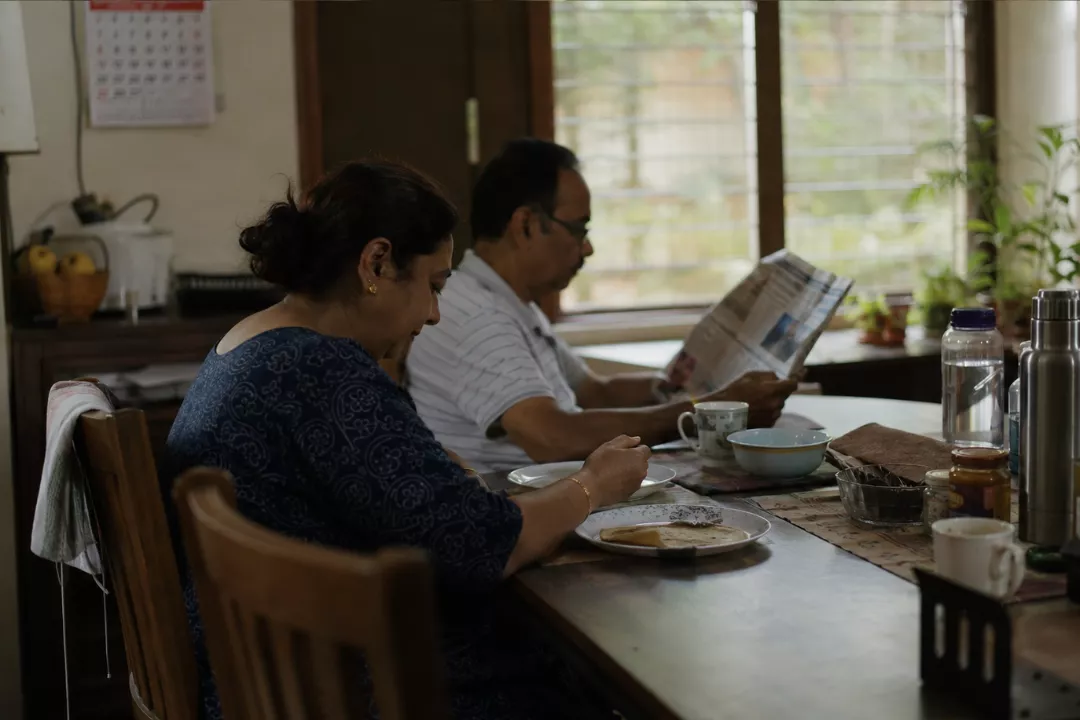
My husband and I eat breakfast in silence most mornings.
Not an uncomfortable silence. Not a silence that means something is wrong. A specific, settled silence that means nothing except that it is early and the food is good and neither of us has anything to say yet and both of us are fine with that.
It took me a while to understand that the silence was fine.
In the beginning, early in the relationship, I interpreted every silence at the table as data. Silence at breakfast meant he was unhappy about something. Or preoccupied. Or that we had not quite found our rhythm yet. The silence made me want to fill it. I would say things. Things that did not need to be said. Things said in the specific register of talking-to-break-silence rather than talking-because-there-is-something-to-say. He would respond, also in that register, and the conversation would run for a few minutes and then lapse and we would be in silence again.
At some point I stopped filling it.
I stopped because I noticed that he was not troubled by the silence. He was just eating. He was present and comfortable and just eating his breakfast and the silence was not a problem for him. He was not broadcasting anything through the silence. The silence was just silence.
The silence is just silence is an insight that sounds obvious and that I had not had before living with someone for a sustained period.
I was eating breakfast last Tuesday, Sunfeast Marie Light on the table because that is always on the table in the morning and he was reading something on his phone and I was thinking about my day and neither of us had said anything for about twelve minutes and the twelve minutes were fine. They were just twelve minutes of two people having breakfast.
The Silence as Information
I spent the early part of our relationship reading silence as information about the relationship.
Silence at meals meant something. Silence in the evening meant something different. Silence after a conversation meant something else. Every silence was data to be interpreted and I was interpreting continuously.
The interpretations were mostly wrong. Not completely wrong. A silence after a difficult conversation is sometimes information. But most silences are not. Most silences are just the absence of conversation rather than the presence of something unspoken.
My friend Priya described the same learning curve. She said she spent the first year of her marriage asking her husband what he was thinking whenever he was quiet. He would say nothing, I am just sitting here. She would not fully believe this. She would probe gently. He would become mildly frustrated by the probing. She would interpret the frustration as confirmation that something was wrong. He was frustrated about the probing. She had created the information she was looking for.
She stopped asking after about a year. She said the silence became comfortable after she stopped asking. He had always been comfortable with it. She needed to arrive at the comfort herself.
The Quality of the Silence
Not all silence is equal. This is the thing I have learned.
There is the comfortable silence, which is the breakfast silence. Both people present, not talking, not needing to talk. This silence has a settled quality. It sits easily.
There is the tired silence, which happens in the evening sometimes when both of us have been working and neither of us has the energy for conversation. This silence is also fine. It is rest, not distance. We are resting in the same room.
There is the thinking silence, which is when one of us is processing something and the other one can feel the processing and knows not to interrupt it. This silence has a texture to it. It is not a distance. It is an interior space being occupied.
And then there is the difficult silence, which is the one after an unresolved argument or a hard conversation. This silence is information. This one means something is being held that has not been said. This one I pay attention to.
My friend Kabir and his wife have developed, over ten years of marriage, a specific signal for the difficult silence. She touches his arm. That is the signal. It means I know something is here and I am ready to talk about it when you are. He said she developed this because he could not always identify when a silence had become difficult. She could. The arm touch translated the identification across.
He said he reaches for her hand now when he feels a silence shifting. He learned the signal eventually. It took time.
The Couple at the Other Table
My husband and I were at a restaurant last month and there was a couple at the table next to us who ate their entire meal in silence.
Not our silence. A different kind. The kind of silence that has been going on for a long time. Not angry. Not tense. Just very settled. They had been eating for thirty minutes and had said approximately six things to each other, all of them practical. More water. Pass the salt. The bill, when you are ready.
I watched them in the way you watch people in restaurants when you are trying to understand them.
They looked comfortable. Not unhappy. Not estranged. Just finished with needing to fill the space. Like two people who had been having conversations for so long that the conversations were now available on demand rather than continuous. The silence was the baseline and the conversations were elected into it when there was something to say.
I said to my husband, quietly, that I hoped we would be like that. He looked at the couple and then looked at me. He said we already kind of were. I said not quite. He said we were getting there.
We ate the rest of the meal mostly in silence.
It was fine.


