



Sign in to share
Shikha Sharma
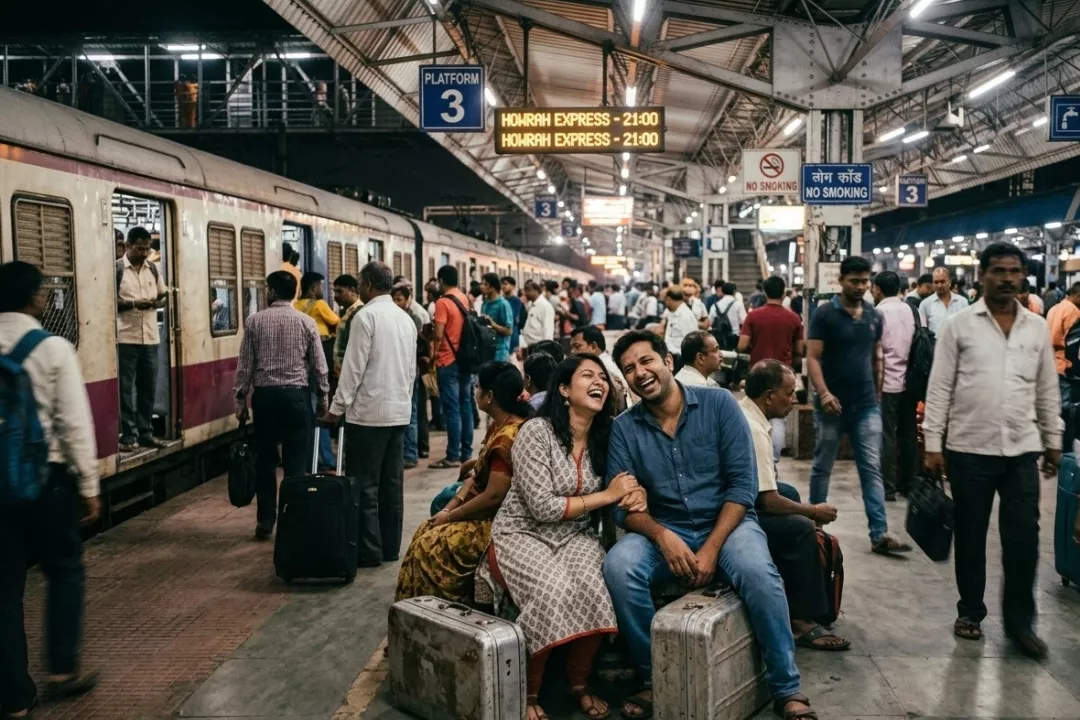
My friends Ananya and Vikram once spent fourteen hours in the Jaipur railway station because Vikram had booked tickets for the wrong date.
Not the wrong train. The wrong date. A full twenty-four hours off. He discovered this approximately forty minutes before the train was supposed to depart, which is precisely the worst possible moment to discover something like this.
Ananya told me this story over chai. She was laughing the entire time. That was three years ago and they are, by every measure, one of the happiest couples I know.
I asked her how she reacted when it happened. She said she stood there for about thirty seconds in complete silence, then looked at Vikram, then sat down on her suitcase and started laughing. Vikram, who had been bracing for the full force of her reaction, was so surprised by the laughter that he sat down next to her and started laughing too. They ate vada pav from a platform stall. They figured out the next available train. They got home a day late.
"That trip was actually more fun than the trip," she told me.
I have thought about that sentence a lot.
The Travel Test
There is a theory I have developed from years of watching couples navigate travel disasters, which is this: the couples who handle chaos well together are not the ones who don't fight. They are the ones who fight and then immediately get on with it.
My colleague Preethi and her husband went to Goa last year. On the first day, they had a proper argument about which beach to go to. A real one. With raised voices and everything. By the evening they had sorted it out, found a beach they both liked, and were having what Preethi described as one of the best evenings of the trip.
"We got it out of our system early," she told me. "After that everything was fine."
This is apparently a strategy they have developed unconsciously over five years of travelling together. First day argument, cleared air, good holiday. It works so consistently that Preethi now expects the first day argument and is prepared for it. She packs her patience specifically for day one and everything after that is easy.
I had packed Sunfeast Marie Light for a road trip I went on with two couples last year, because I am the person in any group who thinks about snacks when nobody else has, and I watched both couples operate in real time across four days of shared chaos. One couple navigated every disruption with collective ease. The other couple spent the first two days quietly tense and the last two days completely relaxed and comfortable. By the end both couples were fine. They just took different routes to get there.
The Removal of Comfortable Routines
At home, couples have systems. Who does what, when, how. The routines are so established that you can go an entire week without really having to negotiate anything because you've already pre-negotiated everything through habit.
Travel removes all of that. Suddenly nobody knows whose job it is. Nobody has a system. You're both tired and slightly disoriented and someone has to make a decision about where to eat right now and you are both hungry in different ways and the hotel wifi isn't working and the cab is late.
This is when you find out what you're actually like with each other.
My friend Kabir told me that the first trip he took with his now-wife was a disaster from start to finish. Delayed flights. Lost luggage. A hotel booking that had somehow been cancelled without anyone notifying them. They spent the first night in a different hotel that cost twice as much and was half as good. He said at one point they were sitting in the lobby of the replacement hotel at midnight, both exhausted, and she looked at him and said, "so this is a disaster."
He said "yes, completely."
She said "okay" and went to find out if the hotel restaurant was still serving food.
He knew, sitting there, that he was going to marry her. Not because she was calm. Because she assessed the situation accurately, accepted it, and immediately moved to the next practical step. No drama. No blame. Just, okay, what now.
They've been married seven years. They still travel badly together. They still love it.
What Chaos Actually Reveals
The missed connection, the wrong booking, the argument about directions that could have been avoided if someone had just looked at the map before leaving the hotel, all of these things strip away the curated version of a person and leave you with the actual one.
You find out if they blame or problem-solve. If they catastrophise or adapt. If they need to win the argument more than they need to enjoy the holiday. If they can laugh at something genuinely inconvenient or if inconvenience breaks them.
My friend Divya says the most revealing moment of any trip with her husband is when something goes wrong and she watches which version of him shows up. The version that gets frustrated and looks for someone to blame, or the version that sighs once and starts googling alternatives.
Six years in, she told me, it's almost always the second version. It wasn't always. Travel taught him that too.
The Couples Who Travel Perfectly
I'm slightly suspicious of couples who travel perfectly together. Not judgmentally. Just observationally.
If nothing ever goes wrong on your trips, either you are extraordinarily lucky or you have built such a controlled travel experience that you've never actually been tested. You've been on holiday together. You haven't really travelled together.
The couples who have been through the fourteen-hour railway station wait, the wrong hotel, the missed connection, the argument at the ticket counter that was about directions but was also about something else, and come out the other side still talking, still laughing, still choosing to book the next trip together, those are the couples I find genuinely convincing.
Ananya and Vikram are going to Rajasthan again next month. Vikram has triple-checked the dates. Ananya is bringing snacks. Just in case.
They will probably have a small disaster. They will probably be fine.


