



Sign in to share
Shikha Sharma
I have always considered myself the funny one.
Not in an arrogant way. In the way that you develop a self-understanding over years of being a certain way and the being-a-certain-way becomes part of how you identify. I am observational. I notice things. I say the thing that makes people laugh at the right moment. I have been this way since school and I have a reasonable body of evidence to support the self-assessment.
My husband is funny too. I knew this when we got together. He has a dry delivery and good timing and a specific kind of humour that lands quietly rather than loudly, which I find more impressive than loud humour but which is also less visible in a crowd.
I thought I was funnier.
I was wrong and I found out at a dinner party two years ago.
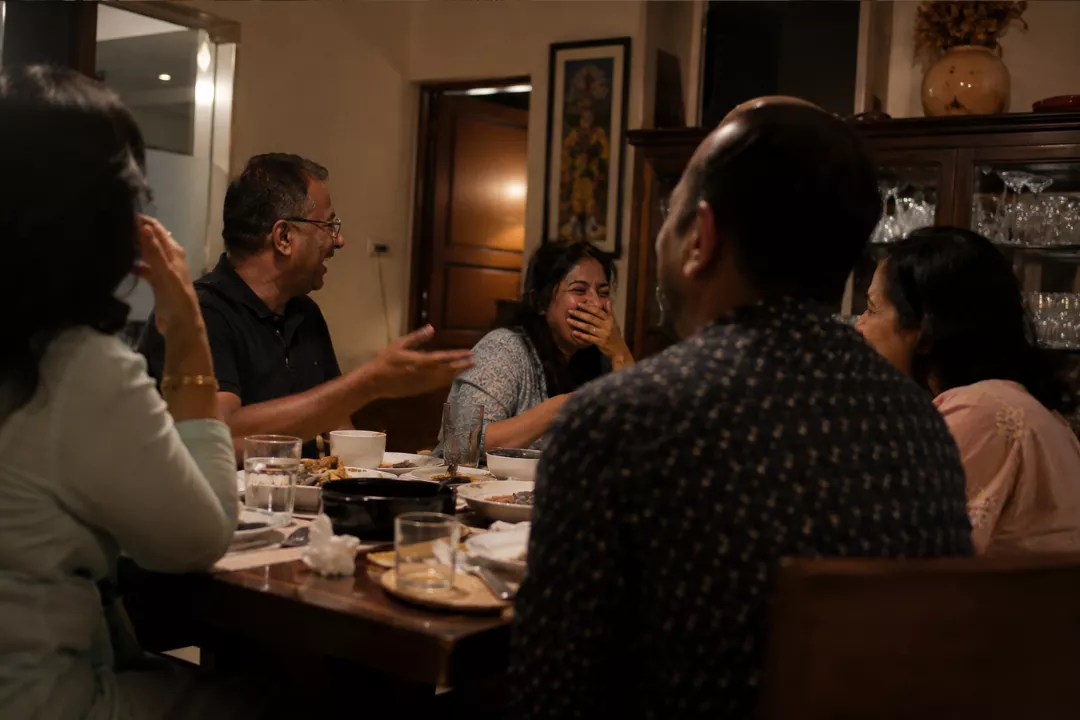
There were eight of us. People we both knew, some couples, a good table. The conversation was the kind that builds and becomes better as the evening goes on. My husband was quieter than usual for the first part of the dinner, which I had noted and assumed was tiredness.
And then he said something.
I will not reproduce the specific thing because it loses everything in reproduction. But he said something in a moment of pause in the conversation, quietly, without announcing it, and the entire table laughed. Not a polite laugh. The real laugh, the kind that catches people mid-sip and requires them to put their glasses down.
I looked at him. He was not performing. He had not been building to it. He had just said the thing, precisely at the right moment, and it had landed with a completeness that I found genuinely impressive and also slightly destabilising.
We were driving home after the dinner. I had Sunfeast Marie Light in my bag as I always do for long evenings, and I said very quietly that I thought he had been the funniest person at the table tonight.
He said thank you.
I said it was a compliment but also an observation I was still processing.
He said he understood.
We drove the rest of the way home with that sitting between us in a comfortable way.
The Nature of His Funny
His funny is different from my funny and this is the part I find most interesting.
My funny is built. I notice something, I think about how to frame it, I identify the moment, I say the thing. There is a process. The process is quick but it exists. I am working when I am being funny.
His funny arrives. He is not building to it. He is not processing. The thing comes out at the moment it comes out because that is when it was ready. He does not appear to decide to be funny. He simply is funny when the conditions are right and the conditions are not always predictable.
This is a different kind of funny. It cannot be manufactured. It cannot be accelerated. It has to wait for its own moment and then it arrives completely and without warning and it is very good.
My friend Priya has the opposite dynamic in her marriage. She is definitively the funnier one and she knows it and her husband knows it and they have both settled into this understanding. She said it was easier to settle into than she expected. She had worried that being the funnier one would create some kind of imbalance. It created a specialisation instead. She is funny. He is other things.
She said what she had not expected was that she would find his other things more interesting to watch than any amount of funny.
The Crowd Test
I have observed my husband in enough social situations now to understand when the funny is going to arrive.
There are conditions. He needs to be comfortable. He cannot be performing. He needs to be around people he trusts or people who are not watching for it. If he knows he is expected to be funny he becomes less funny in the specific way that expectation deflates things.
But when the conditions are right, when the table is settled and the conversation is good and he is just present without pressure, the funny arrives reliably. The table laughed five times at that dinner. He was responsible for three of them. The other two were collective. I was responsible for zero.
I said zero. Not through lack of trying. Through the specific experience of being outfunny by someone you had not fully assessed as funnier than you and now have to update your self-assessment in light of new data.
The update was not painful. It was, genuinely, a good discovery. I had thought I knew the full inventory of what I had married. The inventory turned out to be larger than I knew. There was a comedy item in it that I had undervalued.
My friend Meera described a similar discovery with her husband at a completely different occasion, a family function where he said something to her father that made her father, a man not given to visible amusement, laugh loudly. She said she stood there for a moment just watching her father laugh. She said she had not known her husband could do that. The thing he had done with her father required a specific reading of the room and a specific confidence and a specific kind of warmth that she had not seen deployed publicly before.
She said she found him more attractive for about two weeks after that.
I found my husband funnier after the dinner. Not more attractive exactly. Just more. More than I had assessed.
The Acceptance
I have accepted that he is funnier than me.
Not in all contexts. In a crowd of people he knows well, at a table that is going well, in the specific conditions where his funny arrives, he is funnier than me.
In other contexts I hold my own. I am still funny. I am observational and I notice things and I say the thing at the right moment. I have not stopped being funny. I have just stopped being the funniest person in some rooms.
The room where I am the funniest person has shrunk by one. The person who is sometimes in that room ahead of me is my husband, who I went home with after the dinner, who ate a Marie Light biscuit in the car, who said he understood when I said I was still processing, and who has never once made me feel bad about being the second-funniest person in the car.
He is very good at that too.


