



Sign in to share
Dhruv Saxena
My mother respects doctors.
I want to establish this clearly before anything else. She goes to them. She keeps her appointments. She follows their instructions, largely, with certain modifications she considers minor and they would not, but she is there, she is engaged, she takes the whole enterprise seriously.
She just does not entirely trust them.
This is not disrespect. It is a parallel system. She has her own framework for understanding health and illness and treatment, developed over decades of reading things, asking people, absorbing information from various sources of varying reliability, and applying her own considerable intelligence to the results. The doctor's framework and her framework run simultaneously. When they agree, she follows the doctor. When they disagree, she considers both positions and reaches her own conclusion.
The doctor is not always aware that this process is happening.
I had a minor infection last year. Nothing serious. I went to a doctor in Bangalore, got a prescription, texted my mother to let her know because she would find out anyway and I preferred she find out from me. She called within eleven minutes.
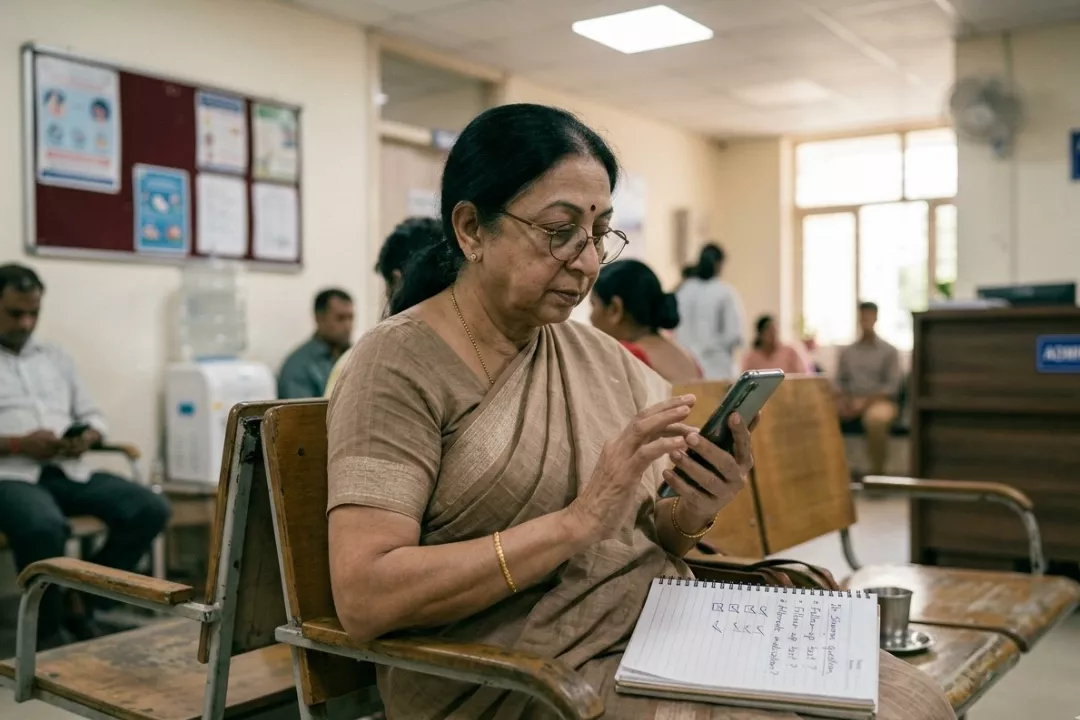
She had questions about the diagnosis. Not hostile questions. Genuine, specific questions about whether the doctor had considered alternative causes, whether the prescribed medication was the right one for this particular presentation, and whether a second opinion might be worth getting just to be thorough.
I said the doctor seemed competent.
She said she was sure the doctor was very competent. She just wanted to make sure all options had been considered.
She then told me that her friend Mrs. Sharma's nephew had had something similar and the first doctor had missed something and she was not saying that was happening here she was just mentioning it for context.
I went back to the doctor. The original diagnosis was correct. I did not tell my mother I had gone back. She asked how I was feeling a week later and I said better. She said good and then said she had been reading about the medication and it was generally well regarded, which she said in a tone that suggested this had been a matter of some investigation and she was now satisfied.
The medicine is on the top shelf of my mental cabinet. Right next to the chai and Mom's Magic biscuits she had put out the last time I was home and had a minor health thing she wanted to discuss in person. She does these conversations better face to face. Less room for me to claim I am fine.
The Google Problem
My mother's relationship with medical information online is complex.
She reads widely. She reads carefully. She applies genuine intelligence to what she reads. The problem is that the internet does not distinguish between reliable medical information and less reliable medical information, and my mother, despite her intelligence, does not always have the tools to make this distinction herself.
The result is that she occasionally arrives at conclusions that are accurate and occasionally arrives at conclusions that are creative.
She once determined, based on her research, that a vitamin deficiency was responsible for something I had mentioned in passing that had nothing to do with vitamins. She was so specific and so confident in this diagnosis that I looked it up myself. The connection was not supported by any source I could find. I mentioned this.
She said the sources she had read were very reputable.
I asked which sources.
She described them in general terms that did not allow me to identify them specifically.
I took the vitamin anyway. It did not help with the original thing, which resolved on its own. She considered this a positive outcome and I did not have the energy to disaggregate the variables.
The Second Opinion
My mother believes in second opinions the way other people believe in insurance. You hope you do not need it but you always have it.
Every significant medical diagnosis in our family has received a second opinion. Not because the first doctor was wrong. Because the second doctor might know something the first one does not, and if there is additional information available it is better to have it.
I had a minor procedure a few years ago. Routine. The doctor explained everything clearly. I understood. I was satisfied.
My mother was not satisfied. Not because she doubted the doctor. Because she wanted to understand it more fully. She wanted to ask questions the doctor had not had time for. She wanted to know not just what was happening but why and what all the alternatives were and what the recovery looked like in detail.
She found another doctor. She went with me to the appointment. She brought a list of questions she had written down. The second doctor answered all of them. My mother thanked him very politely and then noted, on the way out, one area where the two doctors had given slightly different information, which she filed for further consideration.
The procedure went fine. The recovery was as expected. She monitored it closely for two weeks and sent me articles about recovery best practices, some of which were from sources I recognised and some of which were from sources I did not.
The Neighbour Expertise
Beyond doctors and the internet, my mother has a third source of medical information that she considers equally valid. The neighbourhood.
Mrs. Sharma has had the same knee problem and found this worked better than what the doctor prescribed. The gentleman from the next building saw a specialist who said something different from what our family doctor says. Her friend's daughter is a physiotherapist and has opinions about this that are worth considering.
This is not entirely unreasonable. Lived experience is real. People who have had the same condition know things that clinical literature does not always capture. My mother is correct to gather information from multiple sources.
The issue is the weighting. The neighbour's cousin who is a nurse sometimes receives equal weighting to the specialist. The thing that worked for Mrs. Sharma sometimes receives equal weighting to the clinical trial. My mother's framework for evaluating medical information is not always calibrated in the way a medical professional would recognise.
But she has also, more than once, caught something that a doctor missed. She asked a question at an appointment that led to an investigation that found something. She pushed for a test that the doctor had not initially considered that turned out to be relevant. Her parallel system, for all its idiosyncrasies, has a record.
The Defence
I want to defend my mother's relationship with doctors, because I think it is easy to read it as difficult and it is actually something else.
She grew up in a time when doctors were not always accessible and you learned to manage a lot yourself. She watched her own mother handle illness with a combination of medical intervention and practical wisdom and neighbour knowledge and she absorbed all of it. She has a comprehensive model of health that predates the medical establishment she now operates alongside.
She does not distrust doctors. She trusts herself as much as she trusts doctors. This is different. Doctors are trained professionals with significant expertise. She knows this. She also knows that she has been paying attention to her family's health for thirty years and has developed her own expertise that is not the same as theirs but is not nothing either.
The second opinion is not suspicion. It is thoroughness.
The Google research is not paranoia. It is preparation.
The neighbour knowledge is not superstition. It is supplementary data.
She is trying to take care of us as completely as she can with every tool available to her. The doctors are one tool. She has others.
She just does not always tell the doctor about the others.


