



Sign in to share
Dhruv Saxena
My mother has a theory of cold.
It is not a theory she developed recently. It is not a theory based on clinical literature or peer-reviewed research. It is a theory she has held for as long as I can remember, refined over decades of observation, and defended against all available counter-evidence with the calm confidence of someone who knows what she knows.
The theory is comprehensive. It covers causes, prevention, treatment, and the specific circumstances under which cold is most likely to strike. It is internally consistent. It is also, by the standards of modern medicine, not entirely accurate. This has not affected its standing in our household.
I have been subject to this theory for thirty-one years. I know it completely. I will now share it with you.
The theory begins with wet hair.
Wet hair causes cold. This is the foundational principle. If you leave the house with wet hair, or stand near an open window with wet hair, or go to sleep with wet hair, you will get cold. Not might get cold. Will get cold. The causal relationship is direct and has no exceptions in my mother's framework.
I have left the house with wet hair on many occasions. I have not always gotten cold. I have raised this with my mother. She says I got lucky.
The second principle is fans.
Fans cause cold when used incorrectly. Incorrectly means directed at you for extended periods, used at full speed when you are sweaty, or operated at night when you are sleeping and cannot monitor your own temperature. The fan is not inherently dangerous. It is dangerous under specific conditions that my mother has mapped comprehensively.
I came home last month and slept with the fan on full speed because it was warm. My mother came in the next morning to check on me, saw the fan setting, and turned it down without waking me. I woke up to a fan on speed two. I asked about it at breakfast. She said full speed at night is asking for trouble. She put out chai and Mom's Magic biscuits, which is what happens in our kitchen regardless of the topic under discussion, and explained the fan situation while I ate. I did not get cold. She did not consider this relevant.
The Air Conditioning Problem
Air conditioning is the most complicated chapter of the cold theory.
My mother does not oppose air conditioning. She uses it. She understands its function and its value. But she has concerns about specific air conditioning behaviours that she has documented over years of observation.
Sitting directly under the vent is dangerous. Going from air conditioning to outside without an adjustment period creates a vulnerability. Sleeping with the AC too cold and insufficient blanket coverage is a recipe for disaster. And going from air conditioning into rain is something she cannot fully articulate but feels strongly about.
I live in Bangalore. My office has air conditioning. I go from the office to outside regularly, sometimes into rain. I have been doing this for several years without consistent cold. When I tell my mother this she says I have a strong constitution and should not test it.
My friend Nikhil works in an office where the AC is very cold. He mentioned this to his mother once. She immediately asked if he had a jacket at the office. He said no. She mailed him one. An actual jacket, posted from Delhi to Bangalore, for office air conditioning. It arrived in a week. He keeps it at his desk. He has worn it twice. She asks about it regularly.
The Sweater Situation
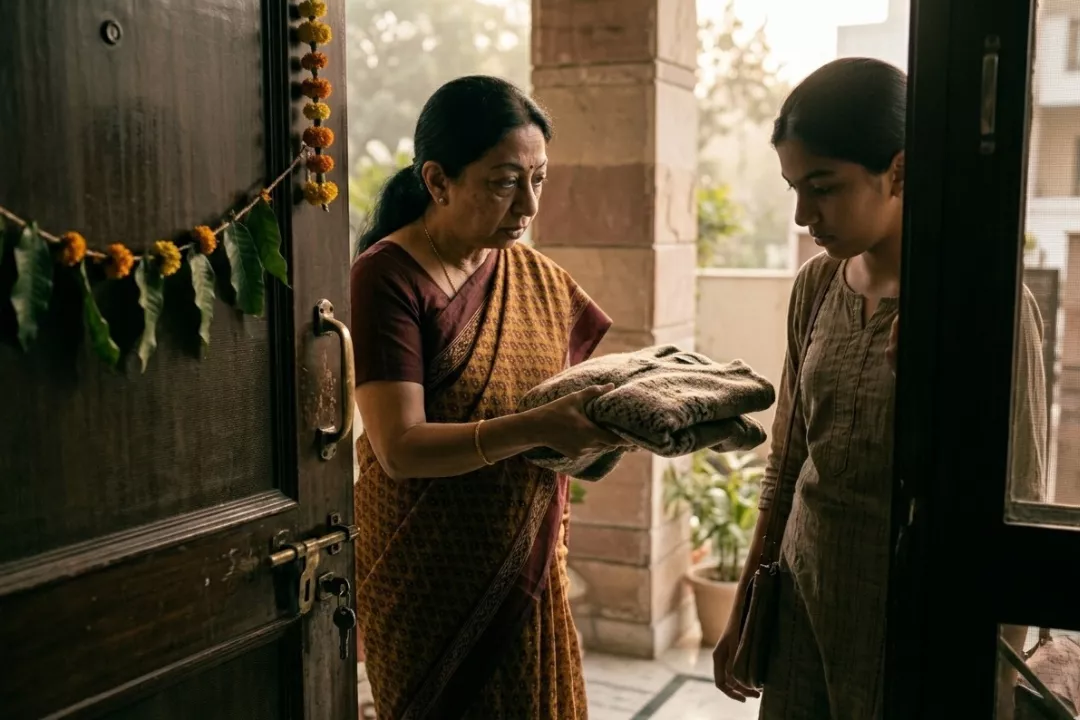
The sweater is the primary preventive tool in my mother's cold management system.
The sweater comes out in October. Not because October is cold in most Indian cities. Because October is when the weather begins to think about being cold, and it is better to be prepared than to be caught without a sweater when the thinking becomes action.
I am thirty-one years old. I am told to wear a sweater in October. Not every October. Most Octobers. The suggestion arrives in a phone call, usually after she has checked the Bangalore weather on her phone, which she does regularly. She will call and say it is getting cold there, are you wearing enough.
I say it is not that cold.
She says it will be.
She is sometimes right. In which case she does not mention it. In which case I do not mention it either. We both know.
The Ice Cream Question
Ice cream causes cold.
This is the most disputed element of the theory and the one I have challenged most consistently over the years. The mechanism by which ice cream causes cold is not fully explained in my mother's framework. It is more of an observed correlation than a causal argument. She has seen the sequence play out enough times that she considers the relationship established.
I eat ice cream. Sometimes I subsequently get cold. I attribute this to the ordinary frequency of cold in adult life. She attributes it to the ice cream.
We have had this conversation many times. Neither of us has changed our position. I continue to eat ice cream. She continues to note it. When I get cold she does not say the ice cream. She does not need to. The implication is there, hanging in the air, self-evident to her.
Last summer I visited home. It was very hot. I suggested we get ice cream. My mother said fine but then added, unprompted, that I should make sure I was not going into AC immediately after eating it.
I asked why.
She said it was a lot for the body.
I did not get cold. She considered the caution vindicated rather than unnecessary. We ate the ice cream. It was good.
The Rain Protocol
Rain has its own chapter.
Getting wet in rain causes cold. This is distinct from wet hair, which is a controlled domestic situation. Rain is an outdoor emergency. If you get caught in rain you must change your clothes immediately upon returning home, ideally shower with warm water, and definitely have something hot to drink.
I have been caught in rain and not followed the protocol. I have mentioned this to my mother after the fact. She makes a specific sound. It is not quite a sigh and not quite an exclamation. It is somewhere in between. It means you know better and yet.
She always asks if I had anything hot after. I always say yes regardless of the actual answer. She says good. The protocol is retroactively satisfied. We move on.
The Unified Theory
Having laid out all the elements, I want to note that they share a common logic.
Each cause of cold involves a temperature transition or a vulnerability created by exposure. Wet hair in moving air. Sweaty body in fan breeze. Warm body in cold AC. Hot consumption followed by cold environment. The theory, when you look at it this way, is not entirely wrong. It is an attempt to map the conditions under which the body becomes vulnerable to illness.
It is an incomplete map. The mechanisms are not quite right and the correlations are not always causal. But the underlying intuition, that the body needs to be protected from rapid temperature changes and environmental stresses, is not unreasonable.
She built this theory from observation. She observed her children getting cold. She noted the conditions that preceded it. She made connections. Over decades, she refined the connections into a framework.
It is not peer-reviewed. But she has been paying attention for thirty years and peer review has only been around since the seventeenth century.
I still eat ice cream. I still leave the house with wet hair sometimes. I still do not always follow the rain protocol.
But I do keep a jacket at the office now.
Nikhil was right. The AC is quite cold.


