



Sign in to share
Shikha Sharma
My first Diwali with my husband's family was in 2018.
I want to be precise about this because the year matters in the sense that it was before we were married, which meant I was there in an unofficial capacity, which meant the stakes were entirely unclear. I was not the daughter-in-law yet. I was the person who might become the daughter-in-law. The family knew this. I knew this. Everyone was behaving accordingly, which meant everyone was being very warm and also very watchful in a way that they were doing their best to make invisible.
They did not make it invisible. But I appreciated the effort.
My husband had briefed me in the car. He told me his mother liked things done a certain way and he would show me the way. He told me his aunt asked direct questions but meant nothing by them. He told me his grandmother was hard of hearing and I should speak up. He told me the puja happened at a specific time and it was important to be ready for the puja.
I took notes. Mentally. I was ready.
I was not ready.
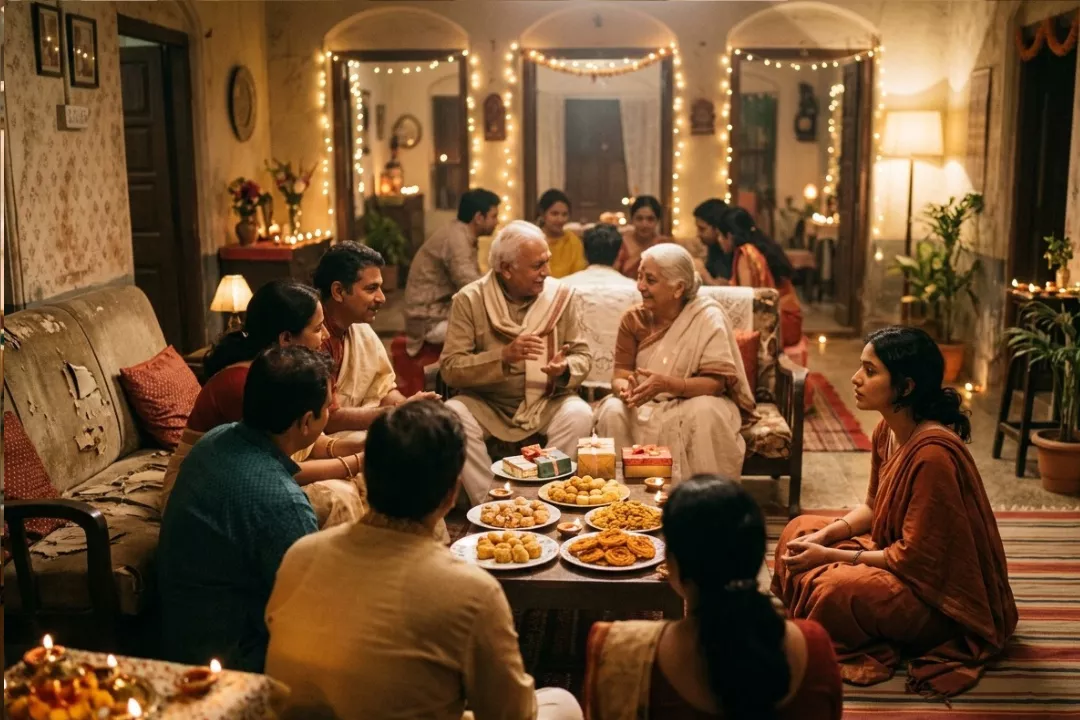
The house had twelve people in it. Not twelve I had expected. The twelve I had expected plus three who had arrived from out of town and whose relationship to the family I spent the first hour trying to reconstruct from overheard conversation and my husband's occasional under-his-breath explanations. The seating arrangement at dinner was governed by a logic I did not have access to. The gift I had brought, which I had agonised over and consulted three people about, was received with warmth and immediately placed somewhere I could not see, which I spent the rest of the evening wondering about.
My husband's mother served me first at dinner. This was, my husband told me later, significant. It meant something in the vocabulary of his family that I did not yet speak. I had received it without knowing I was receiving it. I felt retroactively grateful for having accepted the food with genuine enthusiasm rather than polite restraint.
At some point in the evening everyone was in different rooms doing different things and my husband found me in the kitchen with his mother, both of us eating the Sunfeast Marie Light that she had put out with chai, having a conversation about something I do not now remember but that felt easy. When he appeared in the doorway his expression was one of relief that I had not registered as necessary until I saw the relief.
He told me later that the kitchen conversation was the thing. If his mother was comfortable enough to be in the kitchen talking normally, the evening had gone well. I had not known about the kitchen metric. I had simply been hungry and his mother had been there and the biscuits had been on the table.
The Seating Politics
The seating arrangement at a joint family event is a document.
It communicates hierarchy, affection, obligation, and history in a format that everyone in the family can read and that newcomers cannot. I sat where I was told to sit. I did not know what my seat communicated. My husband, when I asked him later, said it was fine, I had been seated near his mother and his favourite cousin which was a good sign.
I asked why this was a good sign.
He explained a seating logic that I would not have independently constructed in several years of attending family events. There were people you sat near as a courtesy. There were people you sat near because you were trusted to handle them. There were people you sat near because the family wanted to observe the interaction. The categories were not labelled. You had to know the family to read them.
I did not know the family. I was learning it in real time, at dinner, while also trying to eat properly and make good conversation and not miss the cues I did not know were cues.
My friend Priya described her first Diwali with her husband's family as the most information-dense evening of her adult life. She said she came home and immediately wrote down everything she had observed because she did not want to lose the data. She had five pages. She still has them.
The Aunt
Every joint family has an aunt whose questions are direct.
My husband had warned me about his. She arrived at her questions within the first twenty minutes, delivered with complete warmth, about my family, my work, my plans, my opinion on certain things that I had not expected to be asked my opinion on. She was not interrogating me. She was genuinely curious. The directness was care, not aggression.
I answered everything directly. This turned out to be the right choice. Priya had tried to give diplomatic non-answers to a similar aunt and found that the aunt simply asked the questions again, more specifically, until she got the information she was after. Directness met with directness moved faster and left everyone more comfortable.
The aunt told me, at the end of the evening, that I seemed sensible. I did not know at the time that this was a high compliment from this particular aunt. My husband told me later. I was retroactively very pleased.
The Puja
The puja was at a specific time and I was ready for the puja.
What I was not ready for was the specific choreography of the puja, which everyone in the family knew and which I did not know and which meant that I spent the puja in a state of attentive observation, watching what everyone else was doing and attempting to replicate it slightly after they did it so that the replication looked like participation rather than mimicry.
My husband was next to me. He quietly told me what to do at each step. Not all the steps. The important ones. The ones where doing the wrong thing would be noticeable. He did this without drawing attention to the guidance, which was its own skill, the skill of helping someone without making the help visible.
I have thought about that puja guidance a lot. It was one of the first times I understood what it would mean to have this person in my corner. Not solving things for me. Just quietly making sure I had what I needed to handle things myself.
What the Evening Was Actually Testing
Six years later I understand what Diwali was testing.
It was not testing whether I knew the seating logic or could handle the aunt's questions or perform the puja correctly. It was testing something simpler. Whether I was present. Whether I was paying attention. Whether I was genuinely interested in this family or whether I was performing interest.
The kitchen conversation happened because I was actually hungry and his mother was actually there and the biscuits were actually on the table. It was not strategic. It was just real.
Real is what they were looking for. Real is, eventually, what every joint family is looking for in the person their person has brought home.
The gift was fine, wherever it ended up. The seating was fine. The puja was fine.
The kitchen was the thing.
It always is.


