



Sign in to share
Shikha Sharma
I realised it over a bowl of dal.
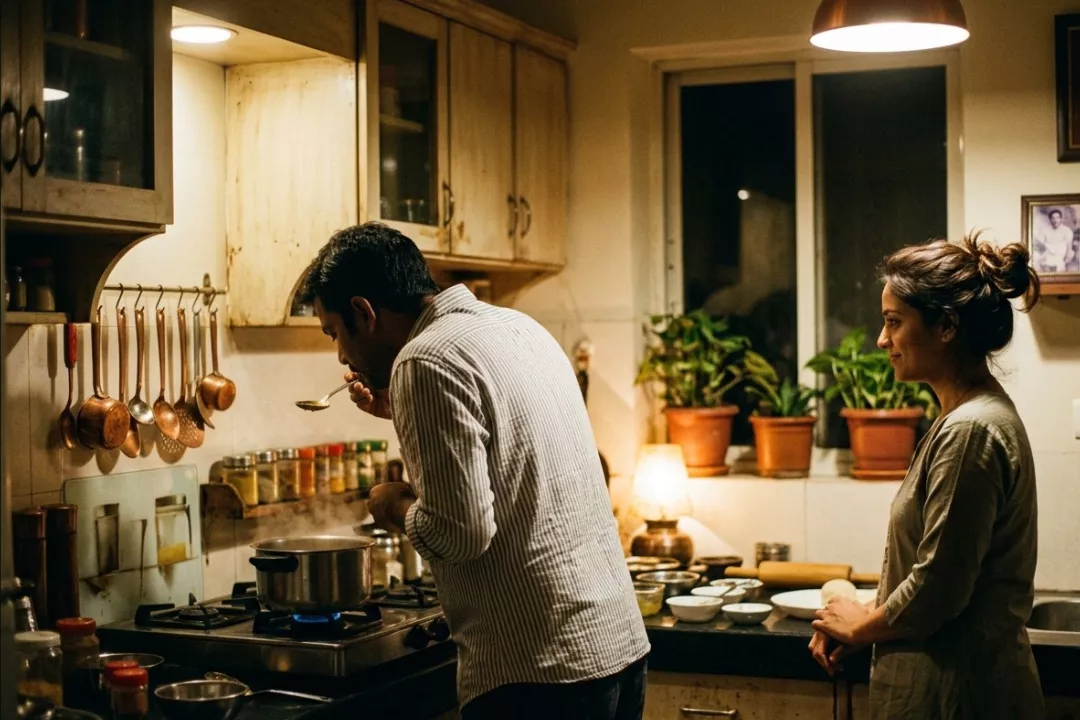
My husband had made dal for the first time last year. He does not cook often. He had decided, for reasons I did not fully investigate, that he was going to make dal that evening and he had made it. He called me to the kitchen when it was ready with a specific quality of anticipation that I had seen before but could not immediately place.
I tasted it. I said it was good. He said are you sure, taste it again. I tasted it again. He watched me taste it with the expression of someone who has put effort into something and is waiting to find out if the effort registered.
I said it was really good, I meant it.
He said he had added a bit more jeera than the recipe said, he hoped that was okay.
I put down my spoon and looked at him.
My mother does this. Exactly this. The offering of food, the watching of the tasting, the hope that the effort registered, the detail about the jeera delivered as a small admission of personal investment. I have been on the receiving end of this exact interaction my entire life. I recognised every element of it and had never until this moment seen it in my husband.
He looked at me looking at him. He asked what.
I said nothing. I took another bite of the dal. It was good. The jeera was fine.
I called my mother on my way to work the next day and did not tell her about the dal. But I thought about it the whole commute and I have thought about it regularly since.
We were sitting on the couch last Sunday, Sunfeast Marie Light on the table between us, my husband watching something and me reading something, and he said without looking up from his phone that I should have some water because I had not had enough today. I looked up. I looked at him. He did not notice me looking. He was already back to whatever he was watching.
My mother says this. In exactly this way. As information. As a statement of fact delivered from a position of continuous low-level attention to whether I am adequately hydrated.
There are now two of them.
The Worry That Arrives as a Question
The specific way my mother expresses concern is to ask questions.
Not direct questions. Angled questions. Questions that are doing the work of expressing concern without technically expressing concern, because expressing concern directly would be too much, would require the other person to manage the concern, and she does not want to be managed.
Are you eating properly. How is the sleep. You sounded tired on the call last week, is everything okay at work. These are not requests for information. They are expressions of love in the vocabulary of someone who loves you enough to worry but loves you too much to say so directly.
My husband does this now. He did not use to do this. Early in our relationship he asked direct questions. How are you, what's wrong, tell me. Somewhere across six years he has developed the angled question. Are you sleeping okay. You seem a bit flat, is work alright.
I recognise the angled question. I have been receiving it from my mother for thirty-one years. It landed differently when it started coming from him.
My friend Priya had the same realisation about her husband. She said she noticed it when he started doing the thing her mother does at the door. The one more thing. As she was leaving, there was always something. One more thing to say, one more piece of information, one more thing pressed into her hands. Her mother has been doing this her entire life. Her husband started doing it in year four of their marriage.
She said she stood at her front door one morning with a container of food he had packed for her that she had not asked for and thought, I have married my mother. The thought was not alarming. It was oddly comforting.
The Food Language
The food is the clearest evidence.
My mother expresses love through food. This is so established in our family that it requires no analysis. She makes things. She offers things. She watches you eat things. She sends things home with you. The food is how she says I see you, I thought about you, I want you to be okay.
My husband has learned this language. I do not know when he learned it or from whom. He makes me things now. Not often. Occasionally. At specific moments when he has assessed, through some calculation I cannot access, that the moment calls for something being made.
He brought me something once at a moment I did not know I needed it. I had not said anything about the day. He had observed something, processed it, and produced the food equivalent of I see you.
That is my mother's move. Exactly. She has been doing it for thirty-one years. He has been doing it for about three.
The Conclusion I Have Reached
I used to think the thing you looked for in a partner was someone different from your family. Someone who would bring new air into the room, new ways of doing things, new approaches to the questions your family had been answering the same way for decades.
I still think this is partly true.
But there is something else that turns out to also be true, which is that you are looking for someone who speaks your language. The specific language of your family, the one you learned before you knew you were learning it. The language of how love gets expressed, what care looks like in practice, which small gestures carry which meanings.
My husband speaks my mother's language. Not because he has studied it. Because he is, in some important way, the same kind of person. The watching while you eat. The angled question. The one more thing at the door. The water comment delivered to nobody in particular.
I have spent my whole life being loved like this. It turns out I chose someone who loves the same way.
The dal was very good. The jeera was exactly right.


