



Sign in to share
Shikha Sharma
The bookshelf came in a flat box and left with information about our marriage.
That is the thing about self-assembly furniture. It arrives pretending to be wood, screws, and a small Allen key. Then, somewhere between Step 3 and Step 4, it begins asking questions no couple has fully prepared for.
Who reads instructions?
Who assumes they understood the diagram?
Who loses Screw B?
Who says "hold this straight" in a tone that may need later repair?
We bought the bookshelf on a Saturday because my husband said our books were "spreading." He used the word spreading as if the books had formed a movement. I agreed because the living room did look like two people who owned books but not systems.
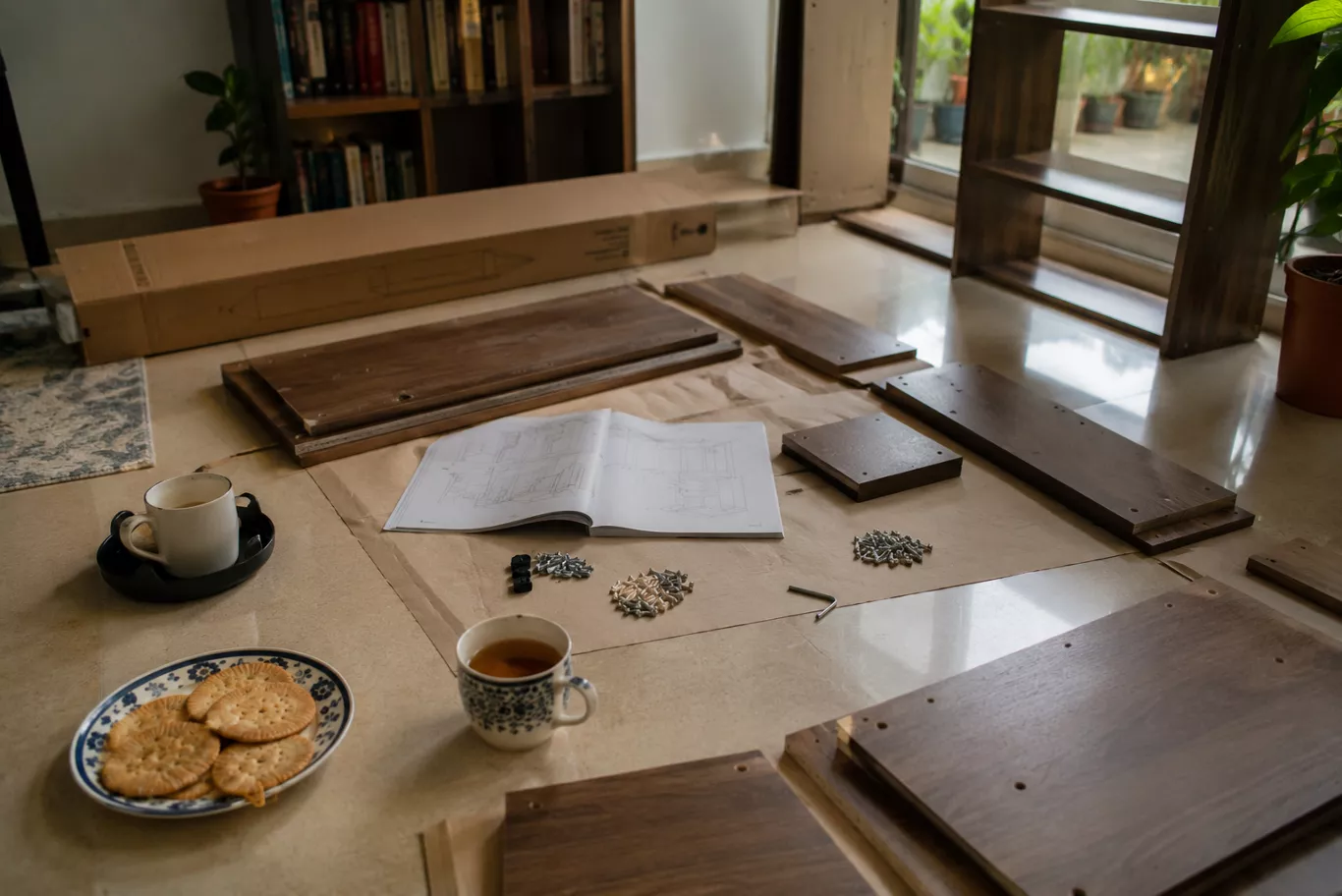
The box arrived at 4 pm. By 4:20, the pieces were on the floor, tea was on the side table, and the Sunfeast Marie Light packet had been opened for what I thought would be a pleasant assembly snack.
I was innocent then.
**The Instructions Had No Language**
The booklet used pictures only.
This is supposed to help everyone.
It helped no one.
There was a smiling cartoon man holding a plank. There were arrows. There were letters. There was one diagram in which a panel seemed to float above another panel with the calmness of a religious vision.
My husband said, "Easy."
This is always the first warning.
I said we should count all the screws before starting. He said we could count as we went. I said that was how people ended up discovering one missing screw at the end. He said companies send extra screws.
The company had not sent extra screws.
This did not stop him from believing in the company.
Priya says her husband has deep faith in diagrams. He will stare at a picture, nod, and then assemble the chair backwards with full confidence. She says the nod is the most dangerous part. The nod means the brain has stopped receiving outside advice.
My husband has that nod.
**The Allen Key Became a Personality Test**
The Allen key was tiny.
Too tiny for the ambition of the bookshelf.
My husband took it first, because he said he had better grip. I let him because I wanted to remain married and because, at that point, the tea was still warm.
He tightened the first screw. Then the second. Then he paused.
"This is not going in."
I looked at the diagram.
"Maybe that panel is upside down."
He said, "No."
We sat with the word no between us.
It was upside down.
To his credit, he accepted this faster than I expected. To my credit, I did not say the sentence I had prepared. Growth can be very quiet and still count.
Meera says she and her husband almost broke up over a shoe rack before they were married. He kept saying "give pressure" while she held two metal rods that refused to behave. She said if a relationship can survive the phrase "give pressure" repeated twelve times, it has seen enough.
Our phrase was "hold it straight."
Nobody enjoys being told to hold it straight while holding it as straight as human arms allow.
**Floor Work Changes the Mood**
The problem with assembling furniture is that everyone ends up on the floor.
The floor removes dignity.
You sit cross-legged, then kneel, then lie slightly sideways to see a hole that should have been visible to the manufacturer, and suddenly two adults with jobs are arguing about a wooden dowel.
My husband reads the diagram too close to his face. I arrange screws into tiny piles. He says my piles are in the way. I say his knees are on Step 5. He says there is no Step 5 yet. I say exactly.
This is not our best work as a couple.
At one point, he asked me to pass Screw C. I gave him Screw D. He said, "This is D." I said they looked the same. He said the groove was different. I said I was happy for the groove.
Kabir says he and his wife now have a rule: no flat-pack furniture after 6 pm. Fatigue enters the screws. Hunger enters the tone. By 8 pm, everyone has accused everyone of not reading the booklet. Their coffee table, he says, contains three compromises and one hidden mistake.
I respect that honesty.
**The Shelf Had a Wobble**
After two hours, the bookshelf stood.
Mostly.
It had a small wobble.
Not enough to collapse. Enough to offend me.
My husband pressed one side down and said, "Once books come, it will settle."
This is a sentence men say about furniture, rugs, and many unresolved problems.
I said furniture should not need emotional settling.
He said the floor was uneven.
I said the floor had been fine before the bookshelf arrived.
We both looked at the shelf. The shelf looked back, slightly tilted and full of secrets.
Nikhil once told me his TV unit has a drawer that does not close fully because he and his wife used the wrong screws in an early stage and refused to reopen the whole thing. They call it "the honest drawer." Guests think it is broken. They think it is history.
I liked that.
Our bookshelf's wobble became history too.
**The Snack Became Dinner**
By the time we finished, the tea was cold and the Sunfeast Marie Light biscuits had become dinner's first draft.
We sat on the sofa, backs hurting, floor covered in cardboard bits, and admired the shelf with the suspicion of people who know what went into it.
It looked nice.
Annoyingly nice.
This is the cruel part. After all the muttering and correction and screw sorting, the thing stands there looking useful, as if it did not bring out several tones in both of you.
My husband placed the first book on it.
Then another.
Then he arranged three books by height, which he has never done in his life, because construction had made him feel ownership.
I said, "Since you built it, will you dust it?"
He said, "We built it."
Amazing how fast shared credit appears after private struggle.
**The Box Stayed for Three Days**
The cardboard box stayed near the door for three days because neither of us wanted to fold it.
This is the part furniture ads do not show. The couple smiling near a new shelf, then living around a giant box like it is a temporary relative.
Every time I passed it, I thought, I should move that.
Every time he passed it, he had the same thought, but with less urgency.
On the third day, I folded it badly. He saw me and said, "Wait, there is a way."
I handed it to him with grace.
He folded it better.
I allowed this because a person should use their skills where they have them.
Now the bookshelf stands in the living room. It has books, one candle, two bills hidden between novels, and a tiny tilt only I can see because I know where the fight lives.
Sometimes, when people praise it, my husband says, "We assembled it."
I say, "Yes."
That is enough.
No one needs to know about Screw D.


