



Sign in to share
Dhruv Saxena
When my mother makes dal, it tastes like a specific afternoon in my childhood that I can't exactly locate but know was real.
I can’t describe it more precisely than that. It’s not just the flavour. It’s something in the combination of smell and warmth and the particular texture of it that bypasses the adult in me entirely and lands somewhere earlier. Somewhere I don’t have full access to anymore, but can visit through that bowl.
Last year I decided I wanted to make it myself.
I called her. “The dal, Maa. How do you make it?”
“It's simple,” she said. Which is never a reassuring beginning.
“Okay. Walk me through it.”
“You soak the dal for a bit.”
“How long?”
“Thoda sa. You'll know when it looks right.”
I would not know. I had no framework for knowing. But she had already continued.
“Then you put the tadka. Jeera, hing, tomato, the usual things.”
“How much jeera?”
“Jitna zaroori ho.”
As much as is necessary. A precise unit of measurement meaning, enough. Enough being a quantity she can feel in her palm after forty years of cooking and I have not yet developed the ability to feel.
I wrote down what I could. It covered half a page and explained almost nothing. Haha
Everything is estimation
This is the central problem with the way our mothers cook.
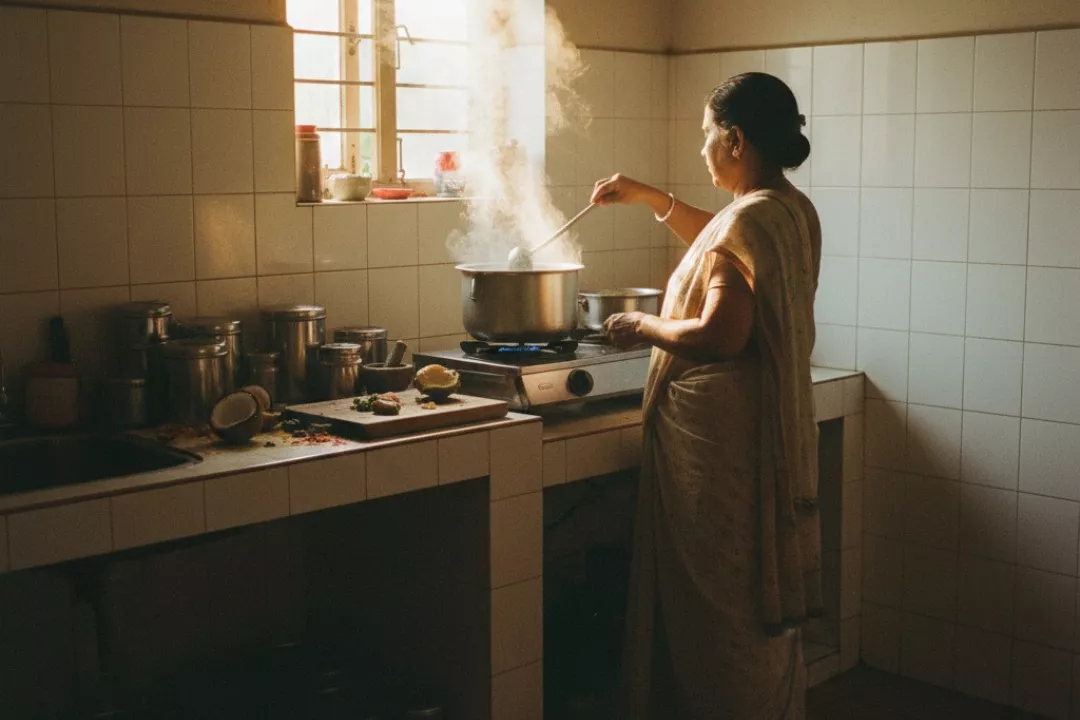
It was never designed to be transmitted through language. It was learned by standing next to someone who was doing it, watching hands, absorbing timing, internalising adjustments that were never made explicit because they didn’t need to be. The person teaching you was right there. You could see it.
When she says “high flame for a bit,” she means until it looks a certain way she’ll recognise in real time and couldn’t describe in advance. When she says “adjust the salt,” she means taste it and apply a judgment built from decades of tasting and adjusting.
The recipe lives in her memory. In her hands and her eyes and her instincts. It was never stored anywhere else.
And the terrible thing, the thing I keep coming back to, is that none of us thought to ask while there was still time to ask properly. Because we assumed it would always be there. That she would always be there, stirring something on the stove, available for consultation whenever we eventually got around to caring.
It’s not just me
My friend’s mother makes a particular raw mango achaar. A family recipe, technically, but the family recipe exists only inside her. Specific proportions of spice, a particular quality of oil, something in the sequencing of when things go in.
My friend has been trying to replicate it for four years. She watches her mother make it every time she visits. She helps where she’s allowed. She takes notes.
“It's never exactly right,” she told me. “There's something she does, something about the way she reads it as it’s cooking, that I can’t reverse-engineer yet.”
And then she said something scary. “I feel like I'm running out of time to learn it properly.”
Running out of time. It’s just the kind of phrase that arrives and doesn’t leave.
Recipes, you see, are not just ingredients and food. That’s the thing people don’t fully understand until they’re standing in their own kitchen, years later, trying to recreate something that was always just there.
They’re the memory of a house. The sensory record of being taken care of. The specific comfort of a Sunday afternoon, the smell of something on the stove meaning everything is okay, someone is home, you are fed and safe without it needing to be said.
When my mother’s dal recipe is gone, it’s not just a culinary loss. It’s the closing of a door into a particular version of my childhood that only that taste could open.
There are things that cannot be Googled, or Chat-GPTed. And I don’t mean that as a rhetorical flourish. The internet has fifty thousand dal recipes. None of them will taste like home, because home is not an ingredient that comes in a packet.
Home is her. Home is the specific accumulation of her knowledge, her habits, her adjustments, and so many more things. It’s not transferable by text message.
I finally accompanied her
I went home last month for five days. One specific purpose alongside everything else. I wanted to cook with her.
Not watch. Actually cook. Stand at the stove next to her and pay attention to what her hands were doing and ask the annoying follow-up questions I’d never bothered to ask before.
She was patient. Occasionally exasperated. “Beta, you’ll know when it’s ready.” “I’m going to know when, Maa, but I need you to tell me what ready looks like in advance.” She laughed at that. And kept going.
We made three dishes over two days. I took notes on my phone that are incomplete and full of approximations. She kept remembering things she’d forgotten to mention, additions and adjustments that had never been part of the official instructions because they’d never needed to be.
At one point I asked her where she had learned a particular thing she did with the tempering. She thought for a moment.
“Your nani,” she said. “I watched her do it.”
Her mother. Who had watched her own mother. A chain of women standing at stoves, learning through proximity, passing things forward through the only method that actually works.
And here I was, finally, belatedly, standing in my place in that chain.
After, we sat and ate what we’d made. She put out Sunfeast Mom’s Magic biscuits on the side because she always needs something sweet after a meal. We were quiet for a bit in the comfortable way.
It was the most useful afternoon I’d had in years, and also, somehow, the most emotional.
Loved it!
It was never about the recipe
I don’t have the recipe. Not properly. My notes are fragments, approximations, best guesses written in the language of someone who doesn’t yet have the fluency to take accurate dictation.
But I have the memory of standing next to her. Of watching her hands. Of beginning to understand that cooking, for her, is not the execution of a formula. It’s a live, responsive, intuitive act. A conversation with the ingredients conducted in real time.
I can’t fully replicate it. Some of it will go with her, no matter how many afternoons I spend in that kitchen. That’s the honest truth.
But some of it I’m starting to hold. And some of it, over years of trying, will eventually start to live in my hands the way it lives in hers.
Listen to me for once, and go home. While she’s still there to teach you.
Stand next to her in the kitchen. Ask the questions that feel too basic to ask. Film her hands if she’ll let you. Write down the approximations even knowing they’re incomplete.
You won’t capture everything. Be at peace with that.
But capture what you can. Because one day you’ll make something in your own kitchen, and it’ll be almost right, and you’ll know exactly what’s missing.
And what’s missing won't be a spice or a technique.
It’ll be her.
That was difficult to type!


