



Sign in to share
Shikha Sharma
My husband has a theory about leftovers.
This sentence alone should worry you.
His theories are not large enough to become arguments other people can understand, but they are large enough to alter the mood of a Tuesday evening. They arrive in the middle of normal life, usually when I am making tea, usually when the Sunfeast Marie Light packet has been opened, and usually when I have foolishly believed the house is settled.
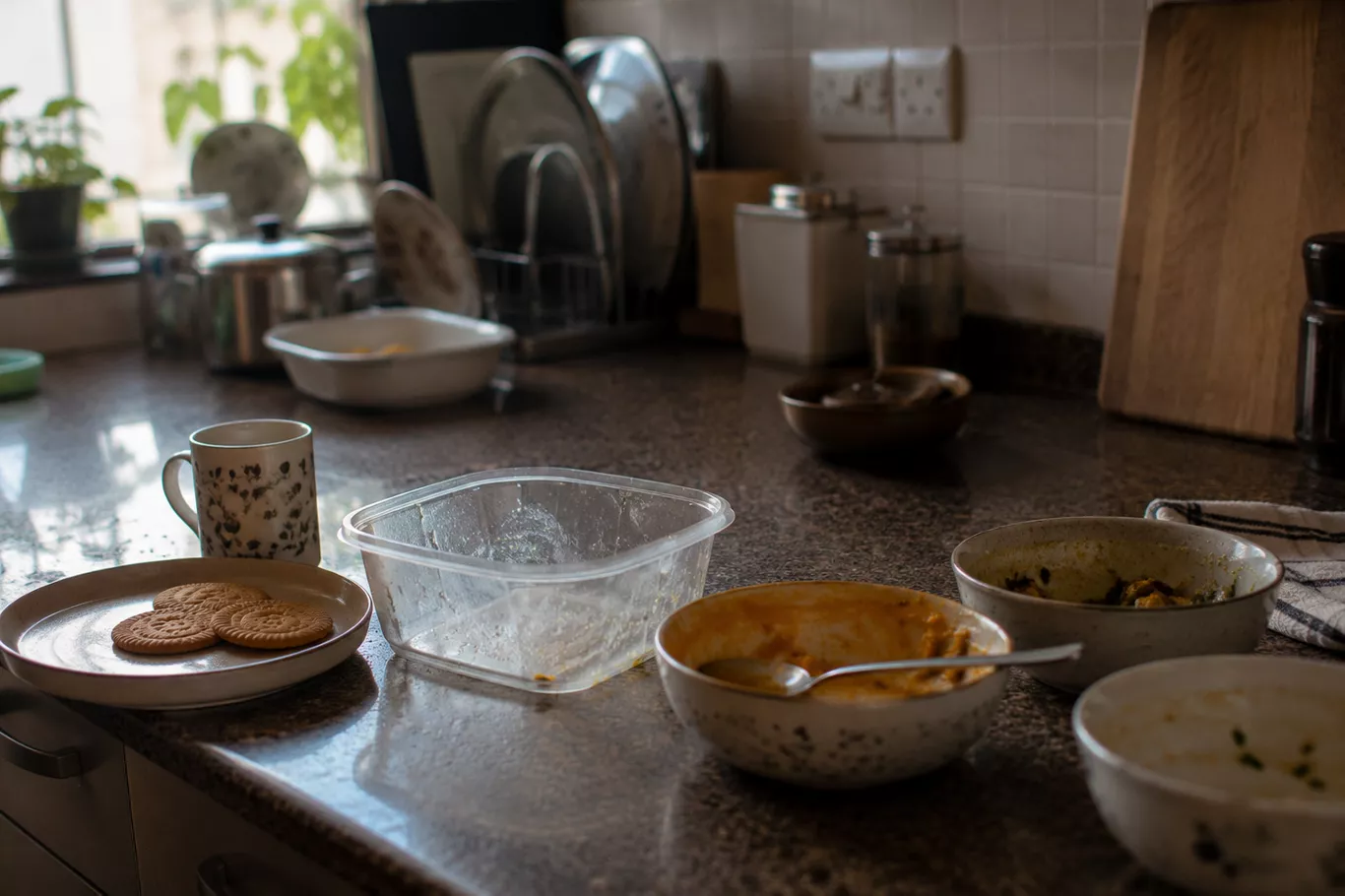
Last week, the issue was two small bowls of leftovers sitting beside one empty container.
I looked at it and saw a small household task.
He looked at it and saw principles.
This is the difference between two people who share a home. One person sees the thing. The other person sees a case.
He said, "This is fine."
I said, "Is it?"
That question did what it always does. It opened court.
**His Standard Is Very Convenient**
My husband's standard for leftovers is based on survival.
If the house does not collapse, if nobody is bleeding, if the object can still be used after some adjustment, he believes the matter is fine. Fine is his favourite category. Fine means no one should ask more questions. Fine means the task can be closed. Fine means he would like to return to his tea.
My standard is less forgiving.
I want the thing to work without negotiation. I want the next person, often me, to not inherit a small problem wearing the costume of a solved one.
He says I make things formal.
I say he makes things vague.
Both of us are right enough to remain annoying.
Priya says her husband saves rice confidently and then refuses to eat it the next day.
That is what comforted me. Apparently every couple has one small object that becomes a referendum. In some houses it is a spoon. In some houses it is a light. In ours, for the week, it was leftovers.
**The Evidence Was Visible**
The evidence was right there.
He wanted to save three spoons of sabzi and throw away half a chutney, which revealed a worldview.
I pointed this out.
He looked at the evidence with the calm of a person who has already decided evidence is a matter of interpretation.
"It still works," he said.
This is not an answer. It is a philosophy.
Many things still work. A cracked mug still holds tea if you are emotionally prepared. A chair with one loose leg still supports a person who has accepted risk. A pen with fading ink still writes if you press as if signing a treaty. That does not mean we should organise our lives around borderline functioning.
He listened politely because he knows a speech when it begins.
Then he said, "You are making it bigger."
I said, "It became bigger when you called it fine."
There was a pause.
He took one Marie biscuit from the plate and ate it slowly. I took that as a delay tactic.
**The Timing Was Bad**
The timing made the matter worse.
These things never happen when both people are rested, fed, and able to act like citizens. They happen at 8:35 at night, when dinner is half ready, one person is looking for a spoon, and the other person has decided this is the exact moment to defend a household theory.
I had been having a normal evening. Tea was decent. The biscuits were still crisp. The house had not yet asked too much of me.
Then leftovers entered the room and chose violence in a small font.
My husband says objects do not choose violence.
This is because objects are kinder to him.
With me, they wait until I am carrying two things and thinking of a third. Then they fail, wobble, leak, ring, slide, stick, or demand a decision. He experiences the failure as one event. I experience it as the latest entry in a file I have been keeping quietly.
**I Am Also Not Innocent**
To be fair, I have my own standards that make no sense to him.
I have a correct way to fold a napkin. I have strong feelings about the shelf where tea should live. I dislike when a wet spoon is placed near dry sugar. I believe some bowls are for snacks and some bowls are for food that has plans.
He has watched all this with patience.
Sometimes he even obeys without understanding, which is a kind of love nobody puts in wedding videos.
So when I criticise his leftovers theory, I am not standing on a clean moral balcony. I am standing in my own pile of preferences, waving from across the room.
The problem is that my preferences feel like order.
His preferences feel like chaos with confidence.
He would say the same thing about me, only with fewer words because he is efficient when irritating.
**The Demonstration Made Things Worse**
He tried to prove his point.
This is always risky.
He picked up the object, adjusted it, moved it, tested it, and looked at me with the expression of a man expecting applause for basic survival.
For three seconds, it did work.
Then it did the exact thing I had warned him about.
I did not smile.
This required character.
He said, "Okay, that time..."
No sentence starting with that time has ever saved anyone.
I waited.
He tried again. It worked again, then failed again in a slightly different way, which gave the object range but did not help his case.
Priya says this is the stage where husbands become loyal to the object because admitting the object is wrong feels like admitting the whole theory is wrong. I think she is right. The object becomes their client.
My husband defended his client for six more minutes.
Then he gave up without calling it giving up.
"Fine, we will change it," he said.
Fine again.
But this time fine was moving in my direction, so I allowed it.
**The Fix Was Small**
The fix took less than five minutes.
That is the silly part.
So many domestic disputes are built around tasks smaller than the argument protecting them. We could have fixed the leftovers before the tea cooled. Instead we held a hearing, called witnesses from memory, insulted each other's standards in mild language, and then did the thing.
The house became better by a small amount.
Not enough for a song.
Enough for peace.
He looked at the fixed thing and said, "Happy?"
I said, "Yes."
He said, "Good."
Then, after a pause, he added, "It was mostly fine before."
I looked at him.
He smiled.
This is how I know he says things for sport.
**The New Rule**
We now have a rule.
If something requires explanation every time someone uses it, it is not fine.
This rule is already making him nervous because it applies to several areas of the house he has been protecting with confidence.
I am being generous and applying it slowly.
Last night, we sat at the table with tea. The Sunfeast Marie Light biscuits were between us. The leftovers issue had been resolved, at least officially. He reached for a biscuit, looked at me, and said, "This packet is almost over."
I appreciated the report.
Then he added, "Still fine."
I said, "Do not start."
He laughed.
I laughed too, because sometimes the argument leaves behind a useful joke, and that is not a bad outcome for a Tuesday.
The house remained exactly as imperfect as before.
But one small thing worked without a speech.
I will take it.


