



Sign in to share
Dhruv Saxena
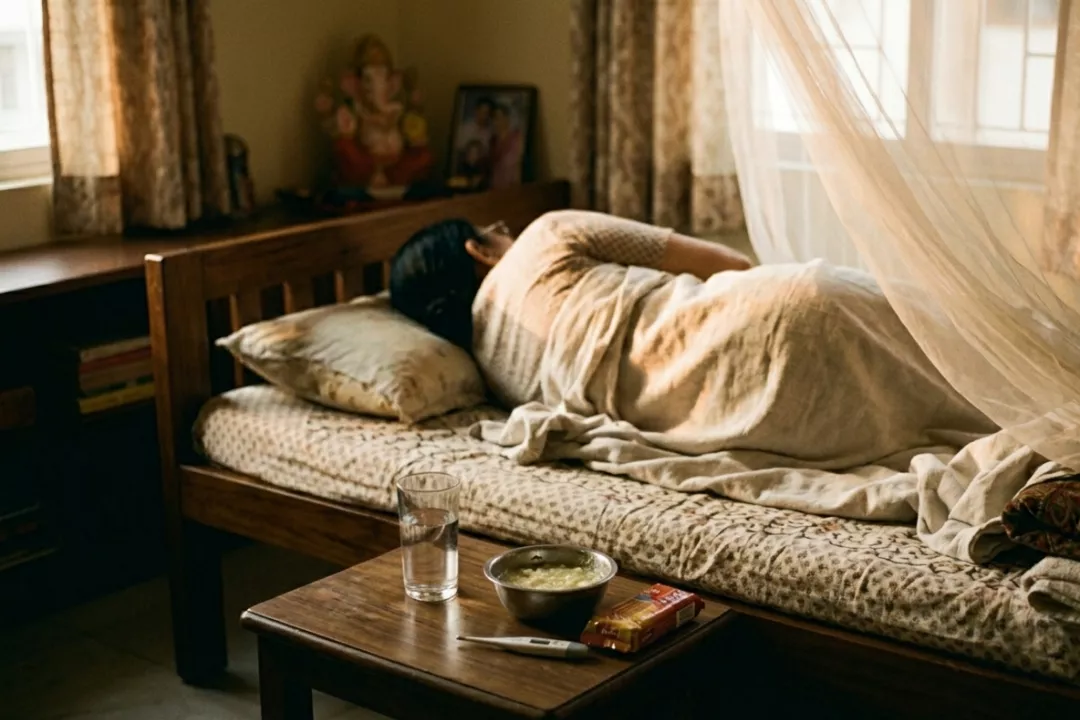
I had a fever in Bangalore last February.
Nothing serious. The kind of fever that requires two days in bed, adequate hydration, and some rest and then resolves itself without drama. I have had this fever or something like it several times in my adult life and I know the protocol and I follow the protocol and the fever goes away.
I lay in my flat. I drank water. I took the tablet. I slept.
At some point on day one I called my mother to tell her, because not telling her would mean she would find out later and that would be worse. She immediately asked a series of questions at a speed that suggested she had been mentally preparing for this call. Temperature. When did it start. Had I eaten. Was I taking something. Did I have the right tablets and not just whatever was at the nearest medical store.
I answered all the questions. She expressed the appropriate level of concern, which was high. She said she would call me in two hours to check on me. She called in forty-five minutes. This was the appropriate level of concern expressing itself in practical terms.
I recovered in two days as expected.
But at some point during those two days, lying in my flat in Bangalore, adequately hydrated, tablet taken, completely managing the situation, I thought about what it would have been like to be sick at home. Not the childhood sick-at-home, where someone else managed everything. The adult version. Where I am the same adult I am in Bangalore but I am sick in the same house as her.
The difference is significant. I have been thinking about it since.
I was home last month. We were at the kitchen table, chai between us and Mom's Magic biscuits on the plate, and I mentioned the February fever. She remembered the February fever. She remembered the exact date of the call, the temperature I had reported, and the specific concern she had had about whether I was eating enough while sick. She had a view on the tablets I had taken and whether they were the best option. She expressed the view. I said I was fine now. She said yes but at the time.
What Happens When You Are Sick at Home
When you are sick at home, the management of the illness is shared.
Not because you cannot manage it yourself. You can. You are an adult. You have been managing your own illnesses in Bangalore for years. But at home the illness does not have to be managed alone. The illness is noticed and attended to and responded to by someone who has been managing your illnesses since before you could describe your symptoms.
She knows when you are sick before you fully register that you are sick. The specific quality of your voice. The way you are sitting. The colour of your face. She runs her own diagnostic before the diagnostic has been asked for and reaches a conclusion.
The conclusion is acted on. Something is made. The specific thing she makes when someone in the house is unwell. Not the regular meal. The illness meal. The one that has been the illness meal your whole life and that you associate with the particular care of being looked after when you are not well.
My friend Nikhil had a bad cold two years ago and went home because his flat felt very quiet when he was unwell. He said the decision to go home took approximately four minutes of lying in his flat coughing. He called his mother, said he was coming, and got in the car. She had the illness soup ready by the time he arrived.
He said the soup was the same soup it had always been. He had eaten that soup sick at age seven and sick at age twenty-nine and it tasted exactly the same both times. Not because the recipe had not changed. Because the soup was not really about the soup.
The Silence in Bangalore
What I noticed during the February fever was the silence.
Not an unpleasant silence. My flat is my flat and I am comfortable in it. But when you are sick, the flat is very quiet in a specific way. The quiet of a space that has no awareness of your condition. The walls do not know you have a fever. The kitchen does not know you need something. The entire environment is neutral in the way that environments are neutral when there is no one in them who loves you.
In Delhi, the house is not neutral. The house has her in it. She knows you have a fever. The house adjusts. Sounds get slightly quieter. The television in the other room goes down. The kitchen produces things. The environment is not neutral. The environment is organised around your condition.
My friend Karan described it as the difference between being sick and being taken care of while sick. In Bangalore he was sick. At home he was sick and also being taken care of and the second part made the first part a different experience.
He said he got a cold once and went home for it. He got better in the same amount of time he would have gotten better in Hyderabad. But the better in Hyderabad would have been lonely and the better at home was not lonely. He cannot measure this as a health variable. He knows it mattered.
The Adult Version
I want to be specific that what I am describing is not the childhood sick-at-home.
The childhood sick-at-home had its own quality, which was the quality of having no responsibility for the management of anything. You were sick and someone else handled everything and your only job was to be sick and recover.
The adult version is different. I am sick and I am also managing the situation. I know what I need. I am capable of getting it. I am doing everything right. But she is also there, and she is also doing things, and the combination of my managing and her attending produces something that neither of us could produce alone.
She respects that I am an adult managing an illness. I respect that she needs to attend to it. We operate in parallel. The illness is handled. The handling has two people in it.
I recovered from the February fever in two days. I was fine. I managed it alone and I was fine.
But I have decided that the next time I am sick in Bangalore and the fever goes past day one, I am going home.
I am going to call her and say I am coming.
She will have the illness meal ready by the time I arrive.
She has had it ready, in some sense, for thirty-one years.


