



Sign in to share
Shikha Sharma
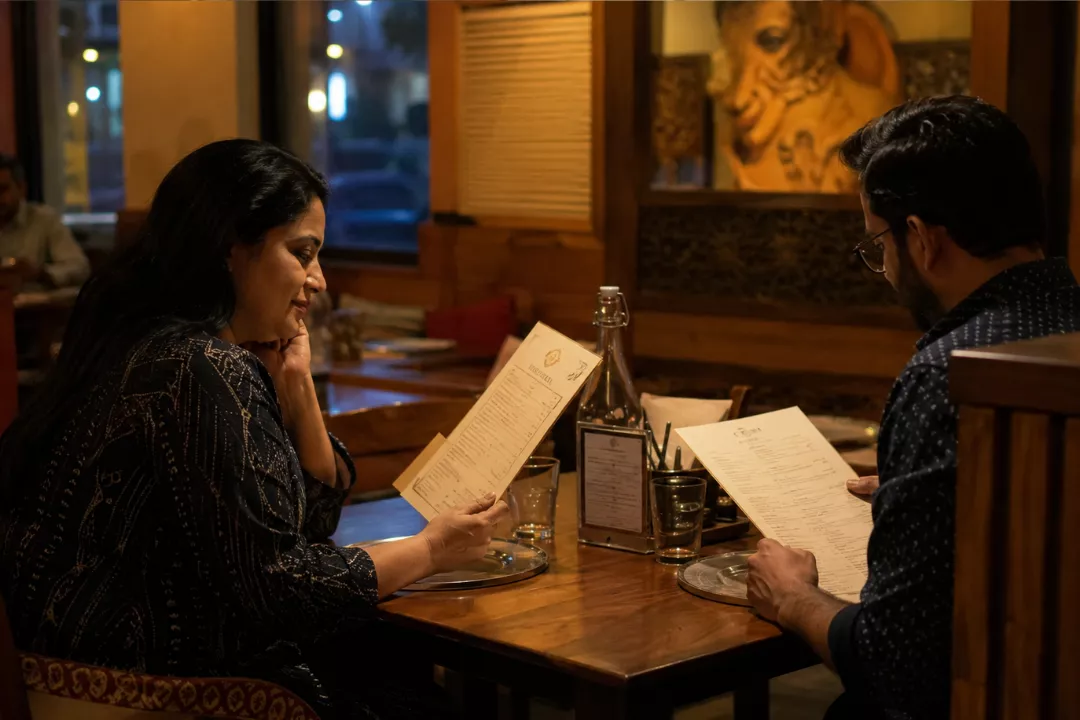
I know what my husband will order before he opens the menu. Not a guess. A certainty. After six years of eating at restaurants together I have accumulated enough data that the order is predictable with high confidence across a wide range of cuisines and establishments. I can look at a menu I have never seen before and identify, within thirty seconds, the thing he is going to order. He knows this. I know this. We have discussed it. He finds it mildly amusing. I find it mildly impressive as a feat of passive data collection. The data was not collected deliberately. It accumulated over dinners and lunches and the occasional breakfast out and the late-night places we found ourselves at after things, and across all of these the patterns emerged without my tracking them. I was just eating with him and the patterns arrived. The patterns are: he will order the most interesting protein on the menu if there is an interesting protein. If there is no interesting protein he will order the thing that sounds most like it was made by someone who thought about it. He does not order safe options. He does not order the first thing he sees. He reads the menu with attention and selects with intention and the selection is almost always the thing I would also have predicted. We were at a new restaurant last month, a place we had not been to before. He was reading the menu. I looked at the menu and identified the thing. He looked up and said what are you thinking. I said I was thinking he was going to order the lamb. He looked back at the menu. He ordered the lamb. We had Sunfeast Marie Light with our chai after the meal because that is what we do at the end of meals at home and sometimes the end-of-meal habit follows us out. He said how did you know. I said I just know. He said that was slightly unsettling. I said I found it quite satisfying. The Archive The knowing is built from an archive of meals. Every meal out together adds to the archive. The archive contains: what was ordered, what was enjoyed, what was noted as interesting, what was a mistake, and what was requested again. The archive runs automatically. I am not maintaining it. It maintains itself through the accumulation of experience. The archive allows prediction. But it also allows something else, which is the ability to order for him when he is not there to order for himself. If he is running late and the server comes and I know he is coming and I know what he will want, I can order without asking. The order will be right. I know it will be right because the archive is accurate. My friend Priya can order for her husband at approximately thirty restaurants in Bangalore. She did not set out to develop this capability. It developed over four years of eating together. She tested it once when he was late. She ordered for him. He arrived. He looked at the order and said he would have ordered exactly that. She said she knew. He said it was impressive. She said it was just data. What the Knowing Feels Like The knowing is not interesting in the abstract. In the moment, at the table, it is a small, specific pleasure. You look at the menu. You identify the thing. He reads the menu. He orders the thing. There is a brief, private satisfaction that does not need to be announced. You know him. You know this specific thing about him. The knowing is evidence of time spent, meals shared, patterns accumulated. It is not a dramatic intimacy. It is not the intimacy of a difficult conversation or a moment of vulnerability or a decision made together. It is the intimacy of small, consistent, accumulated knowledge. The kind that only comes from being present over time. My friend Kabir's wife knows his coffee order at every coffee shop he has ever been to with her. Not just the type. The temperature, the milk ratio, the size, the adjustment he makes at each specific shop because each shop's default is slightly different from his preference. She knows the adjustments. She has never written them down. She just knows. He found this out when she ordered his coffee without asking at a new place. She ordered it with the adjustment he would have made. He had not told her he would make the adjustment. She had inferred it from the pattern. He said he found it extremely unsettling for about four seconds and then extremely comforting for much longer. The Limit of the Knowing The knowing has a limit. I know his order at restaurants. I do not always know what he wants for dinner at home. The home dinner question is not subject to the same pattern-finding because the home dinner is dependent on mood and tiredness and what he ate for lunch and whether the week has been good and whether he feels like something heavy or light. The variables are different from restaurants. Restaurants are occasions. Home is just a Tuesday. My friend Meera described the same limit in her marriage. She knows her husband's restaurant order completely. She does not always know what he wants when she asks what do you want for dinner and he says I don't mind. She said I don't mind is the most useless response available because it is not true. He minds. Everyone minds. He just does not know what he minds yet and she is being asked to determine it for him. She has started asking more specific questions. Not what do you want but do you want something heavy or something light. Then: do you want rice or not. Then: do you want something spicy. The narrowing works better than the open question. He can answer the narrow questions. He cannot answer the open one. The restaurant order is settled. The Tuesday dinner remains a negotiation. After six years it is still a negotiation. Some things do not accumulate into certainty.


