



Sign in to share
Dhruv Saxena
I have brought exactly two people home to meet my mother.
The first time I was twenty-four and had not sufficiently prepared either the person or myself for what was about to happen. The second time I was twenty-seven and I had prepared extensively and it still went largely as the first time had gone, which told me something about the limits of preparation.
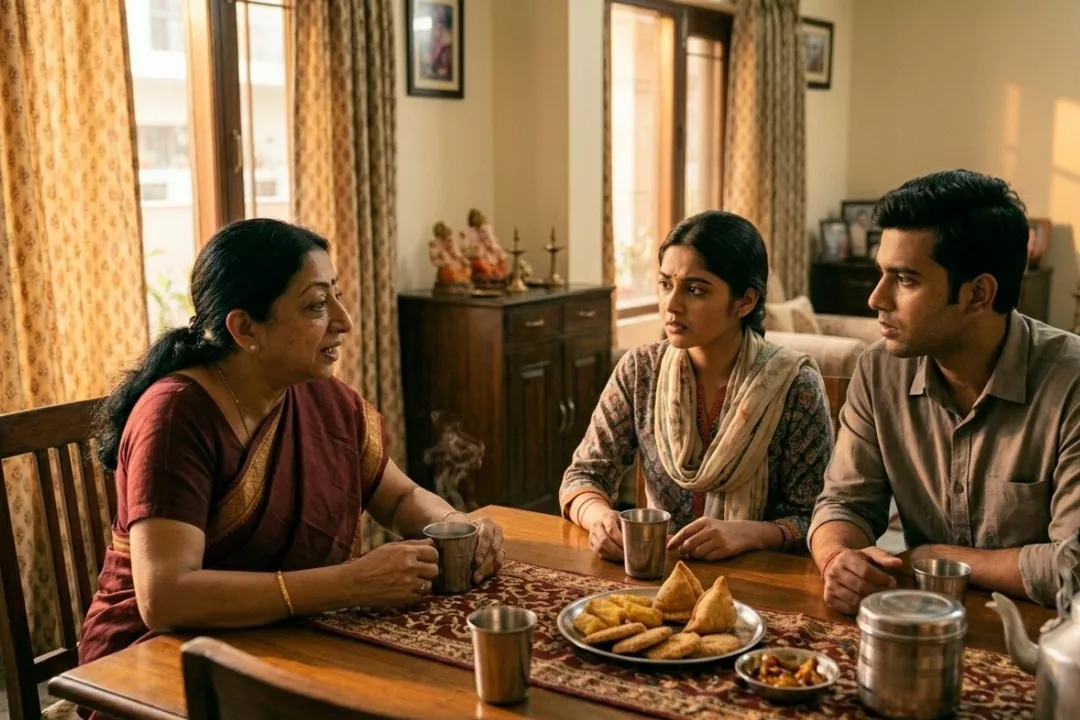
Both times, the experience followed the same basic structure. My mother was warm and welcoming and asked a lot of questions. The questions were delivered with complete hospitality and covered every significant area of another person's life within approximately forty-five minutes. The food kept arriving as punctuation. The assessment was conducted entirely behind a smile that gave nothing away.
I will walk you through what actually happens, for the benefit of anyone who has not yet experienced it and is preparing to.
The preparation begins before the person arrives. My mother cleans a house that is already clean. She cooks things that she has planned in advance based on information I have provided about dietary preferences, which she has taken seriously and then supplemented with additional items in case the stated preferences were incomplete. She has changed her outfit once, possibly twice. She is ready.
I arrive with the person. My mother opens the door. She smiles. She says come in, come in. She offers chai within the first ninety seconds, which is not a question. The chai is already being made. The offer is a formality.
I was home two months ago when a friend brought someone to meet his parents. His mother had put out an arrangement of things on the table including, he told me later, the good crockery, fresh fruit, three types of snacks, and Mom's Magic biscuits on a separate plate, arranged, which as I have noted elsewhere is exclusively a guest and assessment service. The spread was a signal. This was an important visit. Everything was out.
The Questions
The questions begin within the first ten minutes and continue for the duration of the visit. They are not experienced as questions by the person being questioned because they arrive embedded in conversation, in the natural flow of talking, in expressions of interest that are genuine but also strategic.
What does your family do. Where are you from originally. What are you doing now professionally. Where did you study. Do you have siblings. What are your parents like. Do you cook. How long have you been in the city.
Each question receives an answer which is processed in real time and filed. The filing is invisible. My mother's face while receiving the answers is warm and interested and gives no indication of the assessment happening simultaneously behind it.
The professional question is the most important. My mother wants to know not just what you do but what the trajectory looks like. Whether the thing you are doing now is a step toward something or a destination. She is interested in stability. Not wealth specifically. Stability. The sense that you have a plan and are executing it.
The family question is equally important. She wants to understand the context you come from. Not to judge it. To understand it. The context tells her things the direct answers do not.
The Food Assessment
The food keeps coming because this is what happens when my mother wants to take care of someone and also, not unrelatedly, because watching how someone receives food tells you things.
Do they eat properly or do they pick at things. Do they say no thank you too quickly or do they receive the offer with warmth. Do they compliment the food specifically or generally. Do they take second helpings or restrain themselves.
None of these things are decisive. All of them go into the file.
My friend Karan brought someone home once who refused the chai. Not rudely. Just said she did not drink chai. This was received by his mother with complete graciousness and an immediate offer of alternatives. But Karan said he could see, in the fraction of a second before the graciousness, something register. The chai refusal went into the file. Not as a mark against. Just as information.
The person who takes the food and eats it properly and says something specific about it and accepts the second helping is doing well. They may not know they are being assessed. The assessment is happening.
The Smile
My mother's smile during these visits is one of the most impressive things I have observed in thirty-one years.
It gives nothing away. It is warm and genuine and contains nothing that could be read as approval or disapproval or uncertainty. She is an excellent host. She makes people feel welcome. The assessment runs underneath the hosting like a parallel programme and never surfaces.
I have never, during the visit itself, been able to tell what she thinks. I find out later, sometimes much later, in the way I find out most things about my mother, which is obliquely, in the context of some other conversation.
After the first person I brought home, I found out her opinion three weeks later when she mentioned, in passing, something about what she had noticed. She had noticed things I had not noticed. Specific things. Things that turned out to be accurate.
I do not know how she does this. I have watched her conduct the assessment and I cannot identify when the noting happens because the smile never changes.
The Debrief
After the visit ends and the person has left, there is a debrief.
Not immediately. She does not debrief in the car on the way back or the moment the door closes. She waits. She processes. She lets some time pass. And then, when it is natural, she says something.
What she says is always measured. She does not give a verdict. She shares an observation. She mentions something she noticed. She asks a question that contains an opinion inside it.
With the first person I brought home, the observation she shared three weeks later was about something specific she had seen that I had not registered as significant. She was right. It was significant. It took me another year to fully understand what she had seen in forty-five minutes.
This is the thing about my mother's assessment. It is not about whether she likes the person. That comes later. What she is doing in those forty-five minutes is seeing. Really seeing. With thirty years of watching people and reading situations and understanding what things mean.
She is not interviewing you. She is meeting you. Fully. In the way that very few people have the patience and skill to meet someone.
The food and the questions and the smile are the method. The seeing is the point.
Bring someone home. Let her see them.
She will notice things you missed. She usually does.


