



Sign in to share
Shikha Sharma
Every couple I know has at least one topic they’ve silently, and mutually agreed to never discuss. It came up once, someone changed the subject, the other person let them, and they’ve been quietly maintaining that arrangement ever since. It's an unspoken treaty. We don't go there. And as long as neither of us goes there, we're fine.
The problem with unspoken treaties is that they have an expiry date.
I've watched this happen enough times to recognise the pattern. The avoided conversation doesn't disappear. It just goes underground, picks up weight, and resurfaces later. Usually at the worst possible moment, louder than it needed to be, and with months of accumulated pressure behind it.
So let's talk about the three conversations most couples are currently not having.
Conversation One: Money
Money is the one that surprises people the most, because most couples think they've had the money conversation when they really haven't. They've had the surface version. They know each other's rough salary range. They've figured out how to split rent. They've had the "are we saving enough" check-in a few times.
But the actual money conversation, the one about values, fears, and what money means to each of you, that one's usually still sitting in the avoided pile.
My friend Sameera and her husband discovered this three years into their marriage when they started talking about buying a flat. Suddenly they weren't just talking about EMIs. They were talking about security, about what enough looks like, about the fact that she'd grown up with financial anxiety and he'd grown up with financial ease, and those two things produce very different people with very different relationships to spending, saving, and risk. They'd shared a bank account for three years and had no idea about any of this.
The money conversation isn't really about money. It's about what money represents to each person, safety, freedom, status, control, and whether those meanings are compatible. And the best time to have it is before you're about to make a major financial decision together, when nothing's at stake and nobody's defensive.
Bring it up on a relaxed evening, not as a formal sit-down but as genuine curiosity. What's your earliest money memory? What did your parents' relationship with money look like? What would feeling financially secure actually feel like to you? These questions open the real conversation. The EMI discussion is much easier once you've had it.
Conversation Two: In-Laws
This is the one that makes people the most uncomfortable, and also the one I've watched cause the most damage when avoided.
In Indian relationships especially, in-laws aren't a peripheral consideration. They're a central one. How a couple navigates that, whose family gets priority, what boundaries exist, how much say parents have in decisions, needs to be talked about directly, not figured out in real time during a crisis.
The reason couples avoid this conversation is that it feels disloyal. Talking about boundaries with your partner regarding your own parents feels like betraying the people who raised you. So nobody says anything. And then someone's mother-in-law makes a comment, or someone's father weighs in on a decision that wasn't his to weigh in on, and suddenly there's a fight that's been waiting to happen for two years.
My colleague Ritu told me she and her husband didn't have this conversation until they'd been married for four years. By that point, patterns had already set in that were very hard to undo. "We should have talked about it before the wedding," she said. "Or at least in the first year. Not after everyone already had expectations."
The framing that works, from what I've observed, is to approach it as a team exercise rather than a negotiation. The goal isn't "your parents do this and I don't like it" but "how do we want to handle this together going forward." You're building a shared position, not assigning blame. That distinction matters more than you'd think.
Conversation Three: What If We Grow Apart
This is the one nobody wants to touch, and I completely understand why. It feels like inviting bad luck, like talking about the possibility of growing apart makes it more likely.
It doesn't. What you're actually doing is acknowledging that you're both going to keep changing, and that staying together requires intention rather than just inertia.
My friend Deepa brought this up with her husband a couple of years ago, and she said his initial reaction was panic. "He thought I was telling him I wanted to leave," she told me. "It took about ten minutes to explain that I was actually saying the opposite, that I wanted to make sure we kept choosing each other on purpose, not just by default."
Once he understood that, the conversation became one of the most useful they'd ever had. They talked about what they each needed to feel like they were still growing, what staying connected looked like to them over the next decade, and what they'd do if they started to feel disconnected. It's not a morbid conversation. It's actually quite an intimate one. It says: I'm taking us seriously enough to think about the long game.
The right time for this one is when things are good, during a calm, connected period when both of you have the security to be honest without it feeling like a threat.
Why We Avoid Them and What It Costs
The reason all three of these conversations get avoided is the same: they feel risky. What if we disagree? What if we find out we're less compatible than we thought? What if saying it out loud makes it real?
But here's what I've watched happen when couples don't have them. The disagreements happen anyway, just without any of the context or goodwill that an earlier conversation would have built. The incompatibilities surface at the worst possible moment. The things left unsaid calcify into resentment that's much harder to shift than an honest conversation ever would have been.
The couples who've had these conversations aren't the ones without problems. They're just the ones whose problems don't ambush them. They know where the rough edges are, they've agreed on how to handle them, and when things get hard, which they will, because that's just relationships, they're already facing the same direction.
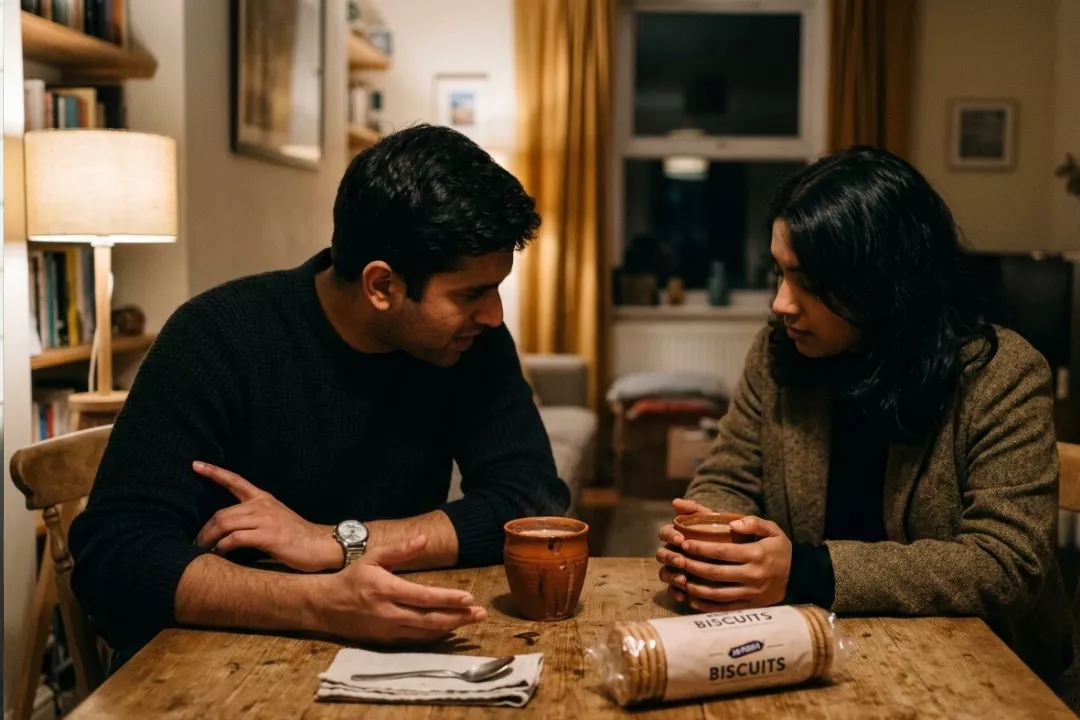
My suggestion for all three of these, genuinely, is to pick an evening when there's nowhere to be and nothing urgent happening. Make chai. Put Sunfeast Marie Light on the table because these conversations go better with something familiar and unhurried in your hands. And then just start. The beginning is always the hardest part. Once you're in it, most couples find it's not nearly as scary as the avoiding made it seem.
That's worth one uncomfortable evening. Actually, make it two cups. Some of these conversations take a while.


