



Sign in to share
Shikha Sharma
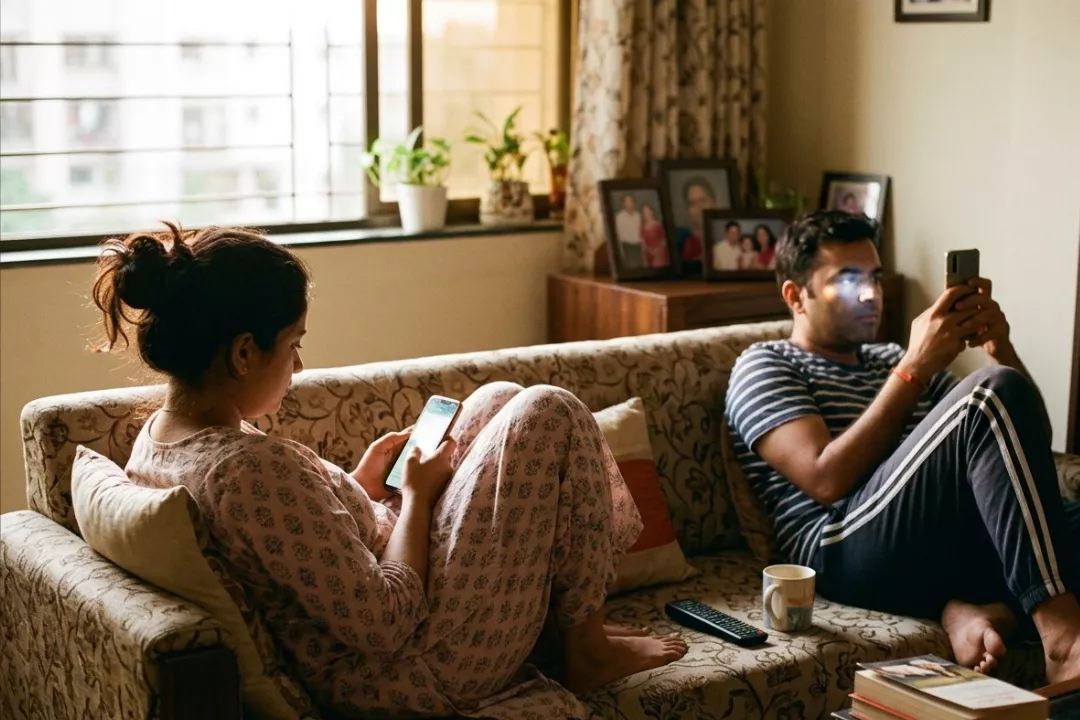
My husband and I have never discussed our phone rules.
We have never sat down and agreed on them. There was no conversation, no negotiation, no moment where we looked at each other and said here is how this is going to work. The rules simply developed, the way the best domestic systems develop, through a series of small incidents and adjustments and moments where someone did something and the other person's reaction made clear whether that thing was acceptable or not.
It took about two years. Now we have a complete system that neither of us could fully articulate if asked but that both of us follow with remarkable consistency.
Here is what I have worked out so far.
He can pick up my phone to check the time. This is the most basic permission. Checking the time is neutral. It implies nothing about reading anything else on the phone. He can pick it up, look at the time, put it down. This is fine.
He cannot read a notification that appears while he is holding the phone to check the time. If a message arrives while he is checking the time, his eyes should move past it. He knows this. He does this. I have never told him to do this.
I cannot answer his calls when he is in the shower. The phone rings, I see who it is, I do not answer. His calls are his. If it is important they will call back or leave a voicemail or, more likely, send a message. My answering would require me to speak on his behalf which is a different category of phone involvement than we have agreed to, even though we have not agreed to it explicitly.
He does not read my messages. Not from any specific policy. Just because reading someone's messages without them being present is a different order of access than anything else, and we have never crossed it, and the not crossing of it has become its own rule through the accumulation of instances where it was not crossed.
Last Tuesday he was sitting next to me on the couch and my phone was on the table and a message came in that was visible on the screen. I watched his eyes. They did not go to it. He was looking at his own phone. I noted this with the quiet satisfaction of someone who has a system that is working.
I was telling my friend Priya about this over chai last week. She had brought Sunfeast Marie Light and we were having one of those Sunday afternoon conversations where you end up talking about something you had not planned to talk about, and she said she and her husband had the exact same system, developed the exact same way, never discussed.
Neither couple has a written policy. Both couples are following one.
The Gallery
The gallery is the most protected territory.
Neither of us goes into the other's photo gallery without being specifically invited. Not because there is anything to hide. Because the gallery is a private archive. It contains things that are personal in the particular way that accumulated photographs are personal, not because of their content but because of what they represent. Moments, moods, things saved for reasons that do not need to be explained to anyone.
My husband has never gone into my gallery without me showing him something. I have never gone into his. This is the strictest rule in the system and neither of us has come close to breaking it.
I asked him once why he thought this was. He said he would not go through someone's journal. The gallery is the same thing in a different format. He said this so matter-of-factly that I understood it had always been obvious to him. It had always been obvious to me too. We had both arrived at the same conclusion independently and the conclusion had become the rule.
The Work Calls
Work calls are their own category.
If he is on a work call I leave the room, or if I cannot leave the room I make myself as absent as possible. Not because the call is confidential necessarily. Because being present while someone has a work call creates a witness to a performance they are doing for someone else, and witnesses change performances, and the work call should just be the work call.
He does the same for me. If I am on a work call he disappears. He does this so reliably that I do not think about it. The disappearing is just what happens.
We have never discussed why. It is the same reason you do not stand behind someone while they are writing an email. The thing they are doing is for someone else. Be elsewhere.
The Last Seen
WhatsApp last seen is information neither of us uses.
I know what his last seen was. He knows mine. This information is technically available at all times. We have an unspoken agreement not to use it as evidence in any conversation.
If he last-seen-ed at 11pm and did not reply to my message from 10:30pm, I do not mention this. The message will be replied to when it is replied to. Last seen is data that exists for operational purposes, not interpretive ones.
This rule was arrived at after one early relationship incident where I mentioned someone's last seen in a way that turned out to be the wrong thing to mention and the wrongness of it was immediately clear and has not been repeated since. That single incident established a permanent rule. The system learns.
The Phones in Bed
The phones are allowed in bed. We have not enforced a no-phones-in-bed rule because we have tried this and it does not reflect how either of us actually works, which is that sometimes you want to look at your phone before sleeping and that is fine.
The unspoken rule about phones in bed is that you do not narrate what you are looking at unless you are sharing it. If you are laughing at something, you can show it. If you are reading something, you read it. The phone is a private activity even when you are in the same room doing it simultaneously.
You do not say what are you laughing at unless the laughter seems like the kind that is being withheld from you.
You do not show things unless they are showable.
You do not ask about the phone activity unless there is a reason to ask.
These are sophisticated rules for a system that has never been articulated.
The System
I have been trying to work out what the system actually is and I think it is this.
We treat each other's phones the way we would want our own phone treated. The access we would not want extended to us, we do not extend. The space we would want maintained around our own device, we maintain around theirs.
It is not about trust in the suspicious sense. We trust each other. It is about something adjacent to trust, which is respect for a boundary that exists not because anything needs to be hidden but because everyone deserves a private interior, even inside a marriage.
The phones are one expression of the private interior.
The rules are how we protect it for each other.
Neither of us had to say a word.


