



Sign in to share
Dhruv Saxena
My mother was twenty-two once.
I know this mathematically. I know the year she was born and I know how years work and the calculation is straightforward. But knowing it mathematically is different from being able to picture it. The version of my mother that was twenty-two is not a version I have access to. She existed before I did. She was a complete person, with a life and friends and opinions and a future she could not yet see, and none of that is available to me in direct experience.
It is available to me in other people's stories.
The first time I understood this properly was at a family event when I was maybe nineteen. A relative of my mother's, an aunt I did not know well, started talking to me about my mother. Not about my mother the mother. About my mother the person who existed before that. The aunt said something about what my mother had been like at a specific age and used a word to describe her that I had never heard used in relation to my mother in my entire life.
The word was mischievous.
I said sorry, could you say that again.
The aunt said my mother had been absolutely mischievous as a young woman. She told me a story. The story involved my mother doing something that I will not detail here but that bore no resemblance to any version of my mother I had ever encountered. I listened to the whole story. I looked at my mother across the room. She had not heard this conversation. She was talking to someone else. She looked exactly the same as she always looks.
I came home and sat with the story for a while.
I was home last month, at the kitchen table, chai between us, Mom's Magic biscuits on the plate, and I asked her about the aunt's story. I had been meaning to ask for years. She listened to me describe it and then her expression did something I had not seen it do before. It went slightly away. Not in a sad way. In the way expressions go when someone is remembering something from a long time ago that still has weight to it.
She said yes, she remembered that. She did not elaborate. I asked her to elaborate. She said it was a long time ago. I said I had a lot of time. She picked up her chai.
She did not elaborate. But the expression told me everything I needed to know, which is that the story was real and the aunt's word was accurate and there is a version of my mother that I have never met.
The Aunt's Archive
The aunt is the primary source.
Aunts, family friends, her own friends from before I existed, relatives who knew her as a child, neighbours from the old house, colleagues from her first job that I sometimes get to speak to at family functions. These are the people who have access to the parts of my mother's life that predate me.
Each of them has a piece. No single person has the whole picture. But if you could assemble all the pieces you would have a portrait of a person I have never met who is also the person I know better than almost anyone.
My friend Nikhil has been doing what I have been doing for a few years now. Collecting the stories. When he meets people who knew his mother before he was born, he asks them things. Not intrusively. Just the question that opens the conversation, which is what was she like when you first knew her, and then he listens.
He has found out that his mother was, by multiple accounts, the funniest person in her friend group. Not funny in the way she is funny now, which is a dry, deadpan funny that arrives unexpectedly. Funny in a louder, more confident way that he has never witnessed. He said this information changed something small in how he understands her.
The Photographs
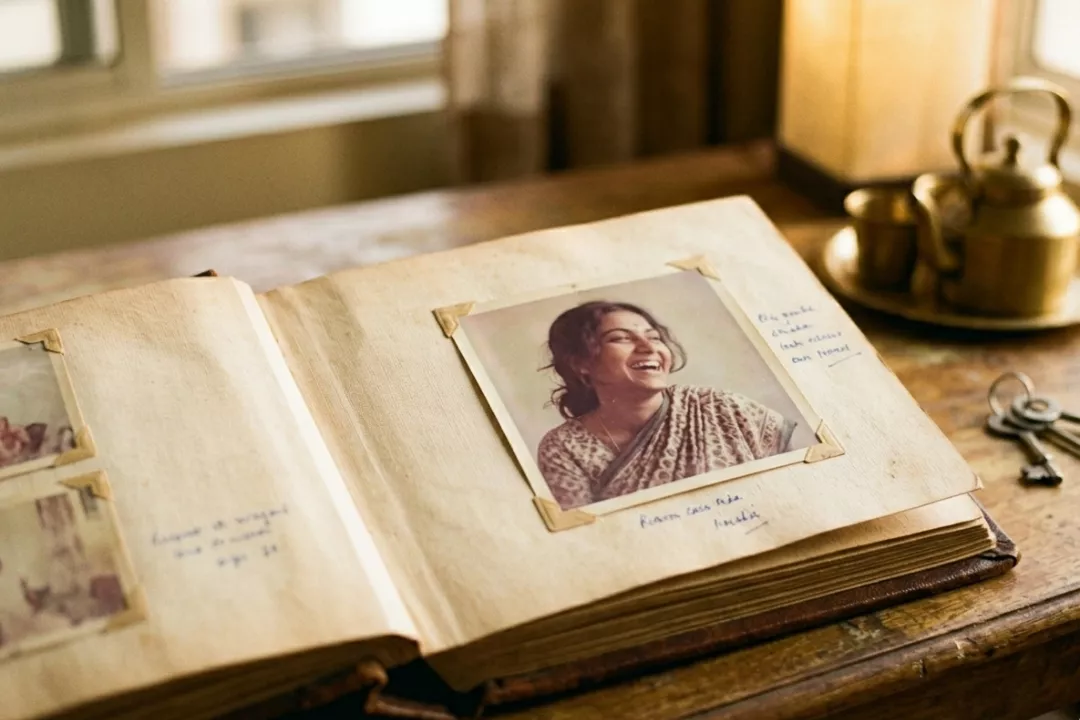
The photographs are a second archive.
There are photographs of my mother from before I existed. I have looked at these with more attention as I have gotten older. Not just at what she looks like, though that is interesting too. At the context. Where she is. Who she is with. What the occasion seems to be. What the expression on her face is doing.
There is one photograph I keep returning to. It was taken before my parents were married. She is standing somewhere I do not recognise, she is with people I cannot identify, and she is laughing. Not the polite laugh she does at family functions. A full, genuine, slightly helpless laugh, the kind that happens when something has genuinely caught you off guard. I do not know what was funny. I cannot ask the photograph.
But I look at it and I see someone who was caught completely off guard by something delightful and had not yet learned to manage her expressions in the way that parents learn to manage their expressions because their children are watching.
I look exactly like that when I laugh.
What She Was Before She Was My Mother
My mother had a career she made decisions about before she had me. She had friendships that existed for years before I was born and that I know only partially. She had opinions and preferences and ways of spending her time that were entirely hers, that had nothing to do with being a mother because she was not yet a mother.
She had a version of herself that was not organised around anyone else.
I think about this version sometimes. The version that made its own decisions without calculating their effect on a child. The version that went places and did things because she wanted to, not because someone needed to be taken or brought or looked after.
That version is still there. I catch glimpses of it sometimes. When she is with her oldest friend and they are talking about something from before my time and her posture changes slightly. When she laughs the real laugh. When she says something and the thing she says is the mischievous thing and she looks, briefly, like the aunt's story.
She became my mother and she is excellent at it and it has been the shape of her life for thirty-one years.
But she was someone else first. That someone else is still inside her.
I would like to know her better. I am going to ask better questions.
I am going to start at the next visit. When the chai is out and the biscuits are on the plate and there is nowhere to be and she is, for a moment, just a person at a table.
I am going to say what were you like when you were twenty-two.


