



Sign in to share
Shikha Sharma
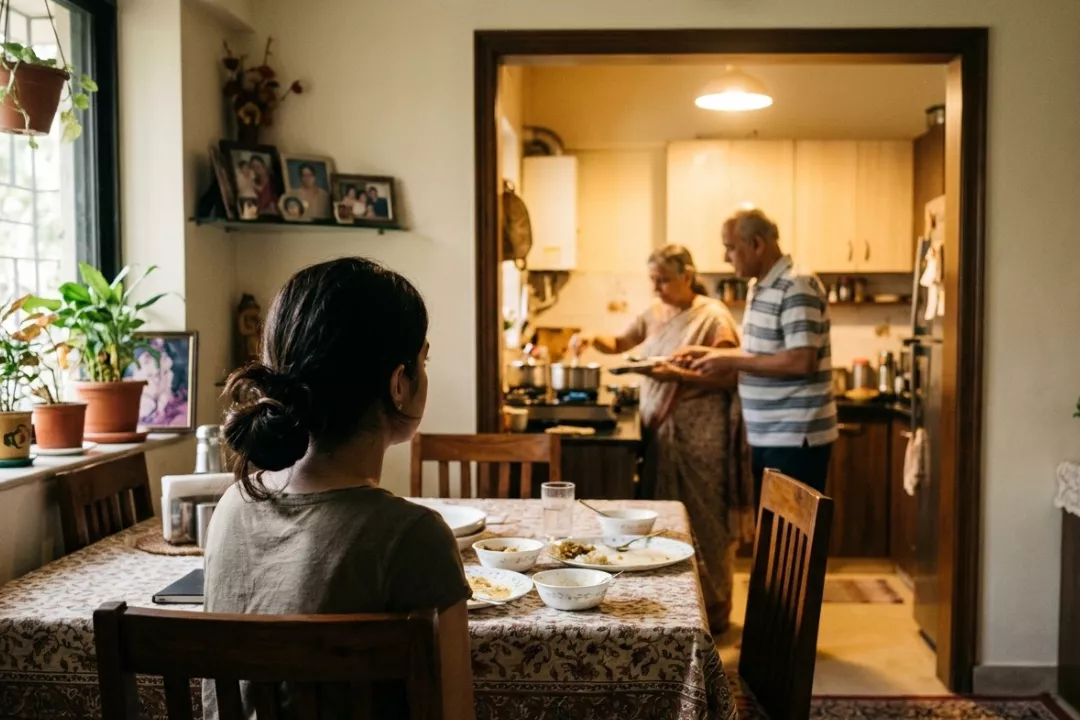
We lived with my in-laws for five weeks last year.
This was not the plan. The plan was two weeks while our flat was being painted. The painting took longer than the painter had suggested it would take, which my husband had predicted and I had chosen to be optimistic about, and so two weeks became five weeks and we lived with my in-laws for five weeks and I learned more about my husband in that time than I had learned in the previous three years of knowing him.
Not because anything dramatic happened. Because I got to watch him in a context I had never had access to before. The childhood home context. The context in which he was formed. The place where the person I married was built.
He is different there.
Not a different person. The same person with different settings. More relaxed in some ways, more formal in others. There are ways he behaves in his parents' house that I had never seen because they only exist in that house. Ways he sits. Ways he speaks. The specific way he addresses his father that is different from how he addresses anyone else. The way he becomes, slightly, the version of himself that existed before I knew him.
I found this fascinating. I also found it occasionally bewildering. There was a version of my husband that was not available to me normally and was suddenly very available, and the sudden availability was a lot of information at once.
The first week I mostly observed. I was a guest in a house that was his and not mine and the guest instinct was strong and I was paying attention to everything.
By the second week I was starting to understand the house's systems. Where things went. How meals worked. The timing of the evenings. The specific way his mother and father moved around each other that told you everything about how they had built their life.
My mother-in-law put out Sunfeast Marie Light with afternoon chai every day without fail. By week three I was in the kitchen helping with things and the afternoon chai was just part of how the day worked, and I was sitting at the table that my husband had sat at his whole childhood, eating the same biscuits he had eaten his whole childhood, and understanding something about what his ordinary had looked like before it included me.
What the House Reveals
The childhood home is a document.
Everything in it was decided by someone else, before him, and he has absorbed it so completely that he does not notice it. The way the furniture is arranged. The timing of meals. The sounds that are normal and the sounds that would be noticeable. The specific threshold for how loud something can be before it requires comment. The temperature at which the house is kept.
All of this is data about the person I married. Data I could not have accessed any other way because it is not data he carries consciously. It is just how things are. He cannot tell me about it because he does not know it as information. He knows it as home.
I noticed things about him in that house that explained things I had been confused about for three years.
He cannot sleep if there is noise. His childhood home was very quiet at night. I had thought this was just his preference. It is his baseline. The noise level his nervous system considers normal for sleeping was calibrated in that house, in the quiet, for twenty years.
He makes the bed every morning without thinking about it. His mother makes the bed every morning. His father makes the bed every morning. It is just what happens. It is not a habit he developed. It is the water he grew up swimming in.
He is immediately better at dealing with problems when he has had food. Not because food helps him think, though maybe it does. Because in his house, when something needed to be addressed, someone made chai first. The problem waited for the chai. The chai was not a delay. The chai was the beginning of how you handled things.
What He Learned About Me
The observation went both ways.
He watched me navigate his house and he learned things about me that he had not known. How I am in unfamiliar domestic environments. What I default to when I am not in control of the space. The specific way I manage the discomfort of being a guest in a place where I want to feel at home but have not yet earned the right to move freely.
He noticed things I did not know I was doing. He mentioned some of them after we left. Not critically. As information. Observations he had filed during five weeks of watching me in a context he knew well and I did not.
I found out I become very formal when I am uncertain. That I ask permission for things I do not need to ask permission for. That I retreat to helpfulness when I do not know where to stand.
He found this out from watching me in his house. He could not have found it out any other way.
What We Brought Home
We came home after five weeks with information we had not left with.
Some of it we have used. Some of it is just sitting in the background, part of the larger picture we have of each other now. The picture is more complete than it was. We have seen each other in more contexts and the more contexts you have seen someone in, the more accurately you understand what they are made of.
He made chai the first morning we were home. He made it the same way his mother makes it, which is the same way he has always made it, but I noticed it differently now. I knew where it came from. I knew the kitchen it had been learned in and the mornings it had been made in and the table where it had been drunk.
The chai was the same. I was seeing it more completely.
That is what five weeks in the childhood home gives you. Not a different person. A more complete picture of the same one.
It is worth the inconvenience of an extended painting project.
Even when the painter was two weeks late.


