



Sign in to share
Dhruv Saxena
I have been trying to figure this out for years.
Not in a surveillance way. In the way you wonder about someone you love. What does her day actually look like when I am not in it. What does she do when the door closes and the house is hers and there is nobody to cook for or check on or worry about.
I have asked her directly. She says she keeps herself busy. This is the least informative possible answer and she knows it and gives it anyway.
So I have been collecting data from other sources. Friends who have gone home unexpectedly and caught their mothers mid-whatever. Fathers who have reported back. The occasional detail she has let slip herself, usually when she is describing something else and the real information comes out sideways.
Here is what I have assembled.
The first thing she does, within minutes of the door closing, is rearrange something I did wrong.
This is not a criticism. It is simply the natural correction of things that have been out of place for the duration of the visit. The cushions go back to their correct positions. The things I moved get returned to where they belong. The kitchen is restored to its proper configuration after my presence disrupted it in ways I was not fully aware of.
She does this quickly and without drama. It is not a statement about my habits. It is just maintenance. When I am home she lets a lot of things go because pointing them out is not worth the conversation. The moment I leave, the things get sorted.
I was home last month, left on a Sunday afternoon, and my father called me that evening about something unrelated. In the background I could hear her moving things. I asked what she was doing. He said she was fixing the cushions. I had been gone four hours. The cushions had needed fixing for four hours.
I told her when I next called that I was sorry about the cushions. She said what cushions. She had already moved past it. The chai and Mom's Magic biscuits were out on the table, she was settled, the cushions were fixed, and the visit was being processed.
The Show She Watches
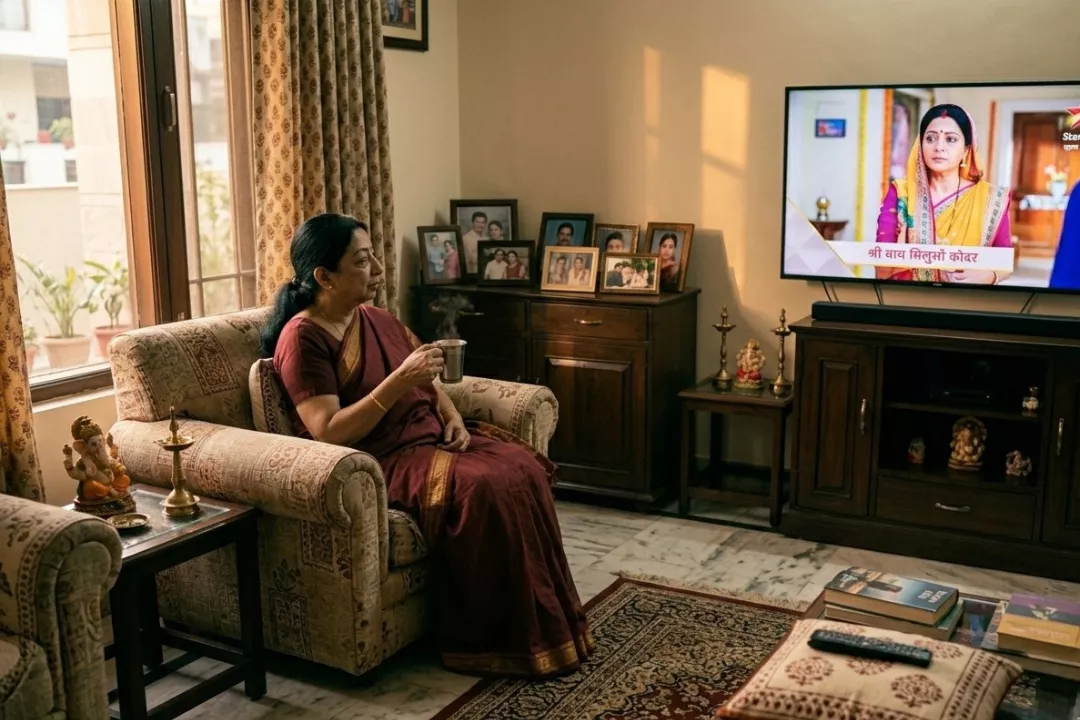
Within approximately one hour of my departure, she watches something she has been saving.
There are shows she does not watch when I am home. Not because I would object. Because when I am home the television is a shared resource and the shared resource gets used for shared viewing which means compromises. She compromises without complaining. She is very good at compromising without complaining.
But the moment I leave, the saved show gets watched.
I know about the saved shows because she mentions them sometimes, in the context of telling me what she has been doing. She will say she finally watched that episode she had been putting off. Or that she finished the series she had started but not had time to continue. The series was started during a visit. The finishing happened after.
My friend Nikhil's mother watches a specific category of content that she does not watch when any of her children are home. Not because it is inappropriate. Because her children make comments about it that she finds annoying and it is more enjoyable without the commentary. The moment the house empties she puts it on at full volume.
He found this out because he came home unexpectedly once and she did not hear him come in. He stood in the doorway for a full minute watching her watch her show, completely absorbed, before she noticed him. She turned it off. He told her not to. She turned it back on. They watched together. He did not make any comments.
She told him it was one of the better visits he had done.
The Phone Call
Within two hours of my leaving, she calls someone.
Not me. I have just left. She calls her sister, or her friend from the building, or her closest friend from her previous city who she still speaks to regularly. She calls and she reports.
What does she report. Everything. The visit. How I looked. Whether I seemed well. What we talked about. What I ate. Whether she felt I was managing okay or whether there were things she was not sure about.
These calls are, as far as I can tell, her primary mechanism for processing the visits. The visit happens. I leave. She calls someone and talks through what happened and how she feels about it and what she is worried about and what she felt good about. The person on the other end listens and asks questions and contributes their own observations about their own children and the call does the work of making sense of the thing.
I am aware that my visits are being discussed on these calls. I have no objection to this. Everyone needs someone to process things with. She processes through her people, the way I process through mine.
The content of the calls is almost certainly more honest than anything she says to me directly. I will never hear these calls. This is probably for the best.
The Food She Eats
When I am home, she cooks for me. What I want, or what she thinks I need, which is usually more than what I want.
When I leave, she eats differently.
She eats smaller quantities. She eats simpler food. She eats things that are for her, which are not always the same as what she makes when someone else is present. She also, and this is the detail I find most affecting, sometimes skips the full meal entirely and just has something small. Not because she is not hungry. Because cooking a proper meal for one feels like too much effort when there is nobody else to cook it for.
I have tried to address this directly. I have said she should eat properly even when I am not there. She says she does. My father, when pressed, gives a more nuanced account. She eats. It is not always what eating properly looks like when I am there to be fed.
The Actual Answer
When I ask her what she does when I leave, she says she keeps herself busy. And this is true. She does. She has her routines, her calls, her shows, her kitchen to restore, her people to talk to.
But there is a version of the house that only exists when someone is in it. A reason to cook a full meal. A reason to have things arranged a certain way. A reason to put out the good biscuits and find the tablecloth and be present in all the ways she is present when someone she loves is there to be present for.
When I leave, that version of the house quiets down. Not unhappily. She is not sitting in distress. She is fine. She keeps herself busy.
But the version of her that exists when I am there, the one that is fully deployed, the one that has somewhere to direct everything she has, that version has less to do.
She rearranges the cushions. She watches her show. She calls her sister. She eats something small.
And then she starts looking forward to the next visit.


