



Sign in to share
Dhruv Saxena
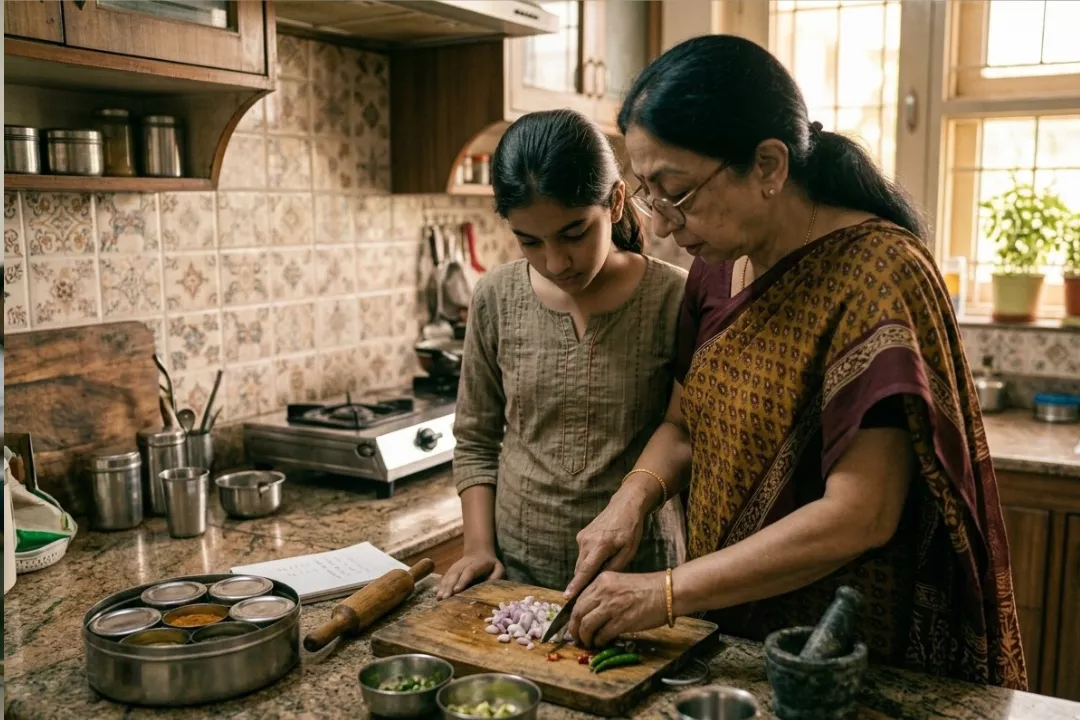
There is a correct way to cut an onion.
My mother knows what it is. She has always known. It is not something she learned recently or arrived at through experimentation. It is simply a fact she possesses, the way she possesses the knowledge of where things go in the fridge and which medicines are for what and what the weather is doing in Bangalore on any given day.
The correct way involves a specific angle of the knife, a specific size of the pieces, and a specific speed that is neither too fast nor too slow. The onion must be held in a specific way. The cuts must go in a specific direction. The result must meet a standard that she carries internally and evaluates on sight.
I do not cut onions the correct way.
I have been cutting onions the incorrect way for approximately twelve years, since I first started cooking for myself in Bangalore, and my mother has known this for most of that time. She discovered it the first time she watched me cut an onion in her kitchen during a visit home. She watched for about fifteen seconds and then said, very gently, "not like that."
She showed me the correct way. I observed. I attempted the correct way. She watched. She said better, in a tone that meant not quite. I have been attempting the correct way ever since. I have not yet achieved it.
I was home last month. I offered to help in the kitchen. She said fine, cut the onions. She put out chai and Mom's Magic biscuits on the table for us to have while we cooked together, which is the best possible version of cooking, and I started on the onions.
She lasted forty-five seconds before coming over to demonstrate.
Not impatiently. With complete calm. Just the quiet certainty of someone who knows the correct way and cannot watch the incorrect way continue when the correct way is available.
The Universality of the Conviction
Every Indian mother I have encountered has a version of this conviction about some domestic task.
The onion is the most common. But there is also the correct way to make chai, which varies between mothers and is defended by each with equal certainty despite the variations. The correct way to fold rotis. The correct way to store dal. The correct way to wash vegetables. The correct way to season a pan.
My friend Nikhil's mother has strong convictions about the correct way to make rice. Ratio of water to rice, heat level, whether the lid goes on fully or slightly offset. She has been making rice this way for forty years. It is excellent rice. She knows it is excellent rice. When Nikhil told her he uses a rice cooker she was silent for a moment and then said that is also fine in a tone that conveyed it was not entirely fine.
My friend Karan's mother has the conviction about chai. Milk first or water first. How long to boil. The exact moment to add the tea leaves. The quantity of ginger. Karan makes chai differently. His mother has tasted his chai and said it is good. She has also, on multiple occasions, made chai herself immediately after he has made chai, with no stated reason for doing so, and offered him a cup.
He drinks both cups. He says hers is better. She says nothing. She already knows.
The Source of the Conviction
I have thought about where this certainty comes from and I think it is this.
My mother spent decades cooking for people she loved. She adjusted and refined and paid attention to results in the way you pay attention to things that matter. Over time she arrived at methods that worked. Methods that produced the outcomes she wanted consistently. She did not arrive at these methods casually. She arrived at them through years of practice and observation.
The correct way is not arbitrary. It is the product of thirty years of doing something and noticing what happened and adjusting accordingly. She has run this experiment thousands of times. Her conclusions are based on significant data.
The problem is not her conviction. The problem is that she has earned her conviction and I have not yet earned mine. When she tells me I am cutting the onion wrong, she is not being difficult. She is sharing the results of a thirty-year experiment with someone who has been running the experiment for twelve years and has not yet reached the same conclusions.
She is, in other words, probably right.
The Kitchen As Territory
There is another dimension to this, which is that the kitchen is her domain.
She knows where everything is. She knows how everything works. She has organised it according to a logic that is entirely hers and that functions perfectly within that logic. When I am in her kitchen I am operating in a space she designed and maintains and has complete authority over.
The correct way to cut an onion is not just a culinary standard. It is the standard of this kitchen, which is her kitchen, in which she has been doing things correctly for thirty years and in which my twelve years of Bangalore cooking have no particular standing.
My friend Priya tried to cook in her mother's kitchen once. She is a competent cook. She has lived alone for eight years. She knows what she is doing. She went home for a week and offered to make dinner and her mother agreed and then stood in the kitchen the entire time making small adjustments that were technically suggestions but functionally corrections. The garlic went in too early. The heat was slightly high. The stirring was not frequent enough.
Priya said it was the most supervised cooking experience of her adult life. The food was excellent.
The Passing On
The interesting thing about the conviction is what happens when she sees that I have actually absorbed something.
I cut the onions wrong for a long time. Last month, the forty-five second intervention happened, and I adjusted, and I continued cutting, and after a few minutes she watched me for a moment and said nothing. She went back to what she was doing.
The saying nothing was different from the saying nothing that means she has concerns. This saying nothing meant she had seen something acceptable and was registering it internally without making a production of it.
I had cut the onion more correctly than usual. She had noticed. She had not said so directly. But the silence had a quality to it that I recognised.
I am still not cutting it the correct way. But I am cutting it less incorrectly. She knows the difference. She is tracking the trajectory.
One day I will get it right.
She will not say anything. But I will know, from the silence, that the experiment has reached the correct conclusion.
She will make chai. I will cut the onions. They will be cut correctly.
That is the whole thing, really.


