



Sign in to share
Dhruv Saxena
My mother once sent me “Reached?” while watching my live location enter my building.
I know this because she told me.
I had taken a cab from the airport. It was late, but not very late. Delhi late, which means late enough for your mother to track you but not late enough for you to admit that tracking is reasonable. I shared my live location before she asked, because I have learned some things with age.
The cab left the airport. My mother watched.
The cab crossed Dhaula Kuan. She watched.
The cab took a route she did not approve of. She called.
“Why is he going from there?”
“I don’t know, Maa. GPS.”
“Ask him.”
“I am not asking him. It’s fine.”
“It is longer.”
“It is seven minutes longer.”
“Still.”
We had this conversation while she was looking at the same map I was looking at, except she was looking at it with the moral seriousness of a person monitoring a military convoy.
Forty minutes later the cab entered my lane. The little blue dot, that modern instrument of maternal supervision, reached my building.
I had not even paid the driver.
My phone buzzed.
Reached?
I called her from the lift.
“Maa, you can see that I reached.”
She said, “Still tell.”
That was the whole explanation.
Still tell.
I think about that often.
The Question Is Not About Information
For years I misunderstood the question.
I thought my mother was asking “Reached?” because she did not know. This made the question annoying because most of the time she did know. She had the flight status. She had the train number. She had my cab details. She had my live location. She had more information than I had, because I was in the vehicle and she was at home refreshing things.
But “Reached?” is not a request for information.
It is a request for closure.
The dot on the map is not enough. The airline notification is not enough. The cab showing “trip completed” is not enough. None of these things are the same as your child saying, “I am home.”
My friend Karan’s mother asks for a “reached” message even when he is going from his office to his flat, a distance of eleven minutes. He once asked her why.
She said, “Because after you say reached, I can sleep.”
There it is.
The question was never about geography.
It was about sleep.
The Travel Food
My mother believes no person should travel without food.
This includes flights where food is available. Trains where vendors exist. Car rides short enough that hunger is statistically unlikely. Office commutes. Errands. Possibly going downstairs to pick up a delivery, if she had her way.
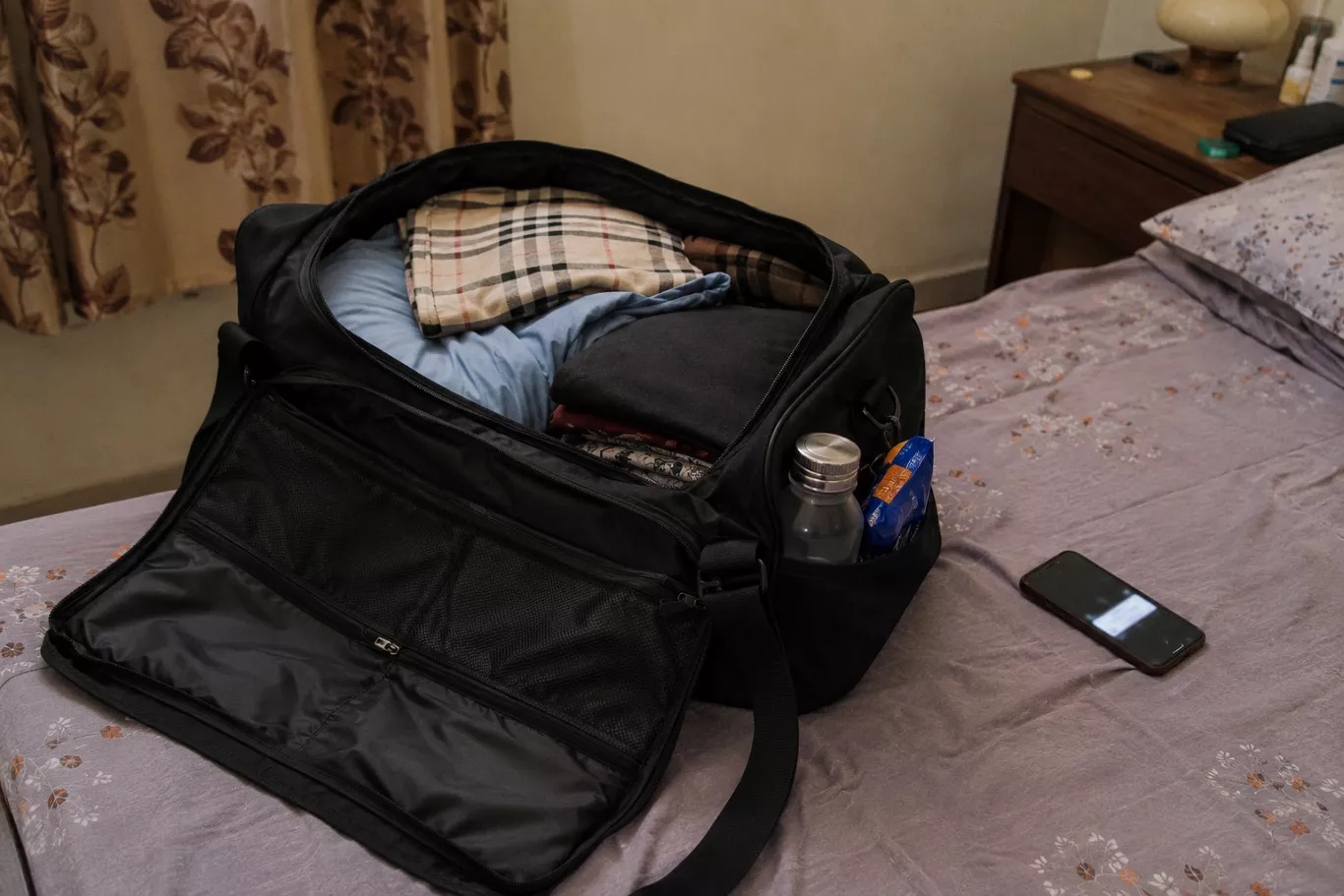
Before I leave home, she will put things in my bag.
A fruit.
A bottle of water.
Something wrapped in foil.
A tissue.
A small packet of biscuits.
I used to remove half of these things as soon as she was not looking because I did not want my bag to become a mobile pantry. This was foolish. I now know better.
The biscuit packet is almost always the thing that saves me.
On that airport night, I found Mom’s Magic in the front pocket of my laptop bag at the exact point where the flight delay had made me hungry and the airport sandwich had made me angry. I had not seen her put it there. Of course she had put it there. The woman has been putting food into the side pockets of my life for thirty years.
When she asked “Reached?” that night, the biscuits were still in my bag.
So was she, in a way.
The Older Waiting
I think our mothers ask because they remember a world where waiting was harder.
We grew up into blue ticks, location sharing, cab tracking, flight apps, and phones that tell us exactly where someone is. Our mothers did not. For them, someone leaving the house meant a period of not knowing. You waited for a call. You waited for the landline to ring. You waited for someone to say they had arrived.
My mother still says “call after reaching” with the seriousness of a person for whom that sentence was once the only available technology.
We treat her worry as outdated because the tools have changed.
But the feeling has not changed.
The world has become trackable. It has not become harmless.
My friend Priya says her mother continues to ask “Reached?” after every flight even though Priya sends screenshots of the boarding pass, the gate number, the seat number, and sometimes the airport coffee. Her mother acknowledges all of this. Then, after the flight lands, she asks again.
Reached?
Priya says she used to reply with just “yes.”
Now she replies, “Reached. Getting cab.”
Then, “In cab.”
Then, “Home.”
She says it has improved everyone’s life by about four percent.
Four percent is not nothing.
The Irritation
I do not want to make this sound sweeter than it is.
Sometimes it is irritating.
Sometimes you are carrying two bags and the cab driver does not have change and the guard is asking you to sign the register and the lift is taking forever and your phone buzzes with “Reached?” and you want to throw the phone into a plant.
Sometimes you reply badly.
I have replied badly.
“Yes.”
“Obviously.”
“I’ll message, Maa.”
“Can I at least get out of the cab?”
These are not my finest sentences.
My mother usually ignores the tone and focuses on the information, which is generous of her and also annoying because it means she gets what she wants anyway.
The thing is, we experience the question at the end of the journey.
She experiences it for the whole journey.
By the time we are irritated, she has already spent forty minutes imagining every possible thing that could go wrong, rejecting most of them, accepting a few, checking the map, checking the time, checking whether our phone battery is enough, and wondering if she should call or if calling will distract us.
Then we reply “yes” like she has asked for something unreasonable.
I am not proud of this.
The Right Reply
I have developed a better reply now.
It is not complicated.
“Reached. Cab was fine.”
“Reached. Eating now.”
“Reached home. Locking the door.”
“Reached. Flight was okay.”
The extra detail helps.
I used to think extra detail was unnecessary. Now I think extra detail is the point. Mothers live in the details. A bare “yes” closes the question. A full sentence closes the worry.
There is a difference.
Once, after a late train, I messaged: “Reached. Had the biscuits. Going to sleep.”
She replied with a thumbs up.
My mother almost never uses thumbs up. It felt like a formal acknowledgement from the ministry of maternal affairs.
The No-Question Day
A strange thing happened once.
I reached home from a work trip and there was no message from my mother.
No “Reached?”
No missed call.
No follow-up.
Nothing.
For fifteen minutes, I felt free.
Then I felt offended.
Why had she not asked? Was she busy? Had she forgotten? Was I no longer track-worthy? Was this growth or neglect?
I called her.
She picked up and said, “Reached?”
I said, “Yes. Why didn’t you ask?”
She said, “I was going to. The maid came.”
That was it.
I had been displaced by the maid.
It was good for my ego.
It also taught me something I did not enjoy learning, which is that the question has become part of my sense of arrival. I do not just reach home. I reach home and tell her. The telling completes the reaching.
This is slightly embarrassing.
It is also true.
Still Tell
One day, I suppose, no one will ask.
I do not like thinking about this, but it is there.
One day you will land, collect your bag, get into a cab, reach home, put your keys on the table, and there will be no “Reached?” waiting. The phone will be quiet. You will be safe, and no one will require proof of it.
That quiet will not feel like freedom.
So while the message comes, answer it.
Even if you are tired.
Even if she has your live location.
Even if the journey was short.
Even if you are thirty-two and fully capable of travelling from one place to another without a reporting structure.
Still tell.
Tell her you reached.
Tell her the cab was fine.
Tell her you ate the thing she packed.
Tell her you are locking the door.
It takes ten seconds. It gives her the one thing technology still cannot give her properly.
Your voice, or your words, saying the world returned you safely.
Reached, Maa.
That is all.


