



Sign in to share
Dhruv Saxena
I was not cold.
This is an important fact to establish at the beginning. I had assessed my own temperature, a skill I have had for thirty-one years, and the result of the assessment was that I was comfortable. Not hot. Not cold. The temperature was correct and I was in it and everything was fine.
My mother did not agree with this assessment.
She looked at me from across the room with the expression of someone who has received information they find incomplete and said are you not cold. I said I was not cold. She said it seemed cold. I said it was not cold, I was fine. She went to the other room and came back with a shawl.
I said I did not need the shawl.
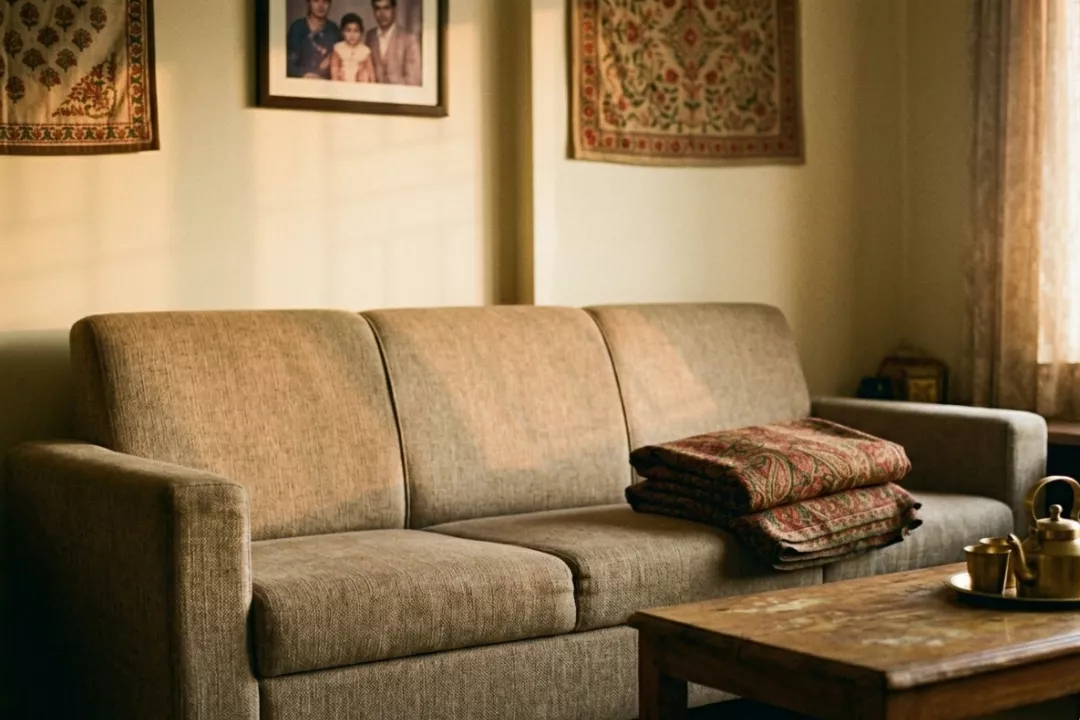
She put it on the arm of the sofa next to me. Not on me. Next to me. Close enough that it was available. She did not insist. She simply made the shawl available in case my assessment of my own temperature proved to be incorrect, which she clearly felt was a likely outcome.
I did not take the shawl. She did not say anything about me not taking the shawl. The shawl sat on the arm of the sofa for the rest of the evening as a standing offer that I was declining and she was maintaining.
This is the dynamic. Not that she forces warmth on me. That she makes warmth available and waits for me to acknowledge that I was wrong about my own temperature. I have never acknowledged this. She has never stopped making warmth available. We have been in this standoff for thirty-one years.
I was home last month. It was October. Not particularly cold in Delhi in October. I came to the kitchen table where she had put out chai and Mom's Magic biscuits and she looked at me when I sat down and said did you bring a sweater. I said I did not need a sweater. She said October was getting cold. I said it was not cold, I was wearing a full-sleeved shirt. She said a full-sleeved shirt was not a sweater. I drank my chai. The sweater subject was suspended but not closed.
It came back three times before I left.
The Temperature Gap
My mother and I do not experience temperature the same way. I have accepted this. She has not accepted this.
In her model, there is an objective temperature at which a person should feel cold and I should feel cold at that temperature because the temperature is cold. The fact that I do not feel cold at that temperature is not evidence that I am not cold. It is evidence that I am not paying adequate attention to my own coldness.
This is the fundamental disagreement. I believe I am the primary authority on whether I am cold. She believes she is also a qualified authority on whether I am cold, possibly the primary one, and that my self-reports are unreliable.
My friend Nikhil has the same gap with his mother. He lives in Mumbai. Mumbai is warmer than Delhi. He visits Delhi and his mother immediately determines that he has forgotten how to feel cold because he has been in Mumbai. The Mumbai acclimatisation has, in her assessment, degraded his cold-detection. He is cold but does not know he is cold because Mumbai has made him forget.
He has explained that he grew up in Delhi and his original cold calibration was set here and has not been overridden by Mumbai. She does not accept this explanation. She gives him a sweater.
The Varieties of Cold
The coldness conversation is not uniform. It has varieties, and each variety has its own response.
The first variety is immediate environmental cold. The room is cold. The outside is cold. The wind is cold. For this variety the response is: shawl, sweater, or the suggestion to close the window that is not currently open.
The second variety is the cold you will be cold later. You are not cold now but you are going out later and it will be cold later and you should be prepared. For this variety the response is the preventive sweater, pressed upon you before you leave so that the later cold does not find you unprepared.
The third variety is the cold from doing something cold-causing. Eating ice cream in cold weather. Drinking something cold. Sitting on a cold floor. Being near the AC for too long. Each of these activities is understood to produce cold that has not yet manifested but will. The response is the warning, delivered in advance, and the offer of something warm to counteract the cold-causing activity.
My friend Karan's mother has a fourth variety that he has not encountered elsewhere. She believes in the delayed cold. You can do something today that will make you cold tomorrow. The cold has a lag. Going out without adequate preparation today produces a cold tomorrow that people incorrectly attribute to other causes. She has been documenting this for years.
He said he has never successfully argued against the delayed cold because the delay makes it unfalsifiable. Any cold that arrives can be attributed to something that happened two days ago and he cannot prove it was not.
The Acceptance
I have been trying to get my mother to accept my temperature self-reports for thirty-one years. I have not succeeded. I have given up trying.
What I have done instead is accepted the shawl adjacent. Not on me. Next to me. She puts it nearby. I do not take it. She does not push. The shawl is there in case. I am warm. We coexist.
This is, I have come to understand, not really about temperature. The shawl on the arm of the sofa is not an assessment of the room temperature. It is an expression of the continuous low-level monitoring of my wellbeing that she has been conducting since I was born. The shawl says I see you and I am paying attention and if anything is not right I have already prepared a response.
The response is a shawl. It is always a shawl.
I am warm. I have always been warm. She has always known I am warm. The shawl is not for the cold. The shawl is for the distance between us. It is the thing she can offer from across the room that says I am here if you need me.
I do not take the shawl. I appreciate the shawl.
These are not contradictory positions.


