



Sign in to share
Dhruv Saxena
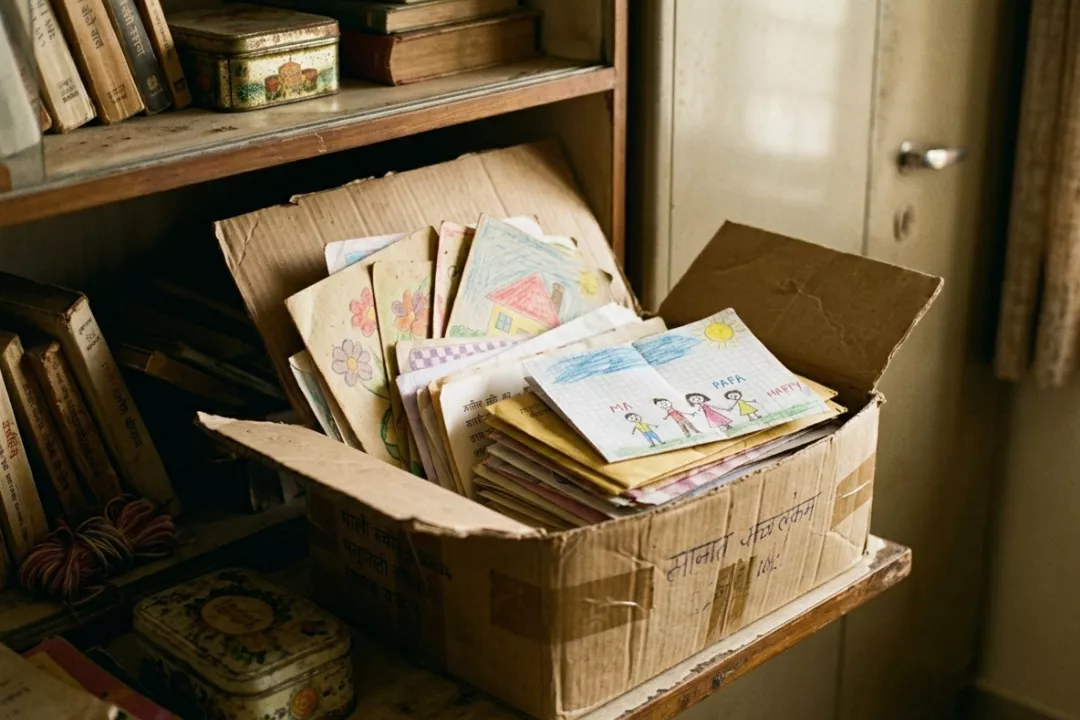
My mother has a box.
It lives on the top shelf of the cupboard in the room that used to be my room. I have known about the box my entire life. I have never been told about the box. I discovered it at age nine when I was looking for something else and found it and opened it and saw what was inside and closed it immediately because something about what was inside made me understand, without anyone explaining it, that this was not for casual browsing.
The box contains every card I have ever given her. Every letter. Every drawing from when I was small enough to draw things and present them as gifts. The birthday cards from ages four through twelve, made from construction paper and mostly misspelled. The letters I wrote when I went to camp and was not sure I was going to be okay and put that in the letter without meaning to. The drawing of what I described at age six as our family but which looks, objectively, like four uneven circles with sticks attached.
She has kept all of it. Not in a general drawer where things accumulate. In a box. A specific box. With intention.
I was home last month. We were at the kitchen table, chai between us and Mom's Magic biscuits on the plate, and I asked her about the box. I do not know why I asked. I had been thinking about it since I had noticed it was still there on the shelf. She looked at me for a moment and then said which box. I said the one on the top shelf. She said she keeps things there. I said I know. We looked at each other. She picked up her chai.
She did not say anything else about the box. I did not push. Some things are understood without being discussed.
The Archive
My friend Nikhil found his box by accident last year. His mother had moved it when she was reorganising the cupboard and it was temporarily on a lower shelf and he opened it thinking it was something else.
He called me the same evening. He said he had found approximately forty items in the box spanning twenty-eight years. Birthday cards from when he was six. A letter he had written from his first job that he did not remember writing. A drawing of a house that he had apparently made at age seven and presented to his mother as a gift, which she had kept without ever mentioning.
He said he sat with the box for about twenty minutes. He said he felt something he could not fully name. The closest he got was that it felt like evidence. Evidence of a continuity between the person he was at seven and the person he is now, held in a box by someone who had decided, across twenty-eight years, that the continuity was worth keeping.
He put the box back where he found it. He has not mentioned it to his mother. She has not mentioned it to him. The box is on the shelf. They both know it is there. Nothing needs to be said.
What Goes In
My mother is selective in a way that I only understood recently.
The box is not everything. She does not keep every piece of paper I have ever touched. She keeps specific things. Things that she found significant at the time of receiving them and which she decided, in the moment, were worth preserving.
This means the box is not just an archive. It is a record of what mattered to her. Each item in it is something she saw, received, and made a decision about. The decision to keep it was a decision made in a moment of feeling something. The box is a map of those moments.
The drawing of the four uneven circles is in the box because six-year-old me presented it with ceremony and told her it was our family and she looked at it and felt something that made her put it in the box rather than on the fridge for a few weeks and then in the bin.
The camp letter is in the box because she read it and understood what I was not quite saying and the not-quite-saying mattered to her enough to keep.
The birthday card made from construction paper is in the box because I made it and it was the best I could do and she knew that and kept it.
My friend Karan's mother keeps a different version of the same thing. Not a box but a specific drawer in the kitchen. He found things in there he did not expect. A note he had left on the fridge at age fourteen telling her he had gone out and would be back for dinner. She had kept the note. He had not known she was keeping the notes. He had written them as functional communication. She had been receiving them as something else.
Why She Does Not Throw Them Away
I have thought about this for a long time and I think the answer is simple.
Throwing them away would require her to decide that the moment they represent is no longer worth preserving. She cannot make that decision. Not because she is sentimental in the casual sense. Because the moments are real and complete and the things are the closest thing she has to holding the moments themselves.
The construction paper birthday card is not a card. It is me at seven, on a Saturday morning, making something for her because I wanted her to know she mattered. You cannot throw away me at seven on a Saturday morning. So you keep the card.
The camp letter is not a letter. It is me being scared for the first time away from home and reaching for her across the distance. You cannot throw away that reaching. So you keep the letter.
The drawing of the circles is not a drawing. It is my understanding of what a family was at age six, which included her at the centre, which is where she has always been. You cannot throw away being at the centre of someone's world. So you keep the drawing.
What I Want To Do
Next time I am home I am going to ask her to open the box with me.
Not to look through everything. Just to sit with it for a while. To let her show me what is in there, what she chose to keep, what it looked like from her end when I was making things and writing things and handing them to her.
I want to see what the archive looks like from her side.
I made the things. She kept them. Thirty-one years of keeping means something I have not yet fully received. I would like to receive it.
I am going to ask her next time.
I am going to do it before I talk myself out of it.


