



Sign in to share
Dhruv Saxena
Ask your mother when her birthday is.
She’ll tell you. That’s not the issue. She knows the date.
Try asking her what she wants to do on that day. Ask her what kind of cake she likes, or what she’d want for a gift.
I’m nearly sure she’ll pause. She’ll probably say something like “Nothing. Don’t make a fuss.” And then she’ll redirect to whether you’ve eaten, or whether your cousin’s wedding gift has been sent yet, or something else entirely that has nothing to do with her. That’s what my mother did.
Now, compare that to how she handles everyone else’s birthdays.
Your birthday, she remembers without reminders and without needing it to be on a calendar. Your father’s, your sibling’s, your childhood best friend’s. She holds all of it. Effortlessly, it seems.
But her own day? She’d genuinely be fine letting it pass.
Is it really just modesty? I don’t think so. I have a term for it. I call it the Indian women syndrome.
The Indian women syndrome
There’s a particular kind of conditioning that happens to women, and Indian women especially, across generations. From very early on, girls are taught, not always in words, that their value lies in how well they take care of others.
The good daughter clears the table before being asked. The good daughter-in-law wakes up first and sleeps last. The good mother puts herself last, always, and calls it love.
I hate it. But that’s what it is.
And do you know what’s the worst part? She’s not doing it because she was forced to. She genuinely feels it. She genuinely wants to make sure everyone else is okay before she thinks about herself. It is that deeply ingrained in her. That impulse was shaped, over decades, by what she saw around her and what she was praised for.
Think about what was celebrated in her world as she was growing up.
She was praised for being selfless. For not complaining, for managing the house without making it visible work, for anticipating everyone’s needs, and for being the kind of woman who “never thinks about herself.”
In the world she grew up in, not thinking about yourself was considered a virtue. A quality worth admiring. So she aspired to it. And she got very good at it.
So good, in fact, that she forgot she was allowed to want things. Ordinary things. A birthday acknowledged properly. A day where she's not the one asking everyone else if they need anything. A meal she gets to choose without polling the family first.
She doesn’t ask for these things because she was never taught that she could. And by the time she might have figured it out, the habit was so deep it felt like her own personality.
Isn’t that sad? It made me feel terrible. There was not much I could do. So, I ran to the nearby grocery store and specifically asked for Sunfeast Mom’s Magic biscuit. I made cute hearts on the wrapper and kept the packet near her bed. Hehe!
The keeper
I’ve been thinking about this subject. And I feel it’s not just about conditioning.
She remembers everyone else’s birthdays because she was the keeper of everyone else’s happiness for so long that it became instinct. When you are responsible for making people feel seen, you develop a memory for the things that make them feel seen.
But sadly no one took on that responsibility for her.
No one said, here, I'll remember what makes you happy. No one tracked her favourite colour, her preferred way to spend a free afternoon, whether she likes the window or the aisle. No one made a note of what kind of flowers she likes or whether she prefers a quiet evening to a noisy celebration.
It’s not that her family didn’t love her. It’s that they were beneficiaries of her attention and never thought to return it in kind. And that’s surely not because they were cruel. It’s simply because it just never occurred to them that she might need it too.
And she never said anything. So they never knew to ask.
It continues
If you think about it, this pattern doesn’t end cleanly with one generation.
Most of us, the children raised by these women, grew up watching this and absorbing it without realising. And then we went out into the world and started trying to do things differently.
We talk about boundaries. We go to therapy. We say “my needs matter too” out loud and mean it. We celebrate ourselves on our birthdays. We have wishlists.
And then we go home, and our mothers are still serving everyone before themselves. Still saying “don't waste money on me,” and we don’t know what to do with that gap.
Some of us feel guilty about wanting more for ourselves when she wanted so little. We feel frustrated that she won’t let us care for her properly. And some of us swing between both.
The next generation isn’t breaking the pattern cleanly. We’re just becoming aware of it, which is in itself a complicated place to be.
Doesn’t a specific version of this that plays out every year? It does in my house.
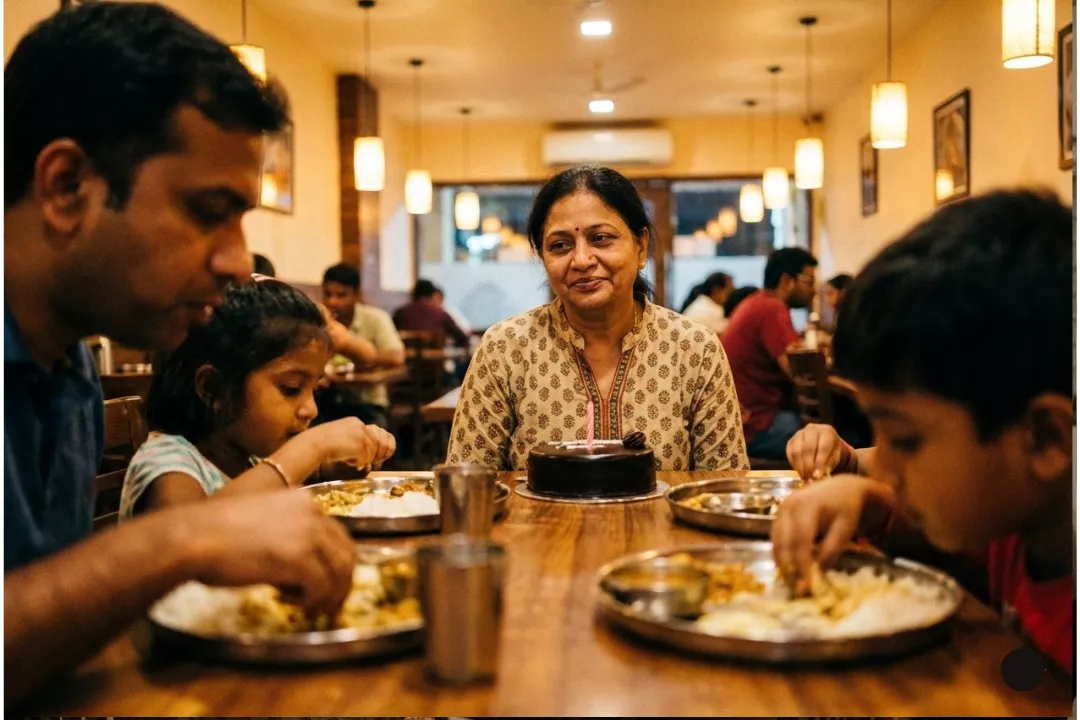
Her birthday comes around. Someone in the family, maybe you, suggests a dinner or a small celebration. She says it’s unnecessary, don’t go through the trouble, she’s fine with whatever.
So you do something small, a cake, maybe flowers, dinner at a restaurant she’d never pick herself because she’d say it’s too expensive.
And she smiles, and says it’s lovely, and spends half the dinner making sure everyone else has ordered what they want.
She can’t help it. You can see her trying to just sit and be the person it’s for. But the instinct is stronger than the intention.
And you don't say anything because what do you say? “Stop taking care of people for one hour”? It would feel unkind. It would also probably not work.
There’s a way around
I was discussing this with my friends. All of them agreed to feeling helpless, except one. She’s found a solution. It is to be specific.
She says, don’t start with “what do you want?” That question is too open. She’s been trained out of answering it.
Instead, say, “I'm ordering that mango dessert you always look at and never order for yourself.” Not a question. Just a statement.
“I'm taking you for a saree this Saturday, just you and me.”
"I've already told everyone we’re not available on your birthday, it's just us.”
You remove the option to deflect. You make the decision. You show up the way she always showed up, with the thing already organised, with the plan already made, without making her feel like she has to justify wanting it.
She might protest. I know moms. She will protest. But that’s okay. Let her protest and do it anyway.
The point is being, for her, what she has been for everyone else her entire life. She doesn’t need a big gesture. She doesn’t know how to receive a big gesture.
She just needs to feel remembered, by the people she’s spent her whole life remembering.
Let’s start there.


