



Sign in to share
Dhruv Saxena
My father has a shelf.
He has not always had a shelf. For most of my life the things in the house were distributed across the house in the way things get distributed when a family lives somewhere for decades. His things were in the bedroom, in the study, in the kitchen, in the places where the things of a person are when that person is present and living and using them.
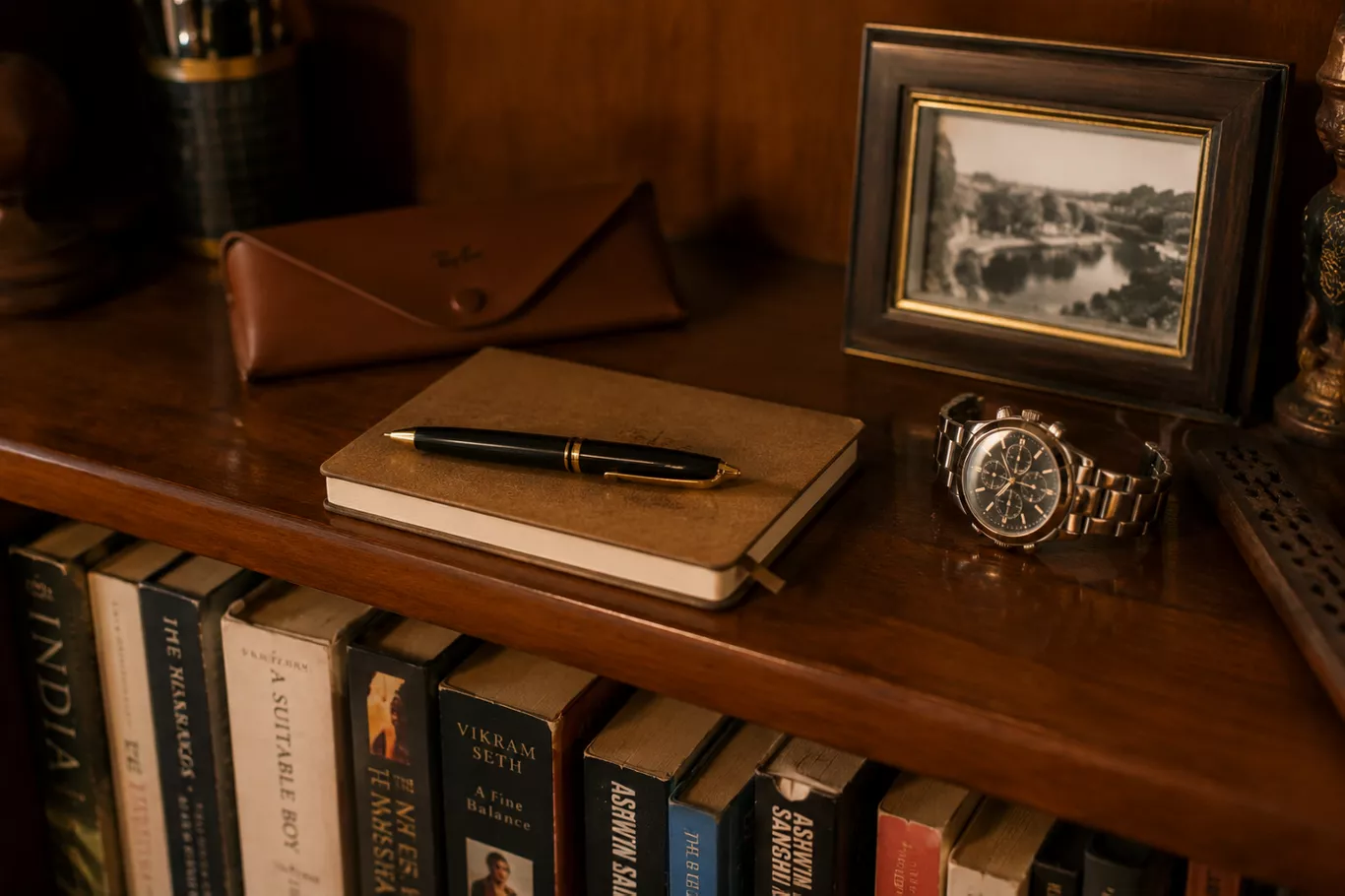
After he retired and his movements slowed and the things he used daily became fewer, my mother made him a shelf. Not dramatically. Not as a project. She just, over a period of some months, gathered the things that were most his and found them a place together. A shelf in the study, at his height, where his reading glasses case is and his particular pen and the small notebook he always carries and two books he is currently in the middle of and a photograph and the watch he does not wear anymore but does not want to put away.
The shelf is his. It is also, I have come to understand, hers. She maintains it with a care that goes beyond tidiness. If something on the shelf is moved she notices. If something is missing she wants to know where it is. The shelf is not just storage. It is an account of him as he is right now and she checks the account regularly.
I noticed this properly last month. I was home and I moved his pen from the shelf to the table because I needed to write something and it was the closest pen. I used it and put it back on the table rather than the shelf. She noticed within an hour. She picked it up and put it back on the shelf without saying anything. I watched her do it.
We were at the kitchen table later, chai between us and Mom's Magic biscuits on the plate, and I asked her about the shelf. She said she just liked things to be in their places. I said she had noticed the pen in under an hour. She said she tends to notice. I said I had observed that she tends to notice. She picked up her chai.
This is not a new behaviour she has developed. She has always kept track of his things. The shelf is just the physical expression of something she has been doing for forty years.
What She Cannot Throw Away
The shelf is visible. What she cannot throw away is a longer inventory.
She cannot throw away his old service records from work, which are in a file in the cupboard in the bedroom, which has not been opened in eleven years to her knowledge but which she checks on periodically to confirm it is still there.
She cannot throw away a jacket he wore in the 1990s that has been in the cupboard for fifteen years and fits nobody in the family and is not in a condition anyone would wear it in even if it did fit. When I suggested, once, that it might be time to let it go, she looked at me in a way that ended the conversation.
She cannot throw away his old appointment diaries. He kept paper diaries for twenty years of his working life. They are in the study, three shelves of them, organised by year. He has not looked at them in a decade. She dusts them.
My friend Nikhil's mother is the same. His father's things are maintained with the same care, the same monitoring, the same inability to let objects leave the house even when the objects have served their purpose and their only remaining purpose is to be his. Nikhil once helped his father clear out some papers. His mother moved through the room the entire time they were doing it, not stopping them exactly, but present, watching what was leaving, occasionally picking something up and saying are you sure about this one.
His father said yes, I am sure. She put the thing down. She did not look entirely sure herself.
The Logic of It
I have thought about the logic of keeping his things and I think it is this.
The things are evidence of him. Not of him in the past. Of him as a continuous, present person who has been here for forty years and whose presence is documented in the objects that accumulated during that time. The jacket from the 1990s is not a relic. It is proof that he was here in the 1990s and is still here now and the line between then and now is unbroken.
Throwing things away breaks the line. Not in a dramatic way. But the line gets shorter. The evidence of the earlier versions of him gets reduced. And she is not ready for the evidence to be reduced. She wants the full record. She wants all of him, all the versions, present in the house.
My friend Karan's mother puts it differently when she talks about it, which is rarely. She said once that she keeps his things because the things remember him too. Karan told me this and said he had not known how to respond to it. I said I thought it made complete sense. He said after thinking about it he agreed.
The things remember him. She keeps the things.
The Shelf
I looked at the shelf before I left last month. The pen was back. The notebook was at its angle. The watch was there, the one he does not wear anymore.
I asked him about the watch once. He said he was not sure why it was there. He said your mother put it there. I said did you mind. He said he did not mind. He said she could put whatever she liked on the shelf.
He was smiling when he said it.
He knows about the shelf. He knows what the shelf is. He does not say anything about it because he does not need to.
Some things do not need to be said.


