



Sign in to share
Dhruv Saxena
I am well over thirty. I have a job, an apartment, a credit card I mostly pay on time. I have navigated airports alone, taken overnight trains alone, figured out foreign cities alone with nothing but a dying phone and misplaced confidence.
By any reasonable measure, I am a functional adult who is capable of packing a bag.
And yet. Every single time I travel from home, my mother packs it.
I don’t ask her to. In fact, I have made sustained, sincere efforts to prevent it. “Maa, I've got it.” “I’ll do it the night before, don't worry.” “I know what I need.”
She nods. She appears to accept this. She waits until I’m distracted by something, a phone call, a conversation with my father, a meal. And then she packs the bag.
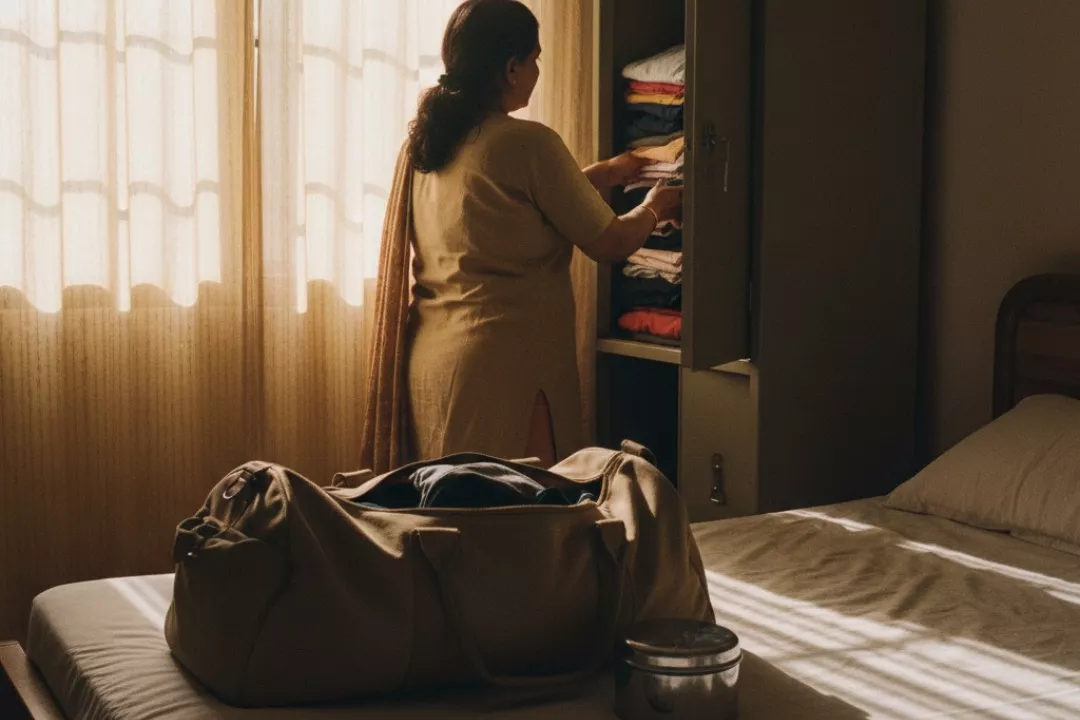
Folded clothes. A small container of something she’s made for the journey. Sunfeast Mom’s Magic biscuits tucked into the side pocket because she knows I eat badly on trains. The medicine strip she is certain I will forget. An extra pair of socks she has decided I cannot be trusted to include.
By the time I notice, it’s essentially done.
Why does she not trust me?
For years I found this mildly irritating. That low-grade friction of someone doing something you didn’t ask for, in a way that implies they don’t entirely trust your competence.
I’d make a small protest. She’d ignore it. I’d let it go because arguing felt like more effort than the thing itself.
Then one evening, packing before an early morning flight, I actually watched her do it. Really watched. Instead of half-paying attention while scrolling my phone.
She was folding a shirt. Carefully. Smoothing the collar with her palm. Placing it in the bag with a specific layering logic she’s developed over years, so things don't crease.
Her face was calm. Focused. Present in a way I don’t see as much now that there's less to do for me.
And I realised, standing there watching, that I had been completely misreading the situation.
This was never about the bag.
She misses her child
For most of my childhood and adolescence, she was needed. Actively, and constantly.
I needed her to make food. Find things, and remember my schedule, and fix my problems. Wake me up and explain things I didn't understand and be there, every single day, for an enormous range of functions I couldn’t perform myself.
The neediness of a child is vast. It’s the central organising fact of a parent’s life for years. And she met it, all of it, for a very long time.
And then I grew up. Which was supposed to happen.
I moved out. Learned to cook adequately. Filed my own taxes with moderate success. Built a life that runs, more or less, without her daily input.
Which is wonderful. The goal achieved. The job done.
And also, from her side of it, a particular kind of loss that nobody really names.
Because she was very good at being needed. It was one of the primary ways she understood herself in relation to me. And I had, through the entirely normal process of growing up, made myself largely unreachable to it.
Packing my bag is the thing she still gets to do.
It’s the last remaining active corner of the job she had for two decades. One small, concrete task that is still available, still hers, still something she can do for me that I actually need done.
She’s not doubting my capability when she folds that shirt. She’s not making a statement about my competence.
She’s taking one more opportunity to take care of me. Before I leave again. Before the self-sufficient version of me takes over and she’s back to twice-weekly calls where she has to take my word for it that everything is fine.
It’s the most practical love language I know. And I had been refusing it. Because I was too committed to demonstrating my independence to understand what I was actually declining.
And then I changed
I started letting her about a year ago. Really letting her, not just tolerating it with a sigh.
Sometimes I sit near her while she does it. We talk about nothing in particular. She tells me which route has less traffic to the airport. She adds something to the bag at the last minute, something she just thought of, something I would genuinely have forgotten.
I’ve stopped saying I don’t need it.
Because I’ve realised, this isn’t about need. It’s about her having somewhere to put the love that used to have so many more outlets.
She can’t help with my work problems. She can’t make my life easier in the large, structural ways she once could. But she can put the right medicines in the right pocket and make sure I have something to eat on the train.
So she does. And I let her.
And it gives her something I can’t fully quantify but have come to deeply understand.
The version that’s less spoken about
There’s a version of growing up that we don't talk about enough.
The version where we become so capable, so visibly self-sufficient, so demonstrably fine, that we accidentally make ourselves unreachable to the people who want to care for us.
We optimise for independence. We handle everything. We say “I’ve got it” often enough that eventually people stop offering.
And our mothers, who built their sense of purpose partly around the ability to do things for us, find that the opportunities to express that care have quietly closed.
Letting her pack the bag is a small thing. It costs me nothing. It takes ten minutes I’d have spent doing it myself.
But it keeps a door open that I think should stay open.
It tells her she’s still in the story. Still useful. Still my mother in the full, active sense of the word, not just the historical one.
If your mother still insists on packing your bag, or pressing food into your hands as you leave, or calling three times before your flight, let her.
Not because you need it. Because she does.
I feel there’s a particular kindness in allowing the people who love you to express that love in the ways that come naturally to them, even when you’ve outgrown the need for it.
You haven’t outgrown her. You’ve just changed the terms.
Meet her in the new ones. Let her fold the shirt.
The bag will be perfectly fine either way. But she’ll spend the next week knowing she sent you off properly. And that matters for her.


