



Sign in to share
Dhruv Saxena
I found out by accident, the way I find out most things about my mother.
I was home for a long weekend in January. No particular occasion, just a visit. I'd been staying up late the way I do when I'm at my parents' place, reverting immediately to every bad habit I'd apparently only suppressed and not eliminated, and I'd gone to bed well past midnight.
At 6:15am, I heard movement in the kitchen.
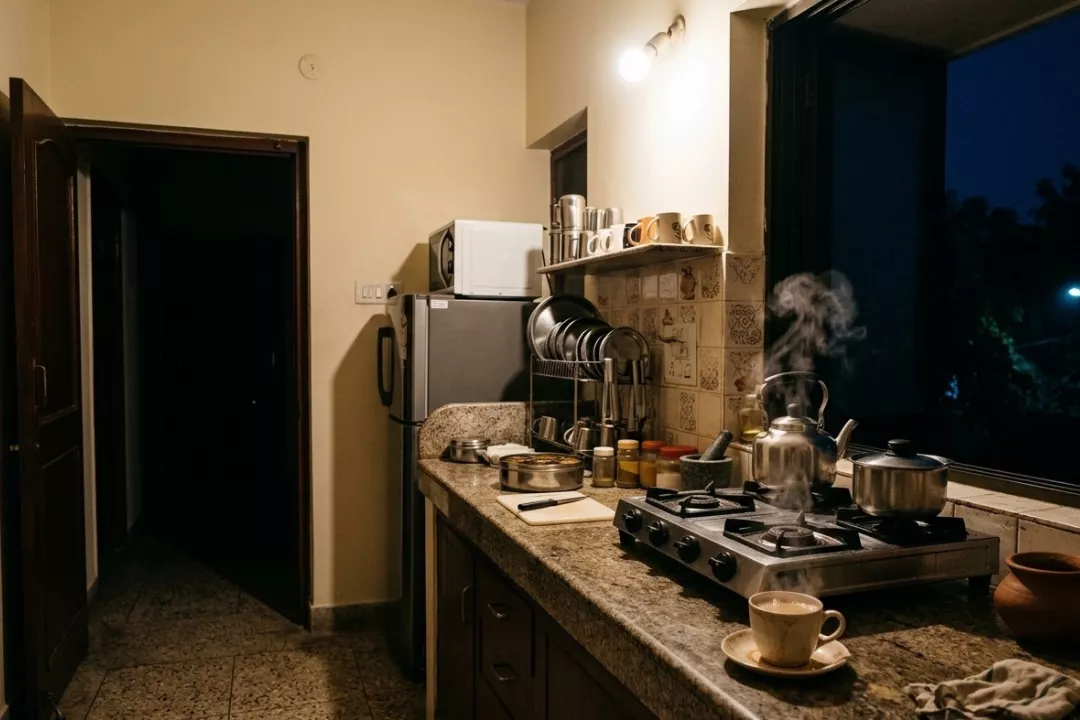
Not alarming movement. Just the specific sounds of someone who has been awake for a while and is now making chai. The particular sequence of sounds that means my mother is up and the day has begun.
I looked at my phone. 6:15am. On a Saturday. With nowhere to be.
I went to the kitchen. My mother was at the counter, already dressed, already organised, already fully operational in a way that suggested 6:15am was not a new development.
I said, "why are you awake?"
She looked at me like this was a strange question. "I'm always up at this time," she said.
I said, "it's Saturday."
She said, "so?"
I sat down. She put out chai and Mom's Magic biscuits and I tried to think about when exactly I used to leave for school. It was around 6:45am. Which meant she'd been up at least 6:15 every morning for the years I was in school, making sure everything was ready, making sure I wasn't late, making sure the morning worked.
I left home twelve years ago.
She's still up at 6:15.
I asked her if she wanted to sleep later. She looked at me as if I'd suggested something mildly unreasonable. "This is when I wake up," she said. As if the body had made this decision and she was simply following instructions.
The Schedule That Stayed
My mother's body learned my schedule. That's the only way to explain it. She didn't set an alarm for years because she didn't need one. She just woke up at the right time, made the right things, had everything ready, and sent me out into the world more or less on time.
The body is very good at learning schedules. It's considerably less good at unlearning them.
My friend Nikhil's mother still wakes up at 7am, which was when he used to leave for school. He left home fifteen years ago. She's been retired for three years. There is no reason on earth for her to be up at 7am. She is up at 7am.
He asked her once if she'd ever tried to sleep later. She said she'd tried a few times, early in retirement, but she just lay there feeling like she'd missed something. Her body had decided 7am was when the day began and it wasn't interested in negotiating.
My friend Priya's mother has an even more specific version. She wakes up at exactly the time Priya's school bus used to arrive, which Priya finds both touching and slightly surreal. The bus has not come to that street in twenty years. Her mother's body doesn't know this.
What the Body Remembers
There's something about this that I find genuinely remarkable when I think about it properly.
For years, my mother's sleep was structured around my needs. Her body learned to wake before me so she could be ready before I needed her. It learned to stay alert, to remain in a kind of low-grade readiness, to be available before I'd asked.
That's not just habit. That's her nervous system having rearranged itself around the project of raising me.
And now I'm gone, and the project has technically concluded, and nobody has told her nervous system.
My friend Karan described his mother's sleep as "always slightly on." Even now, even with him in Bangalore and his sister in Hyderabad, she sleeps in a way that is adjacent to wakefulness. Not anxious. Just available. Like a part of her is still listening for something that stopped needing to be heard years ago.
He asked her about it once. She said she slept fine. He said he meant the early waking, the lightness of it. She thought about it. Then she said, "I think I'm just used to being ready."
Ready. After all this time, still ready.
The Particular Sadness of an Empty Morning
My mother's 6:15am has no purpose now that I'm not there to send off. She's up, she's organised, she's made chai, and there's nobody to hand it to. She has her own chai alone. She reads something. She potters around. She fills the time.
But the time was built for something specific. It was built for me.
I find this, in a way I can't quite fully articulate, one of the most affecting things about my mother's life. The schedule that formed around caring for me is still running, years after I left, like a programme that never received the instruction to stop.
She doesn't experience it as sad. That much is clear. She experiences it as just how mornings are. The body decided and she accepted it.
But I think about her at 6:15am on a Saturday in January, already up and organised, in a kitchen that doesn't need to rush anyone anywhere, and something in me wants to go back in time and be worth that early morning a bit more than I was.
What I Do Now
When I'm home, I get up early.
Not as early as her. I am not built for 6:15am on weekends. But I set an alarm for 7, which means I'm in the kitchen while she's still on her first cup, and we sit together for a bit before the day starts.
It's a small thing. It's the least I can do for someone whose body has been waking up to get me ready for thirty-one years, a third of which I was no longer in the house.
She acts like it's nothing. Like it doesn't matter whether I'm there or not at 6:15am.
But she makes two cups now. Without being asked.


